John 20:19-31 NRSV
19When it was evening on that day, the first day of the week, and the doors of the house where the disciples had met were locked for fear of the Jews, Jesus came and stood among them and said, “Peace be with you.” 20After he said this, he showed them his hands and his side. Then the disciples rejoiced when they saw the Lord. 21Jesus said to them again, “Peace be with you. As the Father has sent me, so I send you.”22When he had said this, he breathed on them and said to them, “Receive the Holy Spirit. 23If you forgive the sins of any, they are forgiven them; if you retain the sins of any, they are retained.” 24But Thomas (who was called the Twin), one of the twelve, was not with them when Jesus came. 25So the other disciples told him, “We have seen the Lord.” But he said to them, “Unless I see the mark of the nails in his hands, and put my finger in the mark of the nails and my hand in his side, I will not believe.”
26A week later his disciples were again in the house, and Thomas was with them. Although the doors were shut, Jesus came and stood among them and said, “Peace be with you.” 27Then he said to Thomas, “Put your finger here and see my hands. Reach out your hand and put it in my side. Do not doubt but believe.” 28Thomas answered him, “My Lord and my God!” 29Jesus said to him, “Have you believed because you have seen me? Blessed are those who have not seen and yet have come to believe.” 30Now Jesus did many other signs in the presence of his disciples, which are not written in this book. 31But these are written so that you may come to believe that Jesus is the Messiah, the Son of God, and that through believing you may have life in his name.
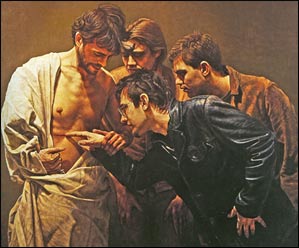
Still Doubting
Jon Granville Gregory emulates the style of Caravaggio, using contemporary and realistic figures to show the story of Thomas encountering the Risen Christ.
From Fr. James B. Simpson and George H. Eatman’s A Treasury of Anglican Art (New York: Rizzoli, 2002). Courtesy of Mr. Eatman.
________
I’m glad that Thomas was a skeptic. That’s because I, too, am a skeptic. It’s not that I don’t believe in God or Jesus. It’s just that I can’t believe in anything unbelievable. And I’d like to think that Thomas represented me, and those like me, when he doubted.
In churches where people easily believe, skeptics may sit quietly…unnoticed. In those rare occasions when they express skepticism, they are often rebuked: “Why can’t you just have more faith?” People give them a certain look—the one that says, “What’s wrong with you?” But is there really something wrong with them?
My attitude toward skeptics is generally positive. I think it’s safe to believe a skeptic’s words than those of a person that easily accepts what she hears or reads. Why? A skeptic would normally get the facts straight first before sharing any information, while the one who easily believes may spread something that’s really nothing but a rumor.
It may sound ironic but in my “business,” which is religion, one of my greatest challenges is not making believers out of skeptics but making skeptics out of believers. Let me tell a story that may show why.
One day I was in the car with an elderly lady I gave a ride to a Bible study I lead. As a believer she was nurtured in a conservative church that had a narrow understanding of certain Christian doctrines. She was reading a book that happened to agree with her view on salvation. She thought she was right because the book confirmed her belief, and she had this idea that a book was infallible!
So I said, “Simply because somebody says it in a book does not necessarily make the statement true.”
But she weakly protested, “A book cannot be published if it contains error, can it?” (or something to that effect).
I wonder where she got the idea that books, especially so-called “Christian books”, are infallible. And I wonder if she was aware of the fact that there are other books that express just exactly the opposite view of the book she was reading. If she was, then the question she might have asked was, Which of these competing views is correct? And so I think believers are better off if they are skeptics—if they don’t easily believe what they hear or read.
But church people normally have a negative attitude toward the word “skeptic” because they associate it with unbelief, and they would rather have faith. We can’t really blame them because for so many times they have heard sermons that only rebuked Thomas. And perhaps they have not heard of anything from the pulpit that pointed out the advantage of having a questioning mind like Thomas’.
Indeed, Jesus did rebuke Thomas for his unbelief and it does appear that the Lord wanted him to believe without the benefit of evidence. However, if evidence or proof is not necessary, why did the risen Lord show himself to the “other disciples” and then to Thomas? Obviously, there is a problem here.
To the question we may reply, Was there any other way to make the disciples believe anyway? It seems to me that the way to make the disciples believe that he indeed was the risen Lord of the universe (1:1) was for Jesus to show himself to them! But one may argue that proof may be important but not really necessary. When Jesus was in “the flesh” he already told the disciples that he would rise from the dead. He revealed himself to them as well. In other words, the words of Jesus should have been sufficient for the disciples to believe. In theory that may be so, but in reality that was not the case!
At the beginning of the passage we are told that the disciples were afraid and hiding. That certainly does not look like a picture of great faith. We can assume then that all the disciples doubted Jesus, not just Thomas. Our understanding is confirmed as correct because we are told that it was only “when they saw the Lord” that “the disciples rejoiced” (v. 20)! They rejoiced because now they know for sure that Jesus’ words about himself was true—he had risen as he said (2:19) and, indeed, he was who he said he was. And that gave them courage!
So how do we solve this problem? I’m not sure if we really can. Perhaps the best that we can do is just to recognize that there is a problem. Yes, the Gospel of John was written “so that” even those that have not actually seen the risen Lord “may come to believe that Jesus is the Messiah, the Son of God, and that through believing (they) may have life in his name” (v. 30). Indeed, we believe not because we “have seen” but because we have “heard,” and so we’re “blessed” (v. 29). Yet part of what we have heard is the story of doubting Thomas, and one that makes the story of Jesus even more convincing!
That’s why I think we should thank God for Thomas—he became the skeptic for us so that we may believe in Jesus with confidence! Also, I think that it will be to our benefit if we, like Thomas, have an attitude of a skeptic—in this world where lies proliferate, we cannot be easily deceived! Know the truth for, as Jesus said, “…the truth will make you free” (8:32). Having a skeptical attitude can help us get to the truth.


 PENnED
Leave a comment