Few passages in the New Testament are as misunderstood—or as misused—as Paul’s teaching on “grafting” in Romans 11. For many Christians shaped by dispensational charts, prophecy conferences, or end‑times timelines, this chapter becomes a kind of theological pit: once someone falls in, they often stay there for years, convinced that Paul is teaching two separate peoples of God—Israel and the Church—running on two different tracks.
But that is not what Paul is saying.
In fact, Romans 9–11, read carefully and in context, teaches the exact opposite. Paul’s vision is not two peoples but one tree, one root, one family formed in Christ. To understand this, we need to slow down, breathe a little, and let Paul speak for himself.
Let’s walk through the key passages together.
- The Olive Tree: One People, Not Two (Romans 11)
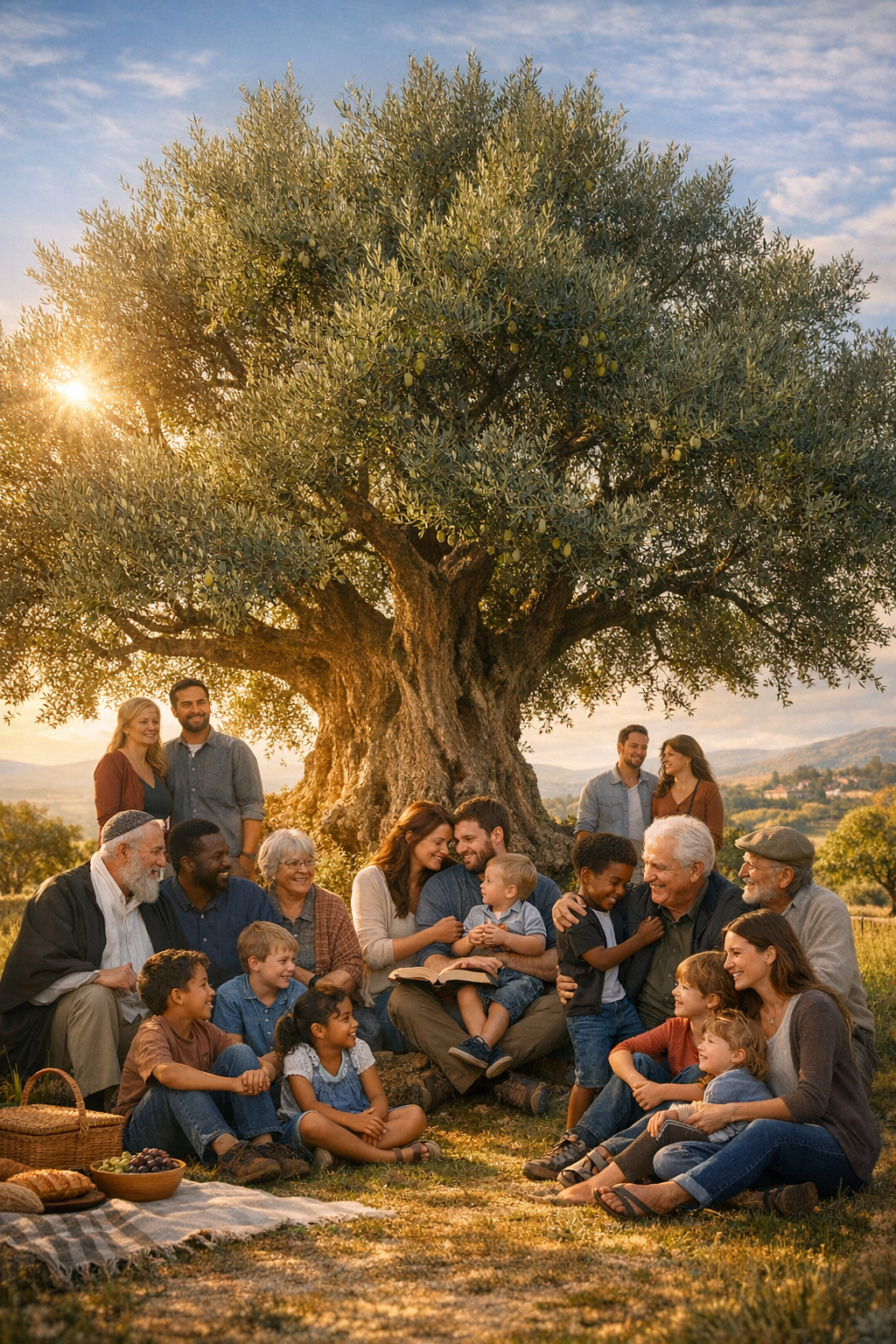
Paul uses an agricultural image his readers would have understood immediately: an olive tree with branches broken off and others grafted in. It’s simple, earthy, and visual.
Here’s what Paul actually says:
- There is one olive tree
- Some natural branches (unbelieving Jews) were broken off
- Wild branches (Gentiles) were grafted in
- All branches share the same root and nourishment
The point is unmistakable:
Gentile believers are grafted into the same tree, not a different one.
Paul never suggests two trees, two peoples, or two parallel covenants. He never says Gentiles are “attached nearby” or “connected but separate.” He says they are grafted in—fully, organically, and equally.
And notice something else:
Paul warns Gentile believers not to become arrogant toward the natural branches. Why? Because they now stand by faith, not by ethnicity. The root supports them, not the other way around.
This is not a picture of two peoples.
It is a picture of one people, united by faith in Christ.
- “Not All Israel Is Israel” (Romans 9:6)
This is the verse that quietly dismantles the entire dispensational reading.
Paul writes:
“Not all who are descended from Israel belong to Israel.”
In other words:
- Being ethnically Jewish does not automatically make someone part of God’s covenant people
- True Israel is defined by faith, not ancestry
Paul then gives examples:
- Isaac, not Ishmael
- Jacob, not Esau
Both pairs share the same bloodline. What separates them is not ethnicity but God’s calling and their response of faith.
This is why Paul can say:
- “It is not the children of the flesh who are the children of God.”
- “The children of the promise are counted as offspring.”
Paul is not erasing Jewish identity.
He is redefining Israel around Christ.
This is why he can say in Galatians:
- “Those who have faith are the children of Abraham.”
- “If you belong to Christ, then you are Abraham’s offspring.”
Paul’s logic is consistent:
Israel is no longer a boundary drawn around ethnicity but around Christ.
- The New Humanity: One Body, One People (Ephesians 2)
If Romans 9–11 gives us the metaphor, Ephesians 2 gives us the theology behind it.
Paul says that Christ:
- “broke down the dividing wall” between Jews and Gentiles
- “made the two into one new humanity”
- “created one body”
- “reconciled both to God through the cross”
This is not two peoples running on two tracks.
This is one people, formed by Christ, through the Spirit.
Paul even says Gentiles are now:
- “fellow citizens”
- “members of the household of God”
- “built on the same foundation”
There is no second-tier citizenship in the kingdom of God.
If Romans 11 shows us one tree,
Ephesians 2 shows us one house,
one family,
one new humanity.
- So Who Is “Israel” Now?
When you put these passages together, Paul’s teaching becomes clear:
Israel = the people of God formed in Christ, made up of Jews and Gentiles who believe.
Not a modern nation-state.
Not an ethnic group.
Not a political entity.
A people.
A family.
A community of faith.
This is why Paul can say:
- “There is neither Jew nor Greek… for you are all one in Christ Jesus.”
- “We are the circumcision, who worship by the Spirit of God.”
- “If you belong to Christ, then you are Abraham’s offspring.”
Paul is not minimizing Jewish identity.
He is expanding Israel around Christ.
- Why This Matters Today
Many Christians today still read Paul through the lens of a system that insists:
- Israel and the Church are separate
- God has two peoples
- Prophecy must be fulfilled through a modern nation-state
- Gentiles are “grafted in” but not truly part of Israel
But Paul’s teaching is richer and more beautiful than that.
He envisions:
- one tree
- one root
- one family
- one new humanity
- one people of God
This is not just theology.
It is the heart of the gospel.
A Pastoral Word
This article isn’t written to win arguments or embarrass anyone who has inherited a particular system. Many believers were taught these ideas with sincerity and devotion. But sincerity doesn’t guarantee accuracy.
Paul invites us to something deeper:
- a faith shaped by Scripture, not systems
- a humility that lets the text correct us
- a unity rooted in Christ, not in charts or timelines
The olive tree is big enough for all of us.
The root is strong enough to hold us.
And the people of God are one—because Christ has made us one.
 PENnED
Leave a comment