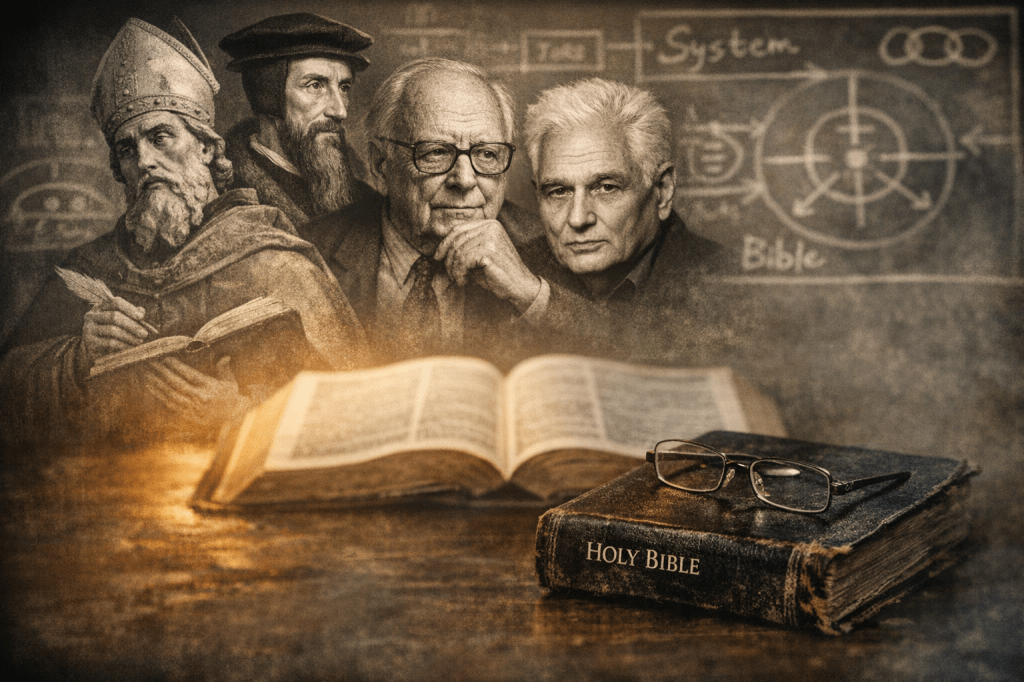
Christians love Scripture. We study it, quote it, debate it, and build our lives around it. But loving Scripture doesn’t automatically mean we’re reading it well. One of the most common mistakes sincere believers make is this: instead of letting the Bible shape our theology, we let our theology shape what we think the Bible must be saying.
Most of the time, people simply inherit a framework—something their church taught, or a system they learned in school, or a set of ideas they absorbed from teachers they admire. These frameworks can be helpful, but they can also become lenses that distort the text. When that happens, we end up defending the framework instead of listening to Scripture.
I’ve seen this happen in conversations with friends, classmates, and even fellow ministers. And the more I watch it unfold, the more convinced I am that we need to help people return to the text itself—its context, its history, its language, and its original purpose.
Let me explain what I mean.
When the Framework Speaks Louder Than the Text
Every Christian reads the Bible with some kind of background assumptions. That’s normal. But problems arise when those assumptions become so strong that they override what the text is actually saying.
Here are a few signs this is happening:
– The interpretation always fits the system, even when the passage doesn’t.
– Difficult verses get “explained away” instead of wrestled with.
– The reader starts with conclusions and works backward to find support.
– The framework becomes untouchable, even more than the text itself.
When this happens, Scripture becomes something we use rather than something we receive.
A Clear Example: Dispensationalism
Dispensationalism is a good case study because it’s so common in conservative churches. It divides history into different “dispensations” and draws a sharp line between Israel and the Church. This leads to interpretations where:
– Israel and the Church are permanently separate groups
– Prophecies about ancient Israel get applied to the modern nation-state
– The Second Coming is mapped out in a very specific timeline
– Paul’s teaching about the “one new humanity” in Christ gets minimized
But when you read Paul carefully—especially in Ephesians 2, Galatians 3, and Romans 11—you see something different. Paul speaks of a new Israel, a people formed in Christ from every nation. Not a geopolitical nation. Not a modern country. A people. A family. A body. A new creation.
When a framework insists that Gentile believers are “grafted in but not really part of Israel,” it’s not Paul speaking anymore. It’s the system speaking over him.
Another Example: Reformed Theology
I have friends shaped by Reformed theology—good, thoughtful people who love Scripture deeply. But even this tradition, rich as it is, can become a filter.
Reformed theology emphasizes God’s sovereignty and covenant. Those are beautiful truths. But when the framework becomes rigid, it can lead to:
– Reading Paul mostly through Augustine or Calvin
– Treating “covenant” as a single, unchanging category
– Assuming predestination must be the center of every passage
Again, the issue isn’t the tradition itself. The issue is when the tradition becomes the starting point instead of the text.
Philosophical Influences: Gadamer, Ricoeur, and Others
Some Christians—especially those who studied theology or philosophy—approach Scripture through thinkers like:
– Hans-Georg Gadamer (tradition shapes understanding)
– Paul Ricoeur (suspicion, narrative, metaphor)
– Martin Heidegger (pre-understanding, being)
– Jacques Derrida (deconstruction)
These thinkers offer helpful tools, but they can also tilt interpretation toward:
– Reader-centered meaning
– Suspicion of “plain sense”
– Treating Scripture as literature rather than revelation
Again, the problem isn’t using tools. The problem is when the tools become the authority.
What Faithful Interpretation Requires
If we want to read Scripture well—without forcing it into our systems—we need to return to the basics. Faithful interpretation requires:
– Literary context: What is the author actually saying in the flow of the argument?
– Historical context: How would the original audience have heard this?
– Canonical context: How does Scripture interpret Scripture?
– Linguistic context: What did these words mean in their time?
– Humility: Letting the text correct us instead of the other way around.
This is how we honor Scripture—not by forcing it to fit our systems, but by letting it speak with its own voice.
A Pastoral Word
At the end of the day, this isn’t about winning debates or proving someone wrong. It’s about helping people hear the Word of God clearly, without unnecessary filters. It’s about humility—approaching Scripture not as experts defending a system, but as disciples willing to be taught.
Frameworks can be helpful servants, but they make terrible masters.
The text itself—alive, inspired, and Spirit-breathed—is what forms us into the people of God. And that people, Paul says, is one new humanity in Christ. Not divided camps. Not competing systems. One family.
 PENnED
Leave a comment