The horse apparently understands it is being helped. Sometimes humans do not have the same commendable instincts–they think you’re there to put them down. So they try to knock you down with a beastly kick.
And some Christians are no different. When they see you not having the same bright red color–‘the color of the righteous’–they conclude you have the ‘devil’s color’: blue. Yes, even if you’re not ‘blue’ at all and your only motive is to bring the light of truth to dispel the darkness of lies.
Today, I read 1 Thessalonians 5 and I wondered how I might apply verse 11 and not be misunderstood: “Therefore encourage one another and build each other up, just as in fact you are doing.”
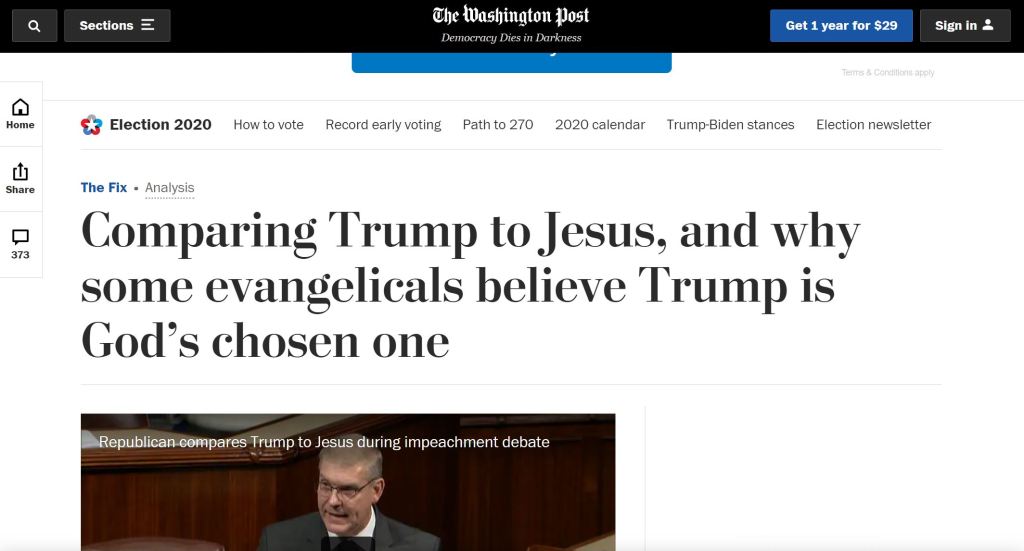
“I am the chosen one.” THE WASHINGTON POST/GETTY IMAGES
Dear friends,
Thank you for sharing your thoughts through the comments you made on my Facebook posts as well as the messages and links you sent through Messenger. To me, that means you are concerned, as I am, about the current affairs.
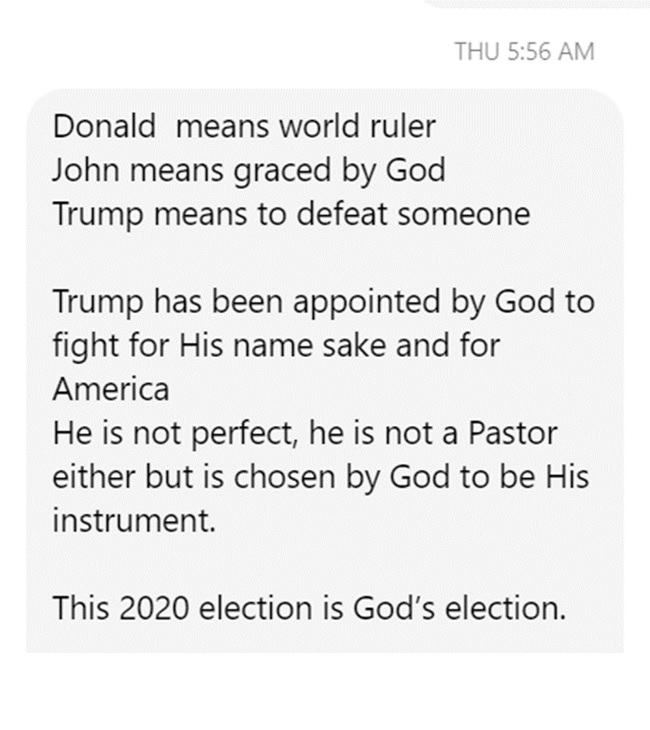
I also appreciate the attempts you have made to defend Donald Trump and the efforts to try to show that you are right, and I am wrong, about him. The time you invested in conversing with me must mean that you care about me and that you’re worried that I ‘get it wrong’. I feel that strongly from those of you who claim that Trump is ‘God’s chosen one.’
But why would I believe Donald Trump has been chosen by God to lead this country and the world? Should I believe simply because someone says he is? Or, because he himself claimed “I am the chosen one”? On the contrary, I should not believe Trump especially because he claims he is!
Who would believe Donald Trump? According to his own niece, a clinical psychologist, he uses lying “as a power play”? If you are honest to yourself, you cannot deny that he lies all the time! But of course, you wouldn’t really know that if your sources of information are only Fox News and those that Trump recommends or whose stories align with the ‘neo-Republican’ narrative.
Ted Cruz on Donald Trump: “This man is a pathological liar.” Still is. It has not changed.
After a brief shock (“What?”), I said, “…If facts and truth make me a radical, so be it. Jesus was too!” That is why the Lord was crucified (that’s aside from the theological answer, which I assume you know).
But let us just forget everything I’ve said. Let us take it for granted that you are right, and I am wrong. Let us see how that would go.
If I remember it right, most of you have claimed, in one way or another, that Donald Trump is ‘God’s chosen one.’ So, he’s more than just an ‘abrasive individual’ who is like Nebuchadnezzar, as some of you have said. He is the anointed one, ‘the king’ who has already come!
No one has expressed such grandiose view of Donald Trump more than Wayne Allyn Root, who described himself as a “Jew turned evangelical Christian.” Such praise had not escaped Trump’s attention. How could it? Wowed by a comment worthy of royalty—no, a god!—he tweets:
“Thank you to Wayne Allyn Root for the very nice words. ‘President Trump is the greatest President for Jews and for Israel in the history of the world, not just America, he is the best President for Israel in the history of the world…and the Jewish people in Israel love him….[sic].
“…like he’s the King of Israel. They love him like he is the second coming of God…But American Jews don’t know him or like him. They don’t even know what they’re doing or saying anymore. It makes no sense! But that’s OK, if he keeps doing what he’s doing, he’s good for…..[sic].
…..[sic] all Jews, Blacks, Gays, everyone. And importantly, he’s good for everyone in America who wants a job.’ Wow!”
“They love him like the second coming of God”? Wow!”
It is no secret that many conservative Christians think highly of President Trump. He has consistently maintained high approval ratings from white evangelicals since he won the majority of white evangelicals and white Catholics in the 2016 election.
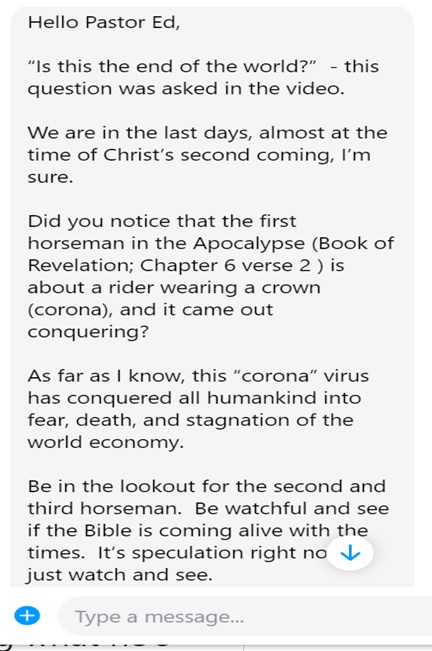
That statement seems to correlate with one message I received that goes:
“We are in the last days, almost at the time of Christ’s second coming, I’m sure.
“Did you notice that the first horseman in the Apocalypse (Book of Revelation; Chapter 6, verse 2) is about a rider wearing a crown (corona), and it came out conquering?
“As far as I know, this “corona” virus has conquered all humankind into fear, death, and stagnation of the world economy.”
Intrigued, I looked up Revelation 6:2 and read it closely: “And I saw, and behold a white horse: and he that sat on him had a bow; and a crown was given unto him: and he went forth conquering, and to conquer” (KJV).
Trump “was given ‘corona ‘virus’”
What my friend, who supports Trump, perhaps missed is that “a crown (which he interprets as “‘corona’ virus”) was given unto him”. Since we are taking it for granted that he is—and all my friends, for that matter are—right, who comes out as the one who was given the corona virus?
You got it: Donald Trump!
I spent many years in seminary studying and exegeting Bible passages, but I must confess I am not a Revelation expert. So for now, I leave it to those who are and trust their conclusion: most scholars agree that the horseman of Revelation 6:2 who was given the crown is the Antichrist.
“…the little horn of Daniel 7 is none other than Donald J. Trump. There has never been a United States president like him; of him could the prophet accurately say, ‘After them another king will arise, different from the earlier ones’….
“It is significant that when the prophet saw the little horn in vision, he notes his mouth. Trump’s bragging, pouting mouth is his most frequently caricatured feature.”
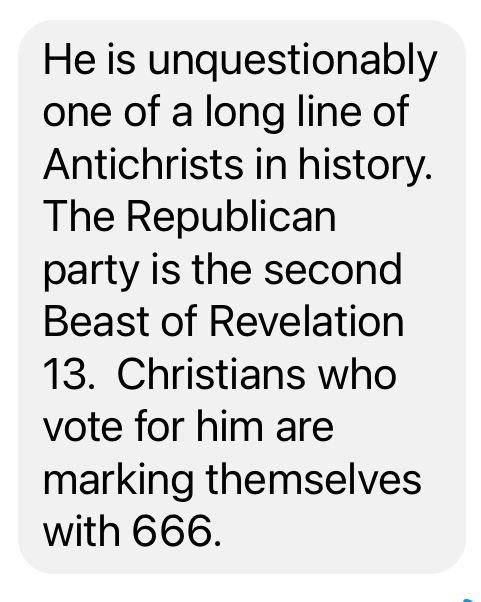
What if my former New Testament professor is right? In a message he sent to me, he wrote, “He is unquestionably one of a long line of Antichrists in history. The Republican party is the second Beast of Revelation 13. Christians who vote for him are marking themselves with 666.”
What if you are right about Donald Trump being the chosen one, but not by God?
What if Donald Trump is an anti-Christ, if not the Antichrist?
What if your support of him will result in him winning the election?
And what if, because of victory, he would begin to believe that he is not just a mere man–that he is divine and the “the second coming of God”?
Just imagine what Donald Trump might do if he is emboldened by your vote of confidence and faith in him. The tremendous surge of power and invincibility, I am afraid, would inspire in Trump a deeper level of narcissism and a new and more grandiose image of himself. The “little horn” might just believe he is the Messiah, albeit a false one, and one who would bring more chaos to the world.
Christians do not see eye to eye on whether there are cases in which abortion might be deemed a right option. Some might say that abortion is acceptable in cases of rape and pregnancy that puts the life of the mother at risk. Others, however, do not see any situation that might justify abortion. To them, it is absolutely no abortion. Conservative evangelicals, in general, take that latter position.
There is no doubt that conservative evangelicals are for overturning Roe v. Wade. Abortion is the reason why many of them have become single-issue voters. In other words, they would vote for the candidates that promise to work for them on this single issue. And to many, that would mean voting straight Republican, the political party that currently takes the anti-abortion stance. (Why not if it caters to their political base?)
Sadly, however, evangelicals might have carelessly voted for incompetent candidates. If these politicians could not deliver even on what evangelicals might deem as less important issues, what’s the chance that they could deliver on more important ones, such as those related to abortion rights? For some reason that eludes me, evangelicals stick to their strategy: work with and vote straight Republican!
The last presidential election has been widely known as a transaction of compromise between evangelicals and Donald Trump. Despite Trump’s questionable reputation, the evangelicals voted for him believing that he was the “chosen one” who could deliver conservative political goals, especially the overturn of Roe v. Wade. But are conservative Evangelicals realistic in their expectations? Can the Republican Party deliver what they promise? Can they have Roe v. Wade overturned?
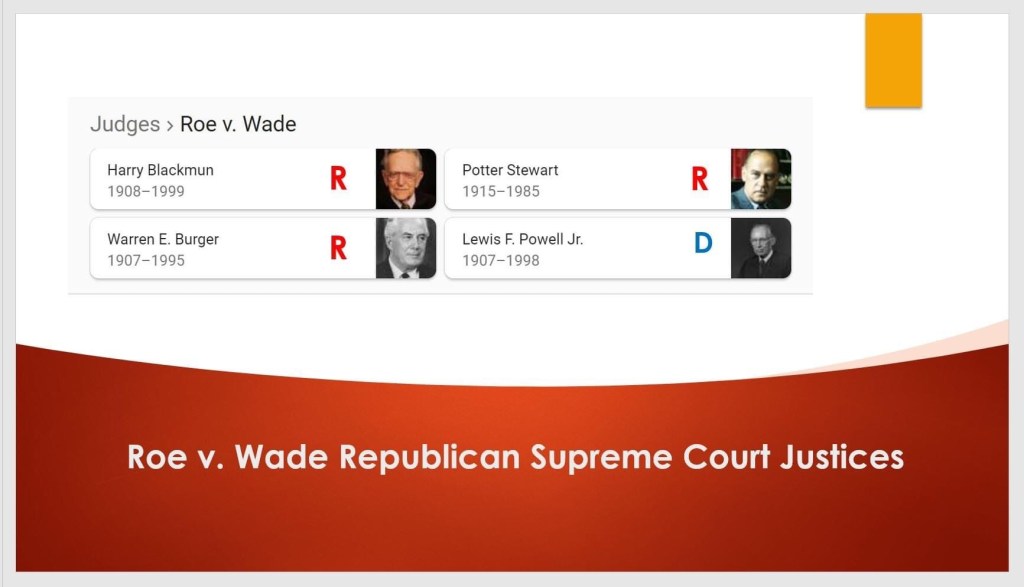
To answer that question, let us have a little review of the abortion right’s history. Roe v. Wade was the landmark United States Supreme Court ruling from 1973 that established abortion as a fundamental right of a pregnant woman. It is ironic that the President at that time was a Republican, Richard Nixon, and the Supreme Court Justice who wrote the majority opinion was a Republican, Harry Blackmun, who was joined by two other Republicans: Chief Justice Warren E. Burger and Justice Potter Stewart!*
In 1992, the Supreme Court, which was “now more ideologically conservative than at the time Roe was decided,” revisited the legal rulings in Roe v. Wade in the case of Planned Parenthood v. Casey. Even though it modified its ruling by abandoning “Roe’s trimester framework in favor of a standard based on fetal viability, the Court “overruled Roe’s requirement that government regulations on abortion be subjected to the strict scrutiny standard” and reaffirmed “that a woman’s right to choose to have an abortion is constitutionally protected.”**
Recently, evangelicals were again disappointed that President Trump’s conservative appointees have not delivered what they hoped their vote for Trump would accomplish. “Pro-life leaders expressed deep disappointment with the U.S. Supreme Court’s refusal June 29 to uphold a Louisiana law designed to protect the lives and health of women by requiring hospital admitting privileges for doctors who perform abortions.”***
So if a “conservative” president (in quotation marks because I don’t believe Trump is a true conservative) and a conservative Supreme Court cannot or not willing to deliver on the issue that makes evangelicals one-issue voters, why stick to a political strategy that has not worked? If Republicans were the original proponents of Roe v. Wade and, as we have seen, are not really working to overturn abortion rights, shouldn’t that make evangelicals think that perhaps the issue has been constantly used as a bait to vote Republican? And since the evangelical strategy to vote Republican has never worked since President Richard Nixon (yes, even when the sitting President is Republican: Gerald Rudolph Ford Jr. (1974 –1977), Ronald Wilson Reagan (1981–1989), George Herbert Walker Bush (1989 –1993), George Walker Bush (2001-2009), Donald Trump (2016-present), wouldn’t it be smart to rethink it?
Politicians and political parties will always tell us what we want to hear. God does not do that. God will always tell us the truth. And God will always fulfill his promises, including the humanly impossible ones. Jesus said, “With man this is impossible, but with God all things are possible” (Matthew 19:29, NIV). So, let’s trust God rather than man.
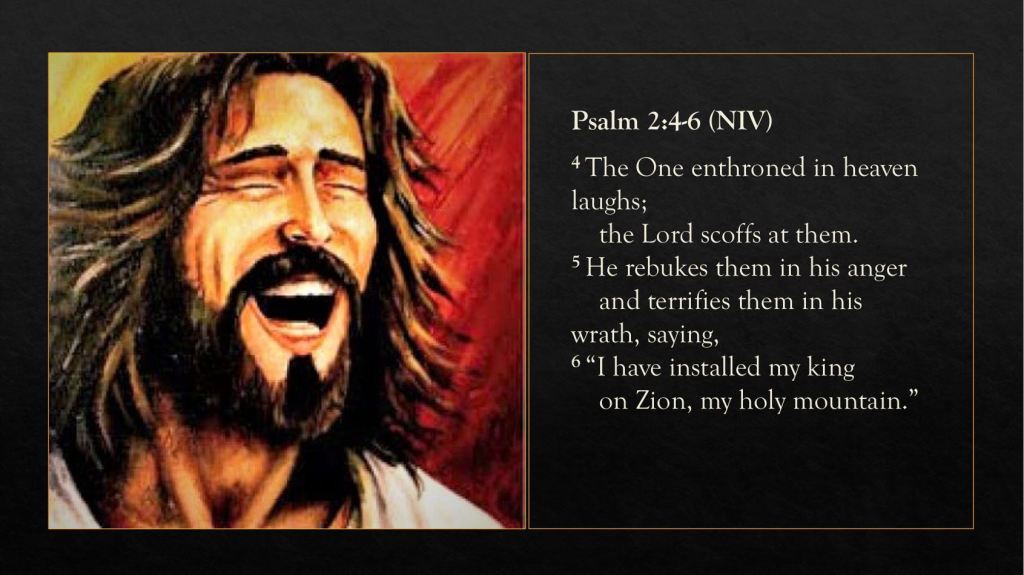
In our desire to live the American dream, we look to a political leader and enthrone him. The One enthroned in heaven laughs; the Lord scoffs at us.
We continue to fight for our politics, trumping, instead of loving, each other. He rebukes us in his anger and terrifies us in his wrath, but we don’t let up.
We insist that our enthroned leader is our sure hope and those that go against us are surely bound to hell. We’ve been warned: God has installed his and OUR KING on Zion, his holy mountain.
I like the Japanese word choku (shown above in kanji; in kana, ちょく). It means simplicity, honesty, frankness, correctness.
In this complex world, we can keep our sanity by keeping things simple. Simple lifestyle. Simple food. Simple pleasures. Simple anything. I think that even profound thoughts can—and should—be expressed simply and beautifully. In truth, verbosity can bury a good idea. And ideas are to be shared with everyone: the intellectually sophisticated individual, a simple person, and the simple-minded one.
I like the word because it also expresses how we should deal with one another: with honesty and frankness. In being direct and passionate for correctness, however, we may hurt another person’s feelings and damage the relationship. Happily, this is where choku also comes to the rescue! Alternately, the word means “to fix or repair.” And perhaps what needs repair can be fixed especially if we “speak the truth in love” (Ephesians 4:15).
Now I think I’m really attracted to choku, not just as a word but as a way of life.
“Mondays with Michelle Obama,” a four-week series of videos that will feature the former First Lady reading aloud from favorite children’s books, begins today with the reading of The Gruffalo, written by Julia Donaldson and illustrated by Axel Scheffler.
The Gruffalo is a story about a mouse that takes “a stroll through the deep dark wood.” There he encounters a fox, an owl, and a snake, respectively. Each of these predators is too eager to have the mouse for lunch. But the mouse who smartly (so it seems) compensates what he lacks in brawn with wit, cleverly fends off each one of them by inventing a monster.
That’s just the kind of story children, like little Donald, want to hear. Let’s continue.
In their attempt to trap the mouse, each predator asks him where he is going. The mouse tells each of them that he is meeting a scary monster who “has terrible tusks, and terrible claws,” and “terrible teeth in his terrible jaws.”
The mouse also tells each of them the monster’s favorite dish, each of which is obviously cooked up to match the one he is conversing with and apparently expected to have an unnerving effect on them: the fox, “roasted fox”; the owl, “owl ice cream”; the snake, “scrambled snake.”
“This smart mouse—he’s just like me!” Little Donald cannot contain himself. Then he adds, “I could be the ‘Mice President’ when I grow up!”
Michelle looks at Donald and puts a finger on her tightly closed lips. “Shush.” Michelle continues reading.
As the mouse points the spot where he and the Gruffalo are going to meet—which is of course where they are—each one scampers away into hiding. The mouse sneers at the predators’ gullibility because “There’s no such thing as a gruffal…?”…OH!”
The smirk on the mouse’s tiny face is quickly erased and the look of shock replaces it when a monster, scarier than a gruffalo he imagined and has just told other animals, suddenly appears:
But who is this creature with terrible claws
And terrible teeth in his terrible jaws?
He has knobbly knees, and turned-out toes,
And a poisonous wart at the end of his nose.
His eyes are orange, his tongue is black,
He has purple prickles all over his back.
The mouse screams with fear when he realizes that the Gruffalo is real:
Oh help! Oh no!
It’s a gruffalo!
I wonder how scared little Donald is when the Gruffalo sees the mouse and says, “My favourite food!You’ll taste good on a slice of bread!”
Surprise! Surprise! The mouse regains his composure. Confidence in his ability to fool other animals has grown. He believes that as he was able to fool the other predators, he can also fool the scariest of them all, the Gruffalo.
Little Donald’s face lights up. He’s happy. He sees himself in this smart little mouse.
But will it work? Well, as far as the story goes, it does!
But how about in real life? Will it always work? As the saying goes, “You can fool all the people some of the time, and some of the people all the time, but you cannot fool all the people all the time.”
If I were the author of the book, I would have ended the story differently—with the mouse on a slice of bread being eaten by the Gruffalo. Why? To teach the danger of unrealistic confidence, especially when ability is in fact lacking. But it’s not my story.
The story goes on and, because of that, it is, in my estimation, one of the finest illustrations for the saying, “Fake it till you make it.”
The mouse successfully shows the Gruffalo how scared are the fox, the owl, and the snake of him (when, in truth, they are scared not of him but the Gruffalo):
“Well, Gruffalo,” said the mouse. “You see?
Everyone is afraid of me!
But now my tummy’s beginning to rumble.
My favourite food is – gruffalo crumble!”
In the end, the scary monster, the Gruffalo, gets scared:
“Gruffalo crumble!” the Gruffalo said,
And quick as the wind he turned and fled.
“Yay!” Little Donald yells as if the mouse’s victory is also his.
No doubt, the story has captivated the imagination of young listeners and, based on the rave reviews, adult readers as well!
But is the story teaching children, like little Donald, the right thing?
Faking it till you make it may not be bad if it is used as a tool to develop character. For instance, a person who has a problem telling the truth might “fake it” by saying to himself I am an honest person (despite the fact that he just told a lie) to help him stop saying dishonest things.
Anything that can help transform us, is worth trying, especially if it doesn’t cause harm. But to fake an ability that one does not have, or might never have, is a dangerous thing—your story might end this way:
All was quiet in the deep dark wood,
Except for the Gruffalo crunching a mouse for food.
Finally, is it OK to read the story, as is, to children? I think so, provided adults point out to them the wrong ideas they should not pick up.
As far as our experience is concerned, today is the first Easter Sunday of its kind—no church service, no egg hunting, no hanging out with family and friends.
So, yeah, today is Easter Sunday or, if you prefer, Resurrection Sunday. But it really feels like we’re still stuck in Holy Saturday. Although most of us have quarantined ourselves and are supposed to be insulated from the world out there, yet we smell the stench of death in a very profound way. It’s a dark Easter Sunday.
Although experts have informed us there will be an end to this pandemic, yet we do not know exactly when. And the waiting seems endless. And so we ask, except staying home and washing our hands, what are we to do?
We can think of countless things we can do but our hands are tied. No, not just our hands, our feet as well!
As I think about what the Lord might want us to do, I thought of his command to love. However, the Scripture texts in which the command show up seem to always demand the literal use of hands and feet.
For instance, Jesus said, “If someone takes your coat, do not withhold your shirt from them” (Luke 6:29, NIV). Giving away one’s shirt obviously involves the use of hand.
In 1 John 3 we read:
16 This is how we know what love is: Jesus Christ laid down his life for us. And we ought to lay down our lives for our brothers and sisters.17 If anyone has material possessions and sees a brother or sister in need but has no pity on them, how can the love of God be in that person?18 Dear children, let us not love with words or speech but with actions and in truth.*
But as I continue to read 1 John 3, I found what I think might be the word of the Lord to us today—a word that might empower us despite our very limited use of hands and feet:
21 Dear friends, if our hearts do not condemn us, we have confidence before God22 and receive from him anything we ask, because we keep his commands and do what pleases him.23 And this is his command: to believe in the name of his Son, Jesus Christ, and to love one another as he commanded us.24 The one who keeps God’s commands lives in him, and he in them. And this is how we know that he lives in us: We know it by the Spirit he gave us.
Within the context of loving, prayer is introduced in this passage. And it tells us exactly what would give us “confidence before God and receive from him anything we ask”: keeping God’s “commands” and doing “what pleases him” (vs. 21-22).
The first of the two commands is “to believe in the name of his Son, Jesus Christ.”
Why such command? Aren’t we supposed to believe freely?
Absolutely! However, because the image of God in us has been marred by sin, we now have the tendency to rebel against God’s good will. And when we do, we forfeit what faith in God might offer. A command could definitely motivate us to stay on the right path (although I believe that, because we are free, we can choose to disobey).
If we obey the command to believe, what does it look like?
Since it is a command to “friends” (vs. 1, 21) or “children of God” (vs. 1,2), I would consider this as a command to those who already believe in Christ. Thus, faith in this context has to do with believing God who, because he “did not spare his own Son, but gave him up for us all” we can confidently believe that he will also “graciously give us all things” (Romans 8:32, NIV), that is, everything within his will. In other words, if God could give us the grandest gift—his Son—how much more the lesser ones!
Wow! If we really ponder about that, our faith can grow exponentially—talk about faith on steroids! If small faith can move mountains (Matthew 17:20), how much more a giant faith?
The second command brings us back to the overarching theme of love of 1 John 3: “love one another as he (Jesus) commanded us.”
Loving is part of what we do as believers because of what we have become: children of God. “This is how we know who the children of God are and who the children of the devil are: Anyone who does not do what is right is not God’s child, nor is anyone who does not love their brother and sister” (v. 10). Doing right and loving reveal our identity.
So, if loving should come naturally because we are children of God, why the command to love?
The reason is because although God has made us to be like Abel, who was righteous, when we put our faith in Christ, we still have the tendency to be like Cain, who was evil and murdered his brother. That’s why this command: “Do not be like Cain, who belonged to the evil one and murdered his brother” (v. 12). So, again, a command could remind us of and help us choose the path of righteousness.
In these days of darkness and death, our obedience can make a huge difference in the world. If we believe in what God can do and love one another, then our prayers can move the hand of God, so to speak.
How can we love when our hands and feet might not allow us to do so?
Yes, we are “not (to) love with words or speech but with actions and in truth,” but I don’t think that the emphasis on loving with actions means that the statement carries an unequivocal meaning. If that is the case, words do not mean anything. And they do.
When someone uses hate language in a politically charged conversation, for example, we cannot miss the message. The words spoken carry with them the venom of hate and we feel its lethal power. We know that when those words are directed to us, they immediately tell us that the person those words are coming from does not love us.
Conversely, the same is true with loving words. Let me illustrate that.
After Ruth, my wife, gave a sandwich to Ezra, our grandson, earlier today, I asked him, “Does lola love you?” He said yes—she made him a sandwich! Then I asked him another question, “Does lolo love you?” He also said yes. Then I asked, “How do you know that?” He said, “Because you said I’m your favorite grandson.” (He’s my only grandson, by the way.)
What I said was as much an expression of love as his grandma’s action of making him a sandwich.
Words have power. They can be used to show hate or love. And that should make us think whether the words we write on social media, for example, are words that convey love.
I am not sure if I am free of guilt. Most likely, not. I don’t remember everything I expressed in words, but I remember negative feelings toward some of those I interacted with on Facebook. And so, for those words I said that did not make people feel loved, I am deeply sorry. Please forgive me.
To make up for that today, when I am unable to lead a congregation in worship, I am writing this to express my love to all, but especially to sisters and brothers in the Lord who need to know what to do during this dark time when even though we know the meaning of Easter Sunday in our heads yet our experience tells us that we have not really moved out of Holy Saturday—the day of darkness and death.
Aside from loving and encouraging words, we can pray.
We cannot undermine the ability of the experts and what we have come to call “frontliners” who are working so hard to put an end to the coronavirus pandemic. We thank God for them. Indeed, they are today’s heroes.
However, God’s word to us today is that we too can perform amazing things even while on quarantine—we can pray! With our faith, hopefully being on steroids, think about what prayer can do to us, our community, country, and the world!
So, let us pray.
Our heavenly Father, we bow down before you You are God, our Creator; we are your creatures Forgive us for trying to create you in our image And forgive us for fashioning idols made of hands
Let us selflessly work for your kingdom while on earth And let us be obedient subjects who freely do your will Help us to not forget your coming perfect and glorious kingdom So that we may not be tempted to build our own
Forgive us our sins—they are too many too count But we know that those sins were hatched in our hearts Please transform our hearts and let us truly love you and our neighbor And help us to love in words, thoughts, and deeds
Thank you for cleansing our hearts and filling it with your love Thank you for the gift of faith and for making it grow Today we have this renewed confidence in you And in what you will do because we pray
We pray for the suffering world because of the pandemic We pray for those who lost loved ones And those who are still suffering from the infection Bring comfort, hope, and healing to them
In these dark days, help us to remember that you are with us Not just in a metaphorical but literal sense— In Christ, you experienced death and its darkness And thus, you know what humankind is experiencing now
We thank you for the frontliners Strengthen and protect them Let them feel they are appreciated and loved For indeed that is the truth And provide all their needs
Give wisdom to our leaders and help them serve selflessly We pray for the leader of our country, even if our vote was cast not for them Give our leader good health and extend the same to her or his family And help our leader lead as she or he should, with sincerity and dignity
We pray for our loved ones—whether members of our family or not We ask that you continue to take care of them as you take care of us Remind each one of them of your goodness in Christ your Son So that they might not go astray
We pray for our “enemies” as well Forgive us if we have hurt them in any way And forgive them as well Perhaps they did not know what they were doing
Most of all, please help us end this darkness There are limits to what we can do But with you nothing is impossible So help us to believe in you and in what you can do
In Jesus’ name, we pray Amen.
___
*All scriptures are from the New International Version®, NIV®
At the outset, let me say that I like Pastor Tony Rapu’s preaching style. He is also a good communicator. So I wouldn’t be surprised if he is a popular pastor in Nigeria.
Pastor Rapu’s communication skill may be above average but the way he preached on the story of the people of Israel, who were enslaved in Egypt, is quite typical of what you’d hear from the average pastor. So what’s the difference?
The difference lies in the fact that people call his message a prophecy of the coronavirus pandemic.
Let’s be clear about what a prophecy is. As you have probably already heard before, there are two kinds. One has to do with the proclamation of the previously revealed word of God. Some have called it the “forthtelling” kind. Preaching the Scripture falls under that category.
Another has to do with the proclamation of the word of God about a future event that nobody else knows about until the prophet reveals it. The prophecy is a privileged information until the prophet makes it known to others. Some have described it as the “foretelling” kind.
When people talk about Pastor Rapu’s “prophecy” of the coronavirus in December 2019, what kind of prophecy are they referring to? Forthtelling? Or foretelling?
Within the Christian fold, some pastors were privileged to have heard God told them about the global pandemic disease, Coronavirus (COVID 19) ravaging the world as it stands now. It has affected the world that most people now resort to God to take control. This outbreak could be likened to the pestilence been mentioned in the bible and also some school of thought termed it to be the end times as the book of revelation in the bible revealed. But one of the most privileged pastors to have seen and heard from God about this global outbreak is Pastor Tony Rapu.
According to Oyediji, Pastor Rapu received privileged information and thus the latter meaning of prophecy, foretelling, applies.
And it seems very clear that that’s the kind of meaning the people who spread the message on social media have in mind. The most obvious is in the way it is introduced:
This is the Prophet everyone is talking about with the accurate 2020 Prophecy. He preached this December 31, 2019.
Here are a couple of problems I see with that claim:
1. The “prophecy” was preached on December 31, 2019
That date is very important. We must ask the question, If it was a privileged information, such as in a predictive prophecy, then only Pastor Rapu knew about the coronavirus at that time.
By the time Pator Rapu preached on the last day of 2019, the news about the virus has already spread across the globe. In Minessota, the Center for Infectious Disease Research and Policy reported the following:
Health officials in China are investigating the cause of a pneumonia outbreak in the city of Wuhan in Hubei province that has sickened 27 people and seems to be linked to a seafood market.
The answer to that is, being a doctor, it is likely that Dr. Rapu knew about it. It is easy to see the reverend doctor as a person who keeps himself abreast with what’s going on in his first area of interest: health.
We do not know that for sure though. However, even if Pastor Rapu did not know about it, I still don’t think we can call his message prophetic, in the predictive sense of the word. And that’s for the simple reason that it was not a privileged information. Other people, perhaps a great number, already knew about it.
Pastor Rapu himself does not seem to claim that his sermon was a prediction of the pandemic. When you listen to him about how believers should respond to coronavirus, he does not make any connection to the sermon he preached, or at least to the “Stay in the house” exhortation (the meaning of which might have changed if he claimed his sermon as a predictive prophecy.
Also, Pastor Rapu’s Facebook posts do not show any indication that he knew something as bad as a pandemic would plague the world. In fact, on the same day he preached the sermon he wrote with optimism (which appears to contradict his “prophetic” message),
Better days are coming. Stayed (sic) tuned child of God. Get ready for 2020 The best is yet to come.
But if Pastor Rapu has in fact claimed that his message was a prediction of the coronavirus pandemic, then that’s another story. As far as I know, he has not done that.
And that leads us to the next problem.
2. “Stay in the house” in Pastor Rapu’s sermon is taken literally
“Stay in the house” does not have the same meaning as the encouragement to stay home or self-quarantine because of the coronavirus.
When you listen carefully to what Pastor Rapu said, you cannot miss the metaphorical meaning of “Stay in the house”:
What is the house? The bible is saying stay in a certain attitude, stay within a certain framework of your mind, do not panic about the situation. Have a certain attitude. It is an attitude of faith. It is an unshakable trust in God.
Any preacher who used the same Scripture passage could have used the same or similar expression, “Stay in the house.”
God said to Moses,
On that same night I will pass through Egypt and strike down every firstborn of both people and animals, and I will bring judgment on all the gods of Egypt. I am the Lord. The blood will be a sign for you on the houses where you are, and when I see the blood, I will pass over you. No destructive plague will touch you when I strike Egypt.” (Exodus 12;12-13, NIV).
With those words from God–assuring his people that they would be safe in their houses–what do you think Moses could have said to the people? You got it. Stay in the house! (Or something to that effect.) That’s what any preacher might say too. And like how Pastor Rapu used it, with an allegorical meaning.
The conclusion, Pastor Rapu preached a very good reminder: Stay in the house. And what he meant by that was to have an attitude of faith. But it was not a prophecy in the predictive sense of the word.
First, I am glad (and amused at how he puts it) that Wright is well aware of the presumptuous assumptions about any human crisis, which I think Evangelicals are often guilty of: “No doubt the usual silly suspects will tell us why God is doing this to us. A punishment? A warning? A sign?”
Second, I am also glad about Wright’s emphasis on lament, even though we’ve probably already lamented way before Wright wrote the article. We lament at the suffering and death that perhaps should have been minimized if people in authority did a better job. We lament the bad politics that care more about agendas than the health of the people. We lament the falsehoods, like fake cures, peddled even by those who profess to be speaking on behalf of God.
However, lament and seeking for answers are not mutually exclusive. And to ask questions and try to find answers is not at all not part of our vocation. We are not going to find answers all the time, but finding answers and explaining them should be part of our vocation. I do that almost every Sunday when I preach a sermon!
Offering explanations about Scripture passages especially as they relate to our situation (like the coronavirus crisis) is the very core of the pastor’s vocation as well as those of us who, like Wright, has been called to teach the Bible. Ironically, however, while Wright tells us to not explain, he explains why we ought not to explain.
To say that might imply that after Wright has done his own research, he does not find any explanation worth sharing. If that is the case, we might ask the question, ‘What does he really know?’ or ‘Does he know anything?’ Or, even if he finds adequate answers, he’s not obligated to share them—it’s not part of his vocation!
Even if our main task is not to explain what’s going on in the world, yet for us to be effective in communicating the Word, we have to somehow understand the world, or else we’ll just be talking to the wall.
Finally, I’m glad that despite Wright’s warning to not give hope when there might be none, he concludes his article with a message of hope anyway: “As the Spirit laments within us, so we become, even in our self-isolation, small shrines where the presence and healing love of God can dwell. And out of that there can emerge new possibilities, new acts of kindness, new scientific understanding, new hope.”
And I’m also glad that despite Wright’s thesis–we are not called to offer explanations–he concludes that “even in our self-isolation…there can emerge new possibilities…new scientific understanding.” We may not be scientists, but I assume most of us can understand scientific explanations and there is no rule against sharing such knowledge.
As of this writing, Italy has recorded the highest daily death toll anywhere in the world and the US leads the world in confirmed coronavirus cases.
While the whole world scrambles to fight coronavirus and individuals from different places and backgrounds offer very generous help, some Christians look at the pandemic as simply God’s judgment of sin and unbelief and that the solution is for people “to repent and receive Christ as personal Savior and Lord”.
I am for repenting of sins, anytime, especially if those sins have been clearly committed—not just assumed or imagined. I also believe that everyone needs God’s salvation, a gift that can be had through faith in Christ (Ephesians 2:8-9). However, to say that God sent the current coronavirus as a form of punishment for sins is not only too simplistic but also presumptuous and lacks biblical and theological grounding.
To come up with a sound theological analysis of the situation, I suggest that we ask the following probing questions (and answer them, as best we could, using Scriptures as our guide): Where did bad viruses come from? Has God sent the coronavirus to punish the sinful unbelieving world? And what picture of God should we show the world, especially in such a time as this?
Where did bad viruses come from?
For our purpose, we’re not evaluating any conspiracy theory or whether the virus is man-made. Also, I think that we need to go beyond Wuhan and the new coronavirus itself to get to the root of the problem.
Not all viruses are bad. We should be thankful for that. Good viruses (and bacteria too) help to protect us. It’s the bad viruses that pose a problem to us—they can wreak havoc to the human body or even kill us.
The enormous health and economic problems that the current coronavirus pandemic has caused may have led us (as it has led me) to ask how these “microscopic devils” came into being. Did God create these “evil viruses”?
When confronted with such or similar question, we may recall a statement we heard in Sunday school, catechism class, or a sermon. It goes something like this: God created everything. Because of such a general doctrinal statement, I will not be surprised if some would say, Yes, God created the bad viruses.
Such an answer, however, raises another question: If God is good (and I believe God is) how can God create such a bad thing? How can a good God create something that could render humans sick or, worse, dead?
Such a question cannot be answered in a simplistic way. That’s why I think every believer should develop the skill to think theologically. And that requires a kind of Christian education that goes beyond catechism, Sunday school, and sermon-listening.
Real-life challenges, such as the one we are facing amidst this coronavirus pandemic, can make us think more deeply or theologically. And that is a good thing—it can make us go deeper in our faith as we search for answers.
The Sunday school teacher, catechist, preacher, or anybody who said God created everything was correct. That is, if we put it in the context of creation, “in the beginning” (Genesis 1), in which “everything that (God) had made” was “very good” (v. 31).
So where in the world did bad viruses come from? Who or what made them? Some say that they come from Satan. In christianforums.com, for example, someone wrote, “I think viruses are the work of satan, (sic) because all they bring is death and destruction.”
That answer, however, puts too much credit to the Devil who does not have creative power. Nowhere in Scripture can we read that Satan has been given the ability to create. The Devil can tempt and cause destruction primarily through human agents. But that seems to be about it. The Devil is not God’s counterpart. God is the Creator; the Devil is not. I searched the Scriptures and didn’t find a single verse that shows Satan created anything. Let me know if you’ve found one.
So, if Satan is not directly responsible, who or what is? Humanity, as represented by Adam and Eve, might be to blame. Because of their disobedience, creation was affected: the earth (or soil) was cursed (Genesis 3:17-19). Still, humans are not directly responsible for the existence of bad things that can cause us to get sick and perhaps even die. Humans did not create those bad viruses. They came into being or evolved in cursed earth.
Sinful human action may have led to the existence of bad viruses, but humans did not create them. They did not have the power to do so. Although God “cursed the earth”, we should not regard such action as divine creation. God did not add anything to his creation. Creation degenerated as a result of human sin. And it is in such an environment (which has been called “the fallen world) that bad viruses raised their, if I may say, ugly crowned heads.
So, based on Genesis, it looks like the cursed earth became an environment where bad things, such as viruses, could now exist and evolve in a way that they can become dangerous to us. It appears then that viruses were not created. They simply showed up or evolved in cursed earth, perhaps from good viruses. (If that’s the case, then that’s of kind of like Satan who was at first called Lucifer [Isaiah 14:12], which means “bearer of light,” but who “fell” and became Satan, our “adversary the devil” [1 Peter 5:8], and the leader of “the rulers of the darkness of this world” [Ephesians 6:12, KJV]).*
Has God sent the coronavirus to punish a sinful, unbelieving world?
Except for those cases in Scripture in which plagues and diseases were clearly sent by the Lord (Deuteronomy 28:58-61), such as the ones God sent to Egypt (Exodus 7-11), a pandemic should not be ordinarily viewed as God-sent or as God’s punishment for sins.
The idea of an angry God who is bent at decimating humans because of their sins and unbelief (which some misguided souls often float in a time of crisis such as we have now) runs contrary to the dominant and clear picture of a loving and gracious God in Scriptures. Reading or hearing Jesus’ story about the prodigal son’s father (Luke 15:11-32), for example, should be enough to erase the picture of an angry God in one’s mind.
The idea of an angry God also runs counter to what has been clearly revealed in Scripture: “For God so loved the world, that he gave his only begotten Son, that whosoever believeth in him should not perish, but have everlasting life. For God sent not his Son into the world to condemn the world; but that the world through him might be saved…” (John 3:16-8a, KJV).
I know that that Scripture passage does not end there. It is followed by verses 18b-19: “He that believeth on him is not condemned: but he that believeth not is condemned already, because he hath not believed in the name of the only begotten Son of God. And this is the condemnation, that light is come into the world, and men loved darkness rather than light, because their deeds were evil” (KJV).
Such judgment, however, is clearly not a national or global judgment; it is individual (“he that believeth not is condemned already”). As such, it cannot be used to support the idea that God could be punishing the “sinful unbelieving world,” particularly not the idea that God is now punishing the world using COVID-19.
If you say a plague, such as the current coronavirus pandemic, is an exception—that God sent it as a form of punishment—then you must show that God has clearly said it is. If you claim that the virus is sent by God as a form of punishment for sin, then you must be able to justify such “revelation” that goes against the theme of redemption that runs through Scriptures or the actions of a loving God who clearly works not for the world’s destruction but its redemption and restoration: “For God was pleased to have all his fullness dwell in him, and through him to reconcile to himself all things, whether things on earth or things in heaven, by making peace through his blood, shed on the cross” (Colossians 1:19-20, NIV).
It is extremely important that we must be careful in claiming to be speaking on God’s behalf. If we say things carelessly, we can be guilty of false prophesy which God has gravely warned us against: “But a prophet who presumes to speak in my name anything I have not commanded, or a prophet who speaks in the name of other gods, is to be put to death” (Deuteronomy 18:20, NIV).
What picture of God should we show the world?
Knowing that God is best characterized by love, not wrath, we must be extra-careful in the way we paint God to the world. When self-righteousness tempts us to show a scary picture of God, for one reason or another, we must pause and think about whether such a picture is an accurate one.
We sometimes get angry, but I doubt if that’s the picture we show the world of ourselves. You don’t have to look at your profile picture or a friend’s on Facebook to know that. Yes, God sometimes gets angry, but anger does not characterize God. Love does. God is love (1 john 4:8).
God’s love can be seen not only in Scripture but also in nature. Specifically, God designed the human body so that it can fight against diseases. Just as there are bad viruses, there are also good ones. “Some viruses can actually kill bacteria, while others can fight against more dangerous viruses. Like protective bacteria (probiotics), we have several protective viruses in our body” (https://www.sciencealert.com/not-all-viruses-are-bad-for-you-here-are-some-that-can-have-a-protective-effect).
And thank God, we were made with an immune system that can “prevent or limit infection” (https://www.sciencealert.com/not-all-viruses-are-bad-for-you-here-are-some-that-can-have-a-protective-effect). We should be thankful that our gracious God so designed the human body that, in case humans became disobedient and, as a result, live in a world that would challenge their very existence, it is prepared to protect itself from diseases.
So if God designed the human body so that it can develop into something that would not be totally helpless in case it finds itself in a harsh environment, such as the “fallen world”, how can we also say that God sent a killer virus that can decimate humans? To say that the Creator is working against his creation does not make sense. The idea that an angry God sent the coronavirus to destroy humans, does not make sense.
The immune system, however, does not guarantee protection for everyone or all the time—it can become weak or may not respond or function properly. And since matter is bound to decay, human bodies, that can survive diseases, ultimately die. But thanks be to God, in Christ we and all of creation will be redeemed (and, consequently, restored):
For the creation waits with eager longing for the revealing of the children of God; for the creation was subjected to futility, not of its own will but by the will of the one who subjected it, in hope that the creation itself will be set free from its bondage to decay and will obtain the freedom of the glory of the children of God. We know that the whole creation has been groaning in labor pains until now; and not only the creation, but we ourselves, who have the first fruits of the Spirit, groan inwardly while we wait for adoption, the redemption of our bodies (Romans 8:19-23, NRSV).
The clear picture of a loving and gracious God who loves the world so much and who offers redemption through faith in Christ is the picture we, Christians, should publish. Any picture that does not, might be a picture of a false god.
_____ *It is plausible to not regard “bad” viruses as inherently bad, just as we do not regard wild animals as inherently bad. When a man is killed by a tiger, we consider it a bad thing (and that’s why some might see the tiger as bad and kill it). However, the reason why people are killed by wild animals might be that they have intruded into the wild animals’ habitat. It appears that something similar can be said about killer viruses: they become a problem not because they “…magically jump out of the forest… It’s because we are getting….into the forest.”
3 I thank my God every time I remember you. 4 In all my prayers for all of you, I always pray with joy 5 because of your partnership in the gospel from the first day until now, 6 being confident of this, that he who began a good work in you will carry it on to completion until the day of Christ Jesus.
7 It is right for me to feel this way about all of you, since I have you in my heart and, whether I am in chains or defending and confirming the gospel, all of you share in God’s grace with me. 8 God can testify how I long for all of you with the affection of Christ Jesus.
When people think of you, what might be their thoughts about you? We are not to presume people often think of us, but sometimes they do. And when they do, what kind of pictures do they see of us? …of me? …of you?
It’s normal to wish that others think well of us. We care about our personal image. However, to have an obsessive desire to portray one’s self as a great person can be taxing and unhealthy, especially if we are trying to portray a perfect image of ourselves. And we are not. It’s like editing or photoshopping photos of ourselves to make them look perfect before we post them on Facebook. It’s tedious and time-consuming. But it does not really make us feel good in the end. We know—and other people know—that they’re not authentic pictures of ourselves.
There is nothing better than being a person who is authentically good and naturally beautiful inside. The Philippians believers were such persons. That is why “every time” the apostle Paul remembered them he thanked God and prayed for them “with joy”!
The Philippians were a great people. The beautiful pictures that Paul had of them were the kind that they did not labor to paint. Because of what they truly were, the amazing pictures of the Philippians simply appeared on the apostle’s mind. Unretouched. Beautiful!
Paul was so in love with the beautiful body of Christ at Philippi. Like a lover who is away from his beloved, he longed for the Philippian believers with a certain kind of affection. His love for them was the kind that can also be found in the heart of God—seeing what his “holy people” have become, God loves and treasures them infinitely much more greatly compared to how one would treasure a 530-carat Cullinan, the world’s most expensive diamond, at $400M apiece (cf. Ephesians 1:18)!
Like today’s inmate who has pictures of loved ones on the wall of his prison cell, Paul had them too when he was in jail. His were not literal photographs, as they were mental pictures of the Philippians, nevertheless, they were real and beautiful pictures!
What stuff were the Philippians made of? What made them so loveable that Paul’s heart leaped for joy whenever he remembered them?
Partners in the gospel
In a straightforward way Paul tells why he “always” prayed “with joy” for the Philippians: “because of your partnership in the gospel from the first day until now” (v. 5). Such partnership began “from the first day.” We may not know exactly what the “first day” was for each one who responded to the call to proclaim the gospel, but we have a sense that the Philippians were quick to respond. They responded immediately to the call to proclaim the gospel. And they did not stop… “until now”?
What? They quit? No, they did not quit. “Until now” must be understood as Filipinos understand the phrase. When Filipinos say mula noon, hanggang ngayon (since then, until now) the latter, hanggang ngayon (until now) does not denote ending. Instead, the phrase carries an ongoing sense. For example, when someone says, Mahal kita mula noon, hanggang ngayon (I love you ever since, until now), it doesn’t mean love has ended; rather, it means that love is still there, continuing!
Such understanding is strongly supported by what comes next: “being confident of this, that he who began a good work in you will carry it on to completion until the day of Christ Jesus” (v. 6; I think that NIV has done a great job translating the verse the way they did).
The Philippians, who I assume had a deep appreciation for the gospel (that gave them hope and changed their lives in Christ) immediately responded to the call to proclaim the same. God may have done a lot of other good works in them, but it seems that “a good work” which God “began in (them)” and which God “will carry…on to completion until the day of Christ Jesus” has to do with God laying in their hearts the desire to proclaim the hope-giving and life-changing gospel until the end: “the day of Christ Jesus” (Paul here seems to anticipate Christ’s second coming to take place in their lifetime, just like some believers today).
Partners with Paul
Paul was in jail. He may have preached to prison guards, but his opportunity to proclaim the gospel was limited because of his incarceration. But thanks be to God, he had the Philippians as “partners” in gospel proclamation!
“Partners in the gospel” not “lay preachers”
Paul called the Philippians “partners in the gospel”. He did not call the Philippians “lay preachers” or “lady preachers” or “assistant preachers”. No! He called them “partners in the gospel.” They were his fellow preachers or gospel proclaimers! As such, he regarded them as equals! And that is why he called Epaphroditus “my brother, co-worker and fellow soldier” (2:25)! There is no hierarchy in gospel partnership. There is really no such thing as a “lay preacher.” Everyone who is called to preach and who responds to the call of God to proclaim the gospel is ordained by God! Church institutions ordain people today to do certain tasks, but God calls and ordains believers to preach or proclaim (or share, if you please) the gospel.
By the way, that does not mean that when God calls you and you respond to such call you automatically become an effective preacher of the gospel. The gift may be already there but, like a knife, it must be sharpened before it can be used effectively. That is why training is very important. And leaders and teachers like me are here to help train those of you who respond to the call.
Every believer is called to proclaim
Who are called to proclaim the gospel? It is quite clear that Paul’s partners in the gospel are all of those whom he prayed for (v. 4). In other words, all the Philippian believers were partners and, therefore, called to proclaim the gospel! They all, generally speaking, responded to that call.
Isn’t that amazing? All the while many of us thought that only ordained pastors, priests, evangelists, and missionaries are the only ones who have been called by God to preach or proclaim the gospel. The truth is, God calls you and all believers to proclaim the good news in Christ Jesus!
To be sure, not all Philippian believers were confident and fearless proclaimers at the beginning. However, “…because of (Paul’s) chains, most of the brothers and sisters have become confident in the Lord and dare all the more to proclaim the gospel without fear” (v. 14). They stepped up to the plate, so to speak, and proclaimed the gospel boldly despite the probability that they too could be persecuted and perhaps end up in jail as Paul did.
Here’s a big difference between Philippians and believers today: while only a few of us engage in gospel proclamation, all of them responded to the call and proclaimed the gospel!
So what are we doing? God did not call us “out of darkness into his wonderful light” to hide the light of the gospel of Christ. God did not call us to be “bench warmers”—to merely come to service or mass (if you’re Catholic) every Sunday and sit like spectators while some people in the so-called higher level of hierarchy perform for us. To not respond to God’s calling and fail to proclaim is, I believe, a great sin of omission! God has not called us to sit and watch.
Rather, God has called all of us to proclaim the gospel and fulfill the Great Commission. Jesus said, “Go into all the world and preach the gospel to all creation” (Mark 16:15, NIV). God has made you, along with other believers, to be God’s “chosen people, a royal priesthood, a holy nation, God’s special possession, that you may declare the praises of him who called you out of darkness into his wonderful light” (1 Peter 2:9, NIV).
Recognition, respect, and support of leadership
Here’s another big difference between the Philippians and some believers today: While Paul regarded the Philippians as “partner” and his equals as gospel proclaimers, yet the latter recognized the fact that Paul was an Apostle. They recognized Paul’s gifts, especially the gift of leadership.
Paul was the leader in spreading the gospel everywhere and the Philippians looked to him as a model. They also looked to him to encourage them and build them up. But today, there is so much disrespect of leadership. Instead of partnering and supporting the leadership, some people are critical of the leadership. In some cases, they look down on leadership, especially if they think they are smarter than the pastor or the leader.
I led a Bible study recently and when I came in I heard someone talking against pastors. He talked specifically of one he seemed to really disliked. I tried not to listen but he was too loud to not hear.
Before I ended the lesson, I asked if they had questions. The highly-opinionated egoistic guy quickly spoke in a loud voice trying to underestimate what I said about St. Paul and his tremendous commitment to the preaching of the gospel (he went to jail for it!) and to build up the Philippians who became “partners in the gospel”.
He said, the passage (Philippians chapter 1:12-26) was all about the Philippians, who despite the fact that Paul was not with them, they still flourish, or something to that effect. And he said that in a voice that sounded mad.
The things he said earlier against pastors were still fresh on my mind and what he said implied to me that pastors or church leaders are not really needed. So I said, “Bro, are you mad at pastors?”
He said, “No!” Still sounding mad, though. Then he explained that that’s just the way he speaks. And then he continued to emphasize what he said earlier: that the passage was about the Philippians. And then I guess he thought that it must also be about God (one shouldn’t forget God, after all), so he quickly added that it’s “also about God”.
So I reminded everybody about what we learned in verse 12: that Paul was not only in jail but also “in chains” for preaching the gospel. Then I asked everybody, “Is this passage about Paul too?” And everybody said yes.
Then I directed the question to the “smart” guy. “Yes, it’s about the Philippians. Yes, it’s about God. But is it also about Paul?”
He could not argue against it so he said nothing, except, “That was my last comment.” (He actually said something afterwards so with a smile I jokingly said, “I thought you said ‘that was (your) last comment’”. Everybody laughed!)
Let’s go back to Paul and the Philippians.
Paul considered the Philippians, along with Timothy and Epaphroditus, as equals and yet the two recognized his leadership. That is why they were willing to assist him in his missionary and evangelistic journey, especially now that he is in jail. They brought provisions for him. They encouraged him with reports about what the Philippians were doing as partners in the gospel.
Like us, I don’t think the Philippians always agreed with Paul in every matter. And it may be that there were Philippian preachers who were more eloquent, healthier and better looking than inmate Paul. But these great and wonderful people and gospel proclaimers did not quarrel with Paul or put him down. Instead, they supported him. They did not go against him because they recognized his leadership, and they worked with him as partners, not rivals!
No wonder, they made Paul’s heart leap for joy whenever he thought of them. How about us today?
Conclusion
Today, leaders and fellow believers should have the same mutually encouraging and supportive relationship as partners in the gospel. We the leaders of the church cannot win our community, much less the world, single-handedly. Like the Philippians, we must all respond to the call to proclaim the gospel of Christ, the light of the world.
The call to preach or proclaim the gospel is not a call to prestige. There’s nothing prestigious about it. It is a call to servanthood. As servants of Christ, we proclaim to obey our Master, not to set ourselves above others and be their master.
The call to preach or proclaim the gospel is not a call to a better life or comfortable life or to gain wealth. Paul as a preacher became so poor he had to depend on others for support. The Philippians, like Paul, faced the same persecution and hardship for proclaiming the gospel. The call to preach is a call to sacrifice. We proclaim the gospel without expecting anything—money, appreciation, “love gifts”, or whatever reward—in return. We proclaim the good news for the sake of others.
Just as the Philippians supported Paul and as his partners proclaim the gospel for other people’ sake, so should we. We preach not for ourselves but for others. When you and I truly become partners in the gospel and work together and support each other no matter what the cost, then, like the Philippians, we’ll make each other’s heart leap for joy!
One of the most enjoyable and challenging conversations I’ve had happened very recently. Last weekend, I was with my Catholic friends who take their faith and the Bible seriously. We had not fellowshipped for a long time and so they decided to invite me and my wife Ruth to “a Sunday afternoon karaoke”.
The one thing I really like about my Catholic friends is that they consider me and Ruth real friends. As such they don’t see us, especially me, as a threat, even though I am an “Evangelical” (their term) who had formal and advanced theological training.
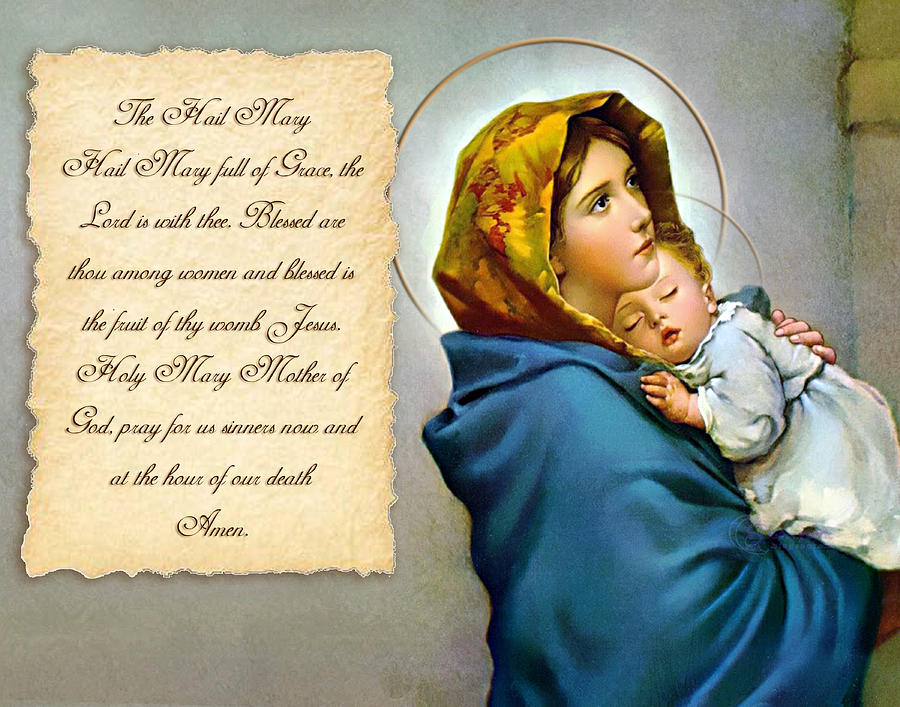
I was amazed to learn from them that they are into some crusade against a misguided devotion to Mary, the mother of our Lord Jesus. They say, and I agree with them, that Mary had a special role in salvation history, being the mother of the Savior and Mediator, but that she is NOT a Mediatrix or co-Mediator on the same level with Christ. And they cite official papal encyclicals that warn “the faithful” (ironically a Catholic term for Catholics) against practices that might violate official Catholic teachings on Mary.
They are also saddened by the fact that an inappropriate devotion to Mary, which they think is tantamount to idolatry, takes away the focus from Christ. Again, I agree with them. Mary may be “Mother of God” but she is not God!
But that was just the beginning of the conversation. The next segment shifted to some hard questions directed to me. The questions ranged from inspiration of Scriptures (and which books should be included) to transubstantiation (yes, they know the theological term!) to purgatory and theology of salvation.
As I look back now, I am amazed at the fact that the disagreements we had we’re small and quite insignificant compared to what we believe in common! It was only in purgatory that it got a little bumpy, but, all in all, these dear sisters and brothers in Christ think and believe more like me than some of my Evangelical friends who have no clue about some of the theological stuff we talked about.
The conversation was topped by a topic that challenged all of us: universalism. One of us (not me) is disturbed by the fact that a loving God would let people, and fallen angels(!), to be tormented for eternity. The same person asked me, “Brother, do you believe in such punishment?”
I said, “Looking at Scriptures, the evidence is quite overwhelming. So yes. But let me ask you this question: Does God change his mind? If so, is there proof, in Scriptures, that God actually does?”
Quickly he said, “Yes! God changed his mind about Nineveh!”
None of us actually sounded like a hard-core universalist. We simply toyed with the idea. But all of us felt a great sense of awe as we pondered upon our God whose great love continues to overwhelm us.
54 He said to the crowd: “When you see a cloud rising in the west, immediately you say, ‘It’s going to rain,’ and it does. 55 And when the south wind blows, you say, ‘It’s going to be hot,’ and it is.56 Hypocrites! You know how to interpret the appearance of the earth and the sky. How is it that you don’t know how to interpret this present time?
57 “Why don’t you judge for yourselves what is right? 58 As you are going with your adversary to the magistrate, try hard to be reconciled on the way, or your adversary may drag you off to the judge, and the judge turn you over to the officer, and the officer throw you into prison. 59 I tell you, you will not get out until you have paid the last penny.”
___________
We know when it’s time to eat, sleep, or work and make money.
But do we know, really, what time is it?This Sunday’s message…
32 “Do not be afraid, little flock, for your Father has been pleased to give you the kingdom. 33 Sell your possessions and give to the poor. Provide purses for yourselves that will not wear out, a treasure in heaven that will never fail, where no thief comes near and no moth destroys. 34 For where your treasure is, there your heart will be also.
Jesus Raises a Widow’s Son 11 Soon afterward, Jesus went to a town called Nain, and his disciples and a large crowd went along with him. 12 As he approached the town gate, a dead person was being carried out—the only son of his mother, and she was a widow. And a large crowd from the town was with her. 13 When the Lord saw her, his heart went out to her and he said, “Don’t cry.”
14 Then he went up and touched the bier they were carrying him on, and the bearers stood still. He said, “Young man, I say to you, get up!” 15 The dead man sat up and began to talk, and Jesus gave him back to his mother.
16 They were all filled with awe and praised God. “A great prophet has appeared among us,” they said. “God has come to help his people.” 17 This news about Jesus spread throughout Judea and the surrounding country.
What did the dead man say?
To this question we normally answer, Nothing. He’s dead.
But this “dead man” in Luke’s gospel is no longer dead. He’s alive! Jesus raised him from the dead. Then, “The dead man sat up and began to talk, and Jesus gave him back to his mother” (v. 15).
I wonder what he said. Perhaps, Why did you raise me up? If so, that’s a tough question for Jesus to answer. The reason: Jesus brought him back to life not really for him but his mother.
Why did Jesus perform a miracle for the dead man’s mother?
In the preceding narrative (7:1-10) Luke tells about the centurion whose faith was so great. Jesus “was amazed at him and turning to the crowd following him, he said, ‘I tell you, I have not found such great faith even in Israel’” (v. 9).
As to this high ranking Roman soldier, it’s easy to see why we might think that Jesus granted his request and healed his servant: because of his faith.
How about this woman? Nothing is said about her faith or lack of it. All we know about her is that she is a widow and she just lost her only son.
In the Jewish society during that time, a woman’s source of support was solely her husband. If her husband was dead, then her son. Very sadly, however, they’re both dead! Her helplessness and need, not her worthiness, is why Jesus “gave him back” (v. 15) to her.
Like any other biblical narrative, this story is not really about the son, nor the mother, but about Jesus who has a heart of compassion. Jesus gives–and does so generously–not really because of who we are but because of who he is: a compassionate Savior and Lord.
So, what did the dead man say?
What did he who was perhaps already quite all right “up there” (but whose mother was not “down here”) said? I would like to think that he said something like this:
Thank you, Lord, for bringing me back to life for the sake of my mother. Thank you for seeing her and her need. Thank you for your heart of compassion.





















 PENnED