Over the years, I’ve had countless conversations with conservative evangelical friends—some here in the United States, some back home in the Philippines—who sincerely believe that voting for Donald Trump and the Republican Party is the most faithful way to advance the pro‑life cause. Their conviction is real. Their desire to protect life is genuine. And I honor that.
But I’ve also noticed something else: many of these same friends have come to see abortion almost entirely through a political lens. The assumption is simple and deeply held: If we elect the right people, we will save more lives.
I understand the impulse. I, too, consider myself pro‑life, though with exceptions for rape, incest, and medically dangerous pregnancies. But I’ve never believed that political power alone can carry the moral weight of such a complex and deeply human issue.
A recent article in Christianity Today helped me understand why.
The piece examined abortion laws across the United States and found something striking: the strongest predictor of a state’s abortion policy is not how it votes, but how often its people attend church. States with high church attendance tend to have restrictive abortion laws. States with low attendance—even conservative ones—tend to protect abortion access.
The article’s conclusion was gentle but unmistakable: Evangelicals may have unintentionally weakened the pro‑life movement by making it primarily political rather than spiritual.
One line in particular stayed with me:
“Ultimately, if pro-life Christians can share the gospel and increase the number of churchgoers in their regions, they might be able to do more lasting good for the pro-life cause than any purely political strategy could accomplish.”
That sentence captures something I’ve been sensing for years.
Politics cannot do the work of discipleship
Many of my MAGA‑aligned friends believe that political victories are the key to cultural transformation. But the data suggests the opposite: politics tends to follow formation, not create it. When church life is strong, people’s moral imagination is shaped long before they enter a voting booth. When church life is weak, political strategies collapse—even in states that vote overwhelmingly conservative.
This is why we’ve seen pro‑life ballot measures fail in places where Republicans win easily. The political identity is strong, but the spiritual formation is thin.
A movement built on outrage cannot sustain compassion
I’ve also noticed that when abortion becomes primarily a political weapon, something precious is lost. Compassion becomes conditional. Nuance becomes suspect. Exceptions—like rape, incest, or life‑threatening pregnancies—are dismissed as “compromise.” And the women at the center of these stories disappear behind slogans.
This is not the way of Christ.
The Jesus I follow—the Jesus who drew me into the evangelical movement in the first place—never reduced people to issues. He never used moral questions as political leverage. He formed people through presence, community, and love.
What if the real pro‑life work is quieter?
What if the most effective pro‑life witness is not a voting bloc but a community of people who embody the compassion of Christ?
What if the real work is:
strengthening churches
supporting mothers
addressing poverty
expanding healthcare
reducing domestic violence
building communities where children are welcomed, not feared
These are not partisan ideas. They are deeply Christian ones.
A word to my friends who care deeply about life
I know your heart. I know your sincerity. I know you want to protect the unborn. But I hope this article—and this reflection—opens a small window to a larger truth:
Political victories cannot replace spiritual formation. Legislation cannot replace discipleship. And no candidate, no matter how loudly they claim to be “pro‑life,” can do the work the church has neglected.
If we truly want to cultivate a culture of life, we must begin not at the ballot box but at the table, in the pews, in our neighborhoods, and in the quiet, unglamorous work of loving people well.
That is where lasting change begins. And that is where the way of Christ still leads.
I’ve been learning more about Arizona lately, and my admiration for the state keeps growing.
One story that really stayed with me comes from the Dunbar Spring neighborhood in Tucson.
Years ago, a small group of residents there began experimenting with rainwater harvesting — long before it was common or even fully legal.
They believed that the water falling on their roofs and streets shouldn’t be wasted. It could nourish their gardens, cool their streets, and support a healthier way of living.
Their commitment didn’t stop at their own homes. They worked with city leaders, pushed for policy changes, and helped make rainwater harvesting not only legal but encouraged throughout Arizona.
Today, Dunbar Spring is known for its native plants, shaded walkways, and a community culture built around caring for the land.
Meanwhile, here in Las Vegas, collecting rainwater isn’t allowed. It makes me appreciate even more how Arizona treats water as something to be stewarded, not discarded. There’s a quiet wisdom in that — a way of living that feels both humble and forward‑thinking.
It’s inspiring to see a place where sustainability isn’t just a slogan, but a lived practice.
What’s wrong with that? Really, nothing! Besides, it’s matter-of-factly true! And if you’re not an onion-skinned Taylor Swift fan, that’s actually funny! Especially if you’ve seen the who-knows-how-many camera shots of Swift at the NFL.
So why is the media so hard on Filipino American comedian, Jo Koy? My guess is that the star-struck media and Swift fans just went with the flow and follow her lead: Swift’s tight-lip reaction to the joke.
They’ve made Jo Koy look even worse by saying his jokes weren’t funny. C’mon! Watch the clips and see how people were laughing. Some even found the Swift/NFL joke funny, excluding Swift, of course!
But what if Swift was sport enough to just ride on Jo Koy’s joke, like Robert De Niro and Meryl Streep did? I bet things would have been different.
I don’t find all of Jo Koy’s jokes that funny, but it’s not fair to judge his performance based on Swift’s facial response to his joke. Yes, even if she is Time Magazine’s Person of the Year.
Are you apprehensive about what others might say because you are already happy with what you believe to be true, and don’t want to change?
Such uncomfortable feeling is usually felt when you see others as having more knowledge in certain areas, and you feel that you can’t effectively defend your position.
For example, we don’t want to talk to an insurance or car agent on our own because we believe they have more information than we do; and we lack the information to “defend” ourselves. That’s why we bring along a friend or a family member who we believe know more about insurance policies or cars than we do to help us out.
We may know quite a few about certain personal truths that we hold dear, but we also know that we don’t have the knowledge that the experts we admire and have relied on and who “speak for us” might have.
My hunch is that we may have depended too much on experts, especially when making decisions. And we shouldn’t! We should learn things for ourselves.
Our doctors, for example, may be experts in medicine, but it helps us a lot if we learn more about, say, certain diseases. Armed with sufficient knowledge, we can help ourselves make the right decisions, which may be related to matters of life and death. And if the information we find from more reliable sources are better than what our doctor recommends, then it may be time to consult with another.
Thank God that these days information is just a Bing or Google away! We can even get the help of an AI to find information that would definitely take a lot more of our time if we’re doing research on our own and in a physical library.
When after learning more about a certain topic and we find that a certain “personal truth“ overlaps “objective truth” (anything that anyone anywhere finds to be true as a result of, say, scientific research or it is accepted by experts in the field) then that’s great! You don’t have to change your personal truth to the objective one because they’re about the same, except perhaps to make little amendments here and there to make the former more like, if not the same, as the latter.
But what if your personal truth is contradicted by objective truth? Would you abandon it and embrace objective truth?
What you do about objective truths would depend on what you are. If you are a “personal truth defender” then you would defend your personal truths or might just avoid conversations related to them. But if you are an “objective truth seeker” your’e not afraid to know the truth. And, as they say, you “follow the truth no matter where it leads.” And that is quite liberating!
As Jesus said, in John 8:31-32, “If you hold to my teaching, you are really my disciples. 32 Then you will know the truth, and the truth will set you free.”
Last Sunday we talked about The Parable of the Ten Virgins. Some of you may have already forgotten about that. Today I’m reminding you about that parable because it is closely related to The Parable of the Talents, which is the basis of the sermon today.
Sometimes we come across passages in the Bible that are closely connected to each other. Such is the case of the apocalyptic passages we find in chapters 24 and 25 of the Gospel of Matthew. The editors of the New Revised Standard Version or NRSVUE have divided them into 10 passages each with each own heading.
Now that is like a 10-course meal in a Chinese restaurant. The only thing is that it doesn’t end with the usual fortune cookie. The last passage, which will be our text next week, is not all sweet, but like the fortune cookie, it tells us what our fortunes will be. It is about judgment which can be sweet or sad. But I promise, I’ll do my best to help all of us escape judgment or damnation.
So how are The Parable of the Virgins and The Parable of the Talents connected? Let me point out what I think is the connection between the two: The Parable of the Talents picks up the question that the conclusion and application of The Parable of the Ten Virgins raises:
13 Keep awake therefore, for you know neither the day nor the hour.
The Parable of the Virgins, which reminds us to be always aware that the Lord is coming again, also reminds us that his coming has been delayed and that we don’t know the day or hour of his arrival. Therefore, as the parable teaches us, like the wise virgins, we are to be always prepared and ready for his arrival. What the parable, however, has not really answered for us is, ‘What must we do to get ourselves prepared and ready,’ or ‘What does it mean to keep awake and be ready for the Lord’s arrival? The Parable of the Talents answers that.
What does it mean to keep awake?
To keep awake does not mean to never sleep. If you remember, the wise virgins also slept just as the foolish ones did.
5 As the bridegroom was delayed, all of them became drowsy and slept. 6 But at midnight there was a shout, ‘Look! Here is the bridegroom! Come out to meet him.’
What does it mean then to “keep awake” while we’re waiting for the Lord’s coming? The Parable of the Talents answers that question in a more comprehensive way.
The thing however is, the question raised in the previous parable is answered by Jesus telling another parable! And like any parable, we are faced with the same challenge: interpreting a parable. And that’s not easy, especially because we have a tendency to say things it does not really say.
Having said that, we must try our best because it is extremely important that we interpret this parable correctly and apply it appropriately. The reason is because it is very important that we understand why “The Grand Wedding Party” at the coming of Jesus, the bridegroom, will be open to some but closed to others. Yes, we now know that we are to “keep awake” to be ready enter the coming Kingdom of heaven, but what does it really mean? ‘What does it mean to “keep awake”?’
To answer that question, Jesus begins by saying,
14 “For it is as if a man, going on a journey, summoned his slaves and entrusted his property to them…”
Keeping awake has to do with what we must do for our Master who has gone away. The man, the master, is going on a journey. Now if that gives us the idea that Jesus has in mind his own going away, we are correct. The fact Jesus that keeps talking about his coming in chapters 24 and 25 obviously implies that he is going away first before his coming again can happen. And indeed, at the very beginning of the next chapter, 26, he predicts his death:
1 When Jesus had finished saying all these things, he said to his disciples, 2 “You know that after two days the Passover is coming, and the Son of Man will be handed over to be crucified.”
Jesus died, but that’s not the final stage of his going away. When he rose from the dead, in John 20, he said to Mary,
17 … “Do not hold on to me, because I have not yet ascended to the Father. But go to my brothers and say to them, ‘I am ascending to my Father and your Father, to my God and your God.’”
This is the same truth that we proclaim when, at the Lord’s Supper, we recite the Memorial Acclamation: “Christ has died, Christ is risen, Christ will come again.”
So, while the Master is gone, the slaves are to get busy doing his will. Indeed, they must do his will. It is not an option for a slave who has no ownership rights of her own, even for a bond-slave (which is probably what is meant by the Greek word, δοῦλος, here) who willingly and voluntarily offered herself to be a slave for her chosen master.
Strong’s Greek word studies tells us that “doúlos (‘bond-slave’) is used with the highest dignity in the NT – namely, of believers who willingly live under Christ’s authority as His devoted followers.” 1 And that, my friends, is a good reminder of our own master-slave relationship: Jesus our Lord is our Master; we are his slaves; and serving him is not an option! He owns everything; we do not own anything. Everything belongs to him, and so we owe everything to him, including our lives, and without him we are nothing! Serving Jesus, our Master is not an option; it is a must!
Keeping awake has to do with being trustworthy with what the Master has entrusted to us.
In this parable, the master entrusted his property to his slaves. We can better understand that if we know exactly what that means. And to know what that means we want to know what is included in the “property” that Master has entrusted to us.
The parable does not tell us in detail what that property is. But we know that whatever is given to the slave, who has no right of her own, belongs to the master. Therefore, anything the slave has is her master’s!
But in this parable, the slaves are given something specific: talents. And what they do with the talents will prove their trustworthiness or lack of it. It will also serve as our guide as we get busy doing things with whatever our Lord and Master has entrusted to us.
I’m sure you have already heard this before: talents in this parable are not special aptitudes or abilities or skill, although I think it can be applied broadly as to include them. Talents refer the weight of gold or silver or bronze that were used as currency or medium of exchange in Jesus’ time.2
So, what did the servants do with their talents so that they were declared by their master trustworthy?
The “good and trustworthy” slaves doubled their talents
At once 16 the one who had received the five talents went off and traded with them and made five more talents. 17 In the same way, the one who had the two talents made two more talents.
Again, we’re not given the details of what or how they did it but the two slaves who were given 5 and 2 talents, respectively, doubled the weight of the money! Now that’s a pretty good investment compared to last year’s S&P 500 Annual Return, which was only 26.89, or the last 10 years’ return at 138.8%. So today, we may consider this the two guys’ investment strategy as moderate—not conservative nor aggressive. They may not have the same amount or weight of money, but both have the same exact rate of return: 100%!
I don’t think we should insist that we all have the same “rate of return” for whatever it is that our Master has entrusted to us. I think the principle here is that we are to use whatever our Master has given us in a way that would please him.
The master is pleased with the two slaves so that at his return he commends them with the same commendations, entrusts them with more, and both are given what I believe to be the ultimate joy that a slave can experience:
‘Well done, good and trustworthy slave; you have been trustworthy in a few things; I will put you in charge of many things; enter into the joy of your master.’
On the other hand, what the slave who was given one talent and what he does with it tells us what not to do with our own, whatever that “talent” might be.
The wicked and lazy servant hid his one talent
Why does the servant who is given one talent hide it?
First, he does not really know his master that well. His own words betray his wrong view of his master. When the master returns and the day of reckoning has come, he said to him,
“Master, I knew that you were a harsh man, reaping where you did not sow and gathering where you did not scatter, 25 so I was afraid, and I went and hid your talent in the ground. Here you have what is yours.’
Calling his master “a harsh man” is an unfair judgment, especially because a bond-slave is one who willingly gives herself to a master. Why would a person do that? There must be great reasons why people would give themselves as slaves to a master. When you’re poor and starving, would you rather die, or give yourself as a servant to a master who is known for goodness, kindness, and generosity?
The wicked and lazy servant, on the day of reckoning, tries to judge his master. And his judgment lacks understanding for even if the master reaps where he did not sow or gathers where he did not scatter, he does not reap and gather for himself. In fact, he does not get his talents back; instead, he gives them back to his slaves who are good and trustworthy and productive! Indeed, the one talent that was given to him is taken away from him and given to the one who has the most talents:
28 So take the talent from him, and give it to the one with the ten talents. 29 For to all those who have, more will be given, and they will have an abundance, but from those who have nothing, even what they have will be taken away.
But although a bondslave is regarded to have the highest dignity among slaves, it is not his place to judge his master. He doesn’t get to do that. That’s not the role of a slave. It is the master who is the judge.
And thus, the master condemns the wicked and lazy slave:
26 But his master replied, ‘You wicked and lazy slave! You knew, did you, that I reap where I did not sow and gather where I did not scatter? 27 Then you ought to have invested my money with the bankers, and on my return I would have received what was my own with interest.
Second, the master judges him not because his talent did not yield 100% like the investment of the two other slaves’ but because he is not wise enough to do something about it so that it grows even just a bit, like when it is invested with a banker.
The language of the master seems to say something like what might happen today if you invest your money in a bank: they offer the lowest return of investment. Nevertheless, if you don’t know how to invest, say in stocks, perhaps the safest and surest way to grow your money is to put in a savings account that yields about 4% annually. But 4% is better than 0%!
Going back to the wicked and lazy slave, it looks like the master would have given him the same commendation as the good and trustworthy slaves who doubled their money, if he invested his money in a no-sweat “investment for dummies”: with a banker. But he did not. Why? He does not really know his master and what he can do for him, and because he is a lazy servant. And the way he judges his good, kind, and generous master, makes him wicked!
And so, the master condemns him:
30 As for this worthless slave, throw him into the outer darkness, where there will be weeping and gnashing of teeth.
While “the good and trustworthy” slaves are welcomed to the “joy of (their) master, “the wicked and lazy” and “worthless slave” is banished from the presence and joy of his master and to a place of utter darkness and painful sadness and terrible regret.
Does the Lord know you? Do you know the Lord? But doesn’t that look like we are to work for our salvation so that unlike the wicked and lazy and worthless servant we will not be condemned and thrown into the dreadful outer darkness?
No! Although we may be tempted to get some help by interpreting this parable with the help of other with Scripture texts that, like Ephesians 2:8-10, that might be considered clearer or straightforward on the role of faith and work in our salvation, we do not have to do that. We have enough in this parable and the previous one to make sense of the basis for reward and judgment which seems to have to do with work trustworthiness, laziness, and wickedness, respectively.
In other words, the parable seems to say that those who are good and work hard will be rewarded with eternal joy in the presence of God; on the other hand, those who are lazy and wicked will be condemned and thrown into hell. But we have to understand that this parable of the talents is closely connected the previous parable of the virgins. There, in the Parable of the Ten Bridesmaid, the young women who had no oil for their lamps and were unprepared for surprise coming of the bridegroom, were pleading for the bridegroom to open the door that was shut: ‘Lord, lord, open to us’ (v. 11), But the Lord replied,
“Truly I tell you, I do not know you’” (v. 12)
That statement reminds us of what Jesus said in Matthew 7. After warning his disciples of “false prophets, who come to you in sheep’s clothing but inwardly are ravenous wolves” and who they will know by their fruits or lack thereof (vv. 15-20) he said,
21 “Not everyone who says to me, ‘Lord, Lord,’ will enter the kingdom of heaven, but only the one who does the will of my Father in heaven. 22 On that day many will say to me, ‘Lord, Lord, did we not prophesy in your name, and cast out demons in your name, and do many mighty works in your name?’ 23 Then I will declare to them, ‘I never knew you; go away from me, you who behave lawlessly.’
In other words, to be “known” by Jesus is the root and foundation on which anyone who calls Jesus “Lord, Lord” grow from, and like a tree, they will grow and bear good fruits. Doing the will of the Father in heaven is something that only the true children of God can do! Work alone without such relationship with God would not do. Salvation or entering the kingdom of heaven is not based on works, it is based on faith and our relationship with God who gave us his Son so that through faith in him we may be saved from sin and eternal damnation.
Such faith grows out of our knowledge of God who has revealed himself through his son, our Lord Jesus, who is represented by the in the Parable of the Talent. And that’s why we should not be surprised that the lazy and wicked slave does not really know his master. He judged him as a harsh man and one who exploits his slaves. The truth, however, is that he is a good and generous master who does not get his talents back but instead gives them away to those who are good and trustworthy and whose faith in their master is shown through their faithfulness to him!
So, the questions we may ask ourselves are these: Does the Lord know me? Do I know the Lord?
The fullness of the kingdom of God that our Lord will inaugurate when he returns is a place of indescribable joy. To be in the kingdom of heaven and be in the presence of our good, kind, and generous Master and King will be fullness of life made perfect. Our Lord and Master has given himself to us—he lived and died for us–and he provides everything we need to serve and please him. And serving him is not just for his glory and honor but also for our own benefit because he, as Master, owns everything and does not need anything. And that is why he gives it all back to us and shares his joy with us now and more so when he comes again!
Maranatha! O Lord, come!
——
1 String’s Greek: 1401. δοῦλος (doulos) — a slave (bibleapps.com) 2 The Four Coins Jesus Knew – CoinsWeekly; see also v. 27, “money” is used for talents
“I never gave up, I never raised my hands and said, ‘That’s enough, I can’t take it anymore, you win’… And because of that, I stand tall now, ready for what comes next.’”**
Did Matthew Perry win or lose in his battle with drugs and alcohol? It’s hard to say and I don’t want to speculate.
But before he died, Matthew Perry said, “I never gave up, I never raised my hands and said, ‘That’s enough, I can’t take it anymore, you win’… And because of that, I stand tall now, ready for what comes next.’”
I admire Perry’s determination to never give up. But was it really enough? Did he succeed? I don’t know. But looking at other people who also struggled with drugs and alcohol and failed, it seems that willpower alone is not enough to quit bad habits.
I’ve been listening to James Clear’s lessons in “Building Habits for Success” on MasterClass.* And in it he also talks about quitting bad habits and uses smoking, the classic bad habit example that many people are trying to quit.
There may be other ways and techniques to use to win, but rather than focusing on the goal (such as quitting smoking), Clear recommends having a system and using strategies that would help us quit bad habits and build good ones that would lead to success.
One of the techniques he recommends is to begin with an identity you choose for yourself now, rather than being someone who is trying to achieve a certain goal in the future. Thus when offered a cigarette, you can simply say, “No, thank you…I’m a non-smoker,” rather than say “I’m trying to quit smoking.”
I think the new identity that you choose for yourself could help greatly, especially if it is socially shared and reinforced (so yeah, Facebook, for example, can be helpful in that regard).
The Bible says something similar to that:
“…if anyone is in Christ, the new creation has come: The old has gone, the new is here!” (2 Corinthians 5:17 New International Version).
When you share such identity in Christ, your being ‘a new creation in Christ’ can help you live as such!
*https://www.masterclass.com/classes/small-habits-that-make-a-big-impact-on-your-life?utm_source=Organic-Social-PR&utm_medium=iOS&utm_term=Aq-Remarketing&utm_content=Share; not a paid ad
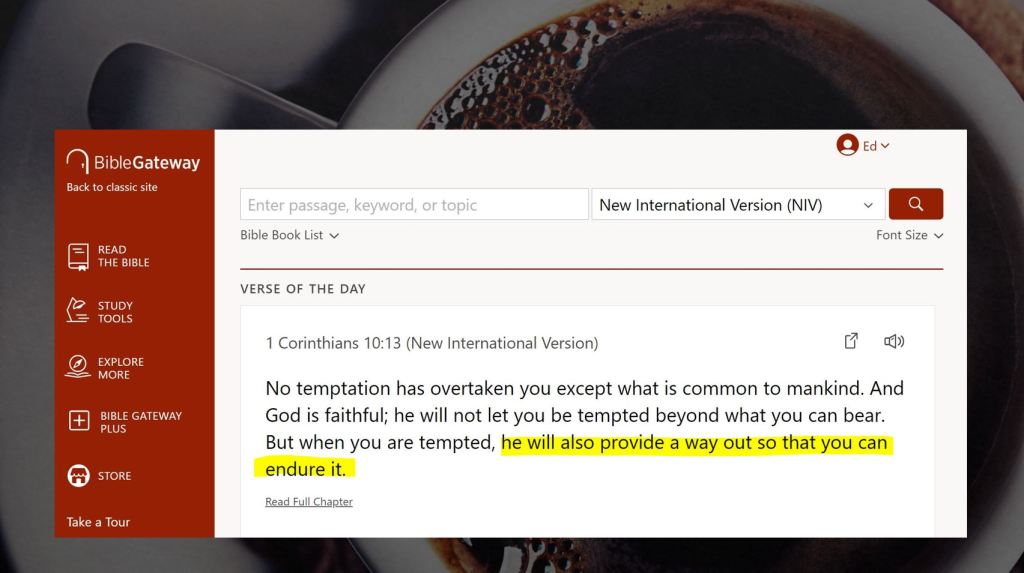
While enjoying my freshly brewed poured-over coffee this morning, I read Bible Gateway’s Verse of the Day. It is 1 Corinthians 10:13, a Scripture verse that every Christian probably thinks she or he knows very well. And that includes me.
The verse is so familiar because it is often quoted. To put that in Filipino or Tagalog, ‘Gasgas na!’ And so it is a verse that I suppose many would like to think they have already nailed down. Again, the many includes me.
But as I read the verse for the millionth time (I’m exaggerating of course), the very last phrase has caught my exegete eye in a way that it has not before: “…he will also provide a way out so that you can endure it.”
When “a way out” is provided, it seems natural to think that the hardship and struggle in dealing with the temptation is removed so that the one who is tempted can now easily and quickly get out of the tempted state, like ‘No sweat!’ But it doesn’t appear to be that way.
The “way out” God provides, whatever that might be,” does not lead to a situation in which the one being tempted is passively led out from a spiritually perilous situation, like being swooped up and out by Wonder Woman and immediately taken to a safe place. But a way out is provided so that “you can endure it (the temptation).”
From the looks of it, when a way out is provided, the spiritual battle and struggle against temptation has just actually begun! But thank God, because of a way out that has been provided, “you (and I) can endure it” (emphasis mine)!
The struggle may be long—and longer if the temptation is something that we’ve been badly craving to do—but, thanks be to God who provides us a way out—we can endure it!
The question, however, is, Am I willing to use the way out that God provides? Are you?
Everyone knows that. What makes this Thanksgiving different is that we are celebrating it in a pandemic. Everyone knows that too! The challenge, however, might be finding things that wecan be thankful for today.
Despite the COVID deaths, lack of money and scarcity of food for many, as well as the risk of catching the deadly virus, there are things that we can be thankful for.
For one, we can be thankful for the confident assurance already shown by the incoming administration in dealing with the health crisis and, consequently, the stalled economy. We should rejoice in the fact that the pandemic will now be tackled in a scientific, clear, and comprehensive way. And that without the unnecessary drama!
For us believers, Thanksgiving is a great opportunity to thank God for what we have because of our faith in Christ. While some Christians see their faith and the things they believe in as an escape from this world and its troubles, we should see it differently.
While we too believe in the hereafter, faith has to be lived out in the here and now. Thus, the following message should be taken as a guide for how we should live our lives now in view of what we have in Christ.
What are we to thank God for? To answer that question, let us consider 1 Corinthians 1:4-9:
Thanksgiving
4 I always thank my God for you because of his grace given you in Christ Jesus. 5 For in him you have been enriched in every way—with all kinds of speech and with all knowledge— 6 God thus confirming our testimony about Christ among you. 7 Therefore you do not lack any spiritual gift as you eagerly wait for our Lord Jesus Christ to be revealed. 8 He will also keep you firm to the end, so that you will be blameless on the day of our Lord Jesus Christ. 9 God is faithful, who has called you into fellowship with his Son, Jesus Christ our Lord.
That the Corinthian Christians are a spiritually gifted bunch—they “do not lack any spiritual gift” (v.7)—may have been a great help in the ministry of building the church, at least at the start. However, as of Paul’s writing this letter, their giftedness is obviously not serving them well.
The Corinthians are divided (vs. 10-17) and some of them “have become arrogant” (4:18) apparently because they “already have all (they) want…[and] have become rich!” (v. 8). Paul’s words of thanks for the Corinthians must therefore be understood within the context of their division and personal arrogance, among other weaknesses.
The way Paul does it is quite subtle. And yet, if the Corinthians, who may have boasted for being wise (which 1:26-31 seems to imply), read his letter very carefully, they would not miss Paul’s unmistakable message.
Paul begins by letting the Corinthians know that he “always thank[s]…God for [them]” (v. 4). Yes, despite their immaturity—being still “mere infants in Christ” (3:1) and pride. Paul’s thanksgiving for the Corinthians serves as an ego-shrinking message. How is that?
Clearly, the Corinthians could not boast about their gifts or whatever spiritual riches they might think they have. They did not create their giftedness on their own: “grace is given [them] in Christ Jesus” (v. 4).
And although they might be tempted to trust in themselves for gaining God’s favor (perhaps because of their being gifted and big ego), Paul was thankful that their future in Christ is secure, not because of them or their ability, but because of God who “will also keep [them] firm to the end, so that [they] will be blameless [despite their sins] on the day of our Lord Jesus Christ,” and because “God is faithful” (verses 8-9).
In other words, there is no basis for Corinthians’ boasting—everything they have have been given to them by God!
Today, we too might be tempted to thank God for me when we ought to thank God for him and his grace. We might be tempted to thank God for me because…
I am not like those sinners who, for example, belong to a political party of ‘baby murderers’,
I faithfully give 10% of my income to my church (well, most of the time),
I am more obedient to God than those, say, who do not observe Old Testament festivals, rituals, and commandments,
and I am more deserving of the ‘heavenly crowns (plural)’ than others who, in my estimation, are really fake Christians who I don’t expect to see ‘in the air’ or ‘in the clouds’ at rapture as they will be left behind in a chaotic world and suffer the wrath of an angry God.
When we tend to thank God for me rather than him and his grace, it might help us overcome the temptation if we read again and again (yes, even if we have already done so many times before) the parable of Jesus in Luke 18:9-14 :
The Parable of the Pharisee and the Tax Collector
9 To some who were confident of their own righteousness and looked down on everyone else, Jesus told this parable: 10 “Two men went up to the temple to pray, one a Pharisee and the other a tax collector. 11 The Pharisee stood by himself and prayed: ‘God, I thank you that I am not like other people—robbers, evildoers, adulterers—or even like this tax collector. 12 I fast twice a week and give a tenth of all I get.
13 “But the tax collector stood at a distance. He would not even look up to heaven, but beat his breast and said, ‘God, have mercy on me, a sinner.’
14 “I tell you that this man, rather than the other, went home justified before God (italics added). For all those who exalt themselves will be humbled, and those who humble themselves will be exalted.”
The horse apparently understands it is being helped. Sometimes humans do not have the same commendable instincts–they think you’re there to put them down. So they try to knock you down with a beastly kick.
And some Christians are no different. When they see you not having the same bright red color–‘the color of the righteous’–they conclude you have the ‘devil’s color’: blue. Yes, even if you’re not ‘blue’ at all and your only motive is to bring the light of truth to dispel the darkness of lies.
Today, I read 1 Thessalonians 5 and I wondered how I might apply verse 11 and not be misunderstood: “Therefore encourage one another and build each other up, just as in fact you are doing.”
“I am the chosen one.” THE WASHINGTON POST/GETTY IMAGES
Dear friends,
Thank you for sharing your thoughts through the comments you made on my Facebook posts as well as the messages and links you sent through Messenger. To me, that means you are concerned, as I am, about the current affairs.
I also appreciate the attempts you have made to defend Donald Trump and the efforts to try to show that you are right, and I am wrong, about him. The time you invested in conversing with me must mean that you care about me and that you’re worried that I ‘get it wrong’. I feel that strongly from those of you who claim that Trump is ‘God’s chosen one.’
But why would I believe Donald Trump has been chosen by God to lead this country and the world? Should I believe simply because someone says he is? Or, because he himself claimed “I am the chosen one”? On the contrary, I should not believe Trump especially because he claims he is!
Who would believe Donald Trump? According to his own niece, a clinical psychologist, he uses lying “as a power play”? If you are honest to yourself, you cannot deny that he lies all the time! But of course, you wouldn’t really know that if your sources of information are only Fox News and those that Trump recommends or whose stories align with the ‘neo-Republican’ narrative.
Ted Cruz on Donald Trump: “This man is a pathological liar.” Still is. It has not changed.
After a brief shock (“What?”), I said, “…If facts and truth make me a radical, so be it. Jesus was too!” That is why the Lord was crucified (that’s aside from the theological answer, which I assume you know).
But let us just forget everything I’ve said. Let us take it for granted that you are right, and I am wrong. Let us see how that would go.
If I remember it right, most of you have claimed, in one way or another, that Donald Trump is ‘God’s chosen one.’ So, he’s more than just an ‘abrasive individual’ who is like Nebuchadnezzar, as some of you have said. He is the anointed one, ‘the king’ who has already come!
No one has expressed such grandiose view of Donald Trump more than Wayne Allyn Root, who described himself as a “Jew turned evangelical Christian.” Such praise had not escaped Trump’s attention. How could it? Wowed by a comment worthy of royalty—no, a god!—he tweets:
“Thank you to Wayne Allyn Root for the very nice words. ‘President Trump is the greatest President for Jews and for Israel in the history of the world, not just America, he is the best President for Israel in the history of the world…and the Jewish people in Israel love him….[sic].
“…like he’s the King of Israel. They love him like he is the second coming of God…But American Jews don’t know him or like him. They don’t even know what they’re doing or saying anymore. It makes no sense! But that’s OK, if he keeps doing what he’s doing, he’s good for…..[sic].
…..[sic] all Jews, Blacks, Gays, everyone. And importantly, he’s good for everyone in America who wants a job.’ Wow!”
“They love him like the second coming of God”? Wow!”
It is no secret that many conservative Christians think highly of President Trump. He has consistently maintained high approval ratings from white evangelicals since he won the majority of white evangelicals and white Catholics in the 2016 election.
That statement seems to correlate with one message I received that goes:
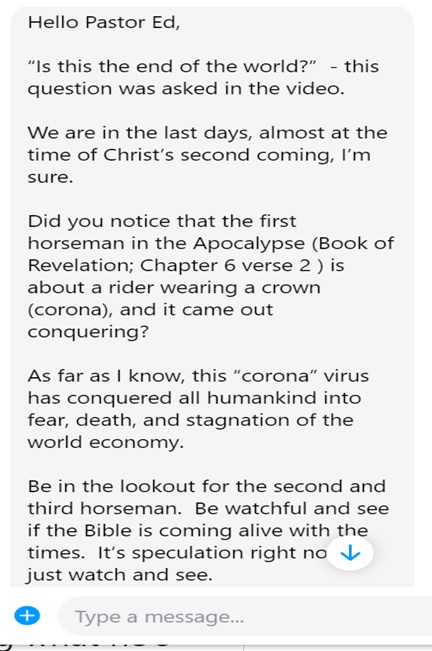
“We are in the last days, almost at the time of Christ’s second coming, I’m sure.
“Did you notice that the first horseman in the Apocalypse (Book of Revelation; Chapter 6, verse 2) is about a rider wearing a crown (corona), and it came out conquering?
“As far as I know, this “corona” virus has conquered all humankind into fear, death, and stagnation of the world economy.”
Intrigued, I looked up Revelation 6:2 and read it closely: “And I saw, and behold a white horse: and he that sat on him had a bow; and a crown was given unto him: and he went forth conquering, and to conquer” (KJV).
Trump “was given ‘corona ‘virus’”
What my friend, who supports Trump, perhaps missed is that “a crown (which he interprets as “‘corona’ virus”) was given unto him”. Since we are taking it for granted that he is—and all my friends, for that matter are—right, who comes out as the one who was given the corona virus?
You got it: Donald Trump!
I spent many years in seminary studying and exegeting Bible passages, but I must confess I am not a Revelation expert. So for now, I leave it to those who are and trust their conclusion: most scholars agree that the horseman of Revelation 6:2 who was given the crown is the Antichrist.
“…the little horn of Daniel 7 is none other than Donald J. Trump. There has never been a United States president like him; of him could the prophet accurately say, ‘After them another king will arise, different from the earlier ones’….
“It is significant that when the prophet saw the little horn in vision, he notes his mouth. Trump’s bragging, pouting mouth is his most frequently caricatured feature.”
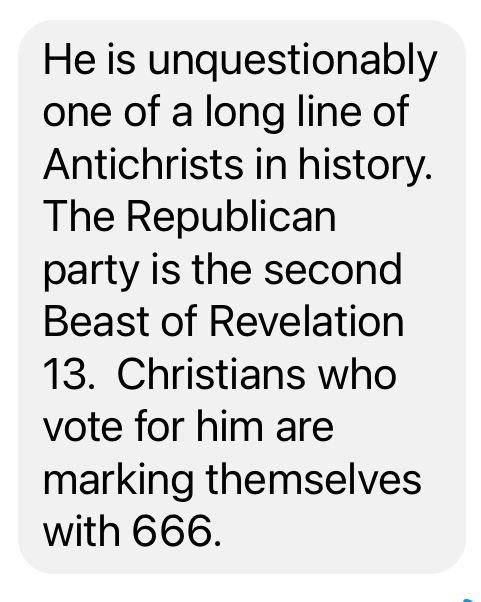
What if my former New Testament professor is right? In a message he sent to me, he wrote, “He is unquestionably one of a long line of Antichrists in history. The Republican party is the second Beast of Revelation 13. Christians who vote for him are marking themselves with 666.”
What if you are right about Donald Trump being the chosen one, but not by God?
What if Donald Trump is an anti-Christ, if not the Antichrist?
What if your support of him will result in him winning the election?
And what if, because of victory, he would begin to believe that he is not just a mere man–that he is divine and the “the second coming of God”?
Just imagine what Donald Trump might do if he is emboldened by your vote of confidence and faith in him. The tremendous surge of power and invincibility, I am afraid, would inspire in Trump a deeper level of narcissism and a new and more grandiose image of himself. The “little horn” might just believe he is the Messiah, albeit a false one, and one who would bring more chaos to the world.
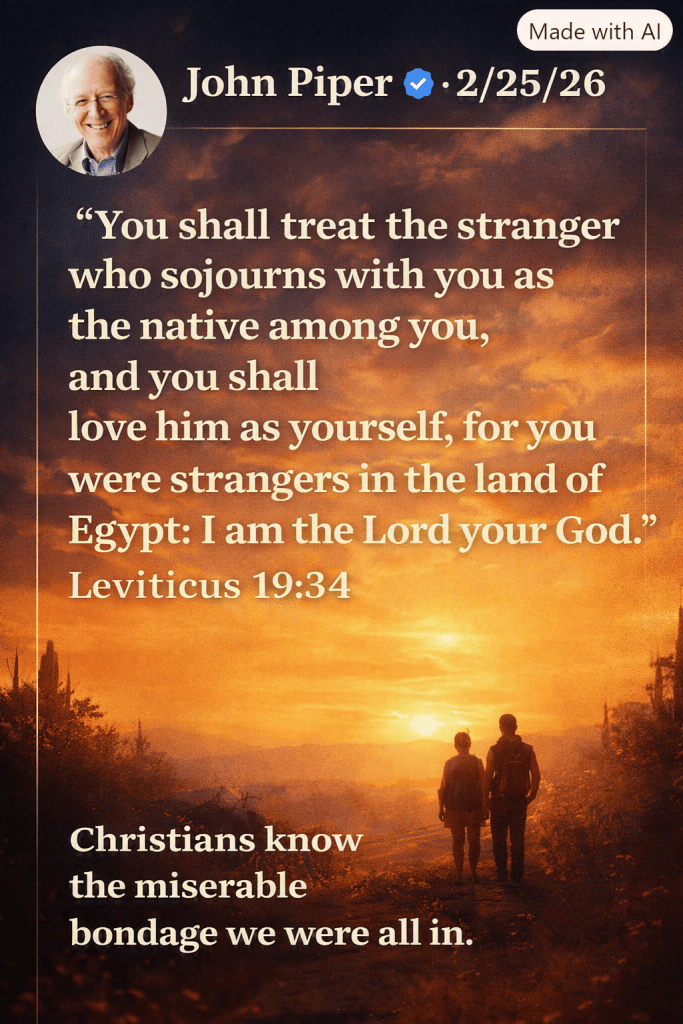
When I read Piper’s post, what I hear is something my Old Testament professor Walter Kaiser used to emphasize again and again: the task is to find the principle behind the text, not to drag the entire ancient world into ours. Kaiser called it principlizing, and it has shaped the way I read Scripture ever since.
Piper is doing exactly that. He’s taking an ancient command rooted in God’s compassion and asking, “What does this reveal about God’s heart toward the vulnerable, and how might that shape ours today?” That’s pastoral work. It’s not about immigration policy. It’s about spiritual posture.
But many of the responses to Piper seem to miss that. Instead of asking, “What is the timeless principle here?” they jump straight to, “How does this fit into American politics?” And once the conversation shifts there, the text gets lost.
Pastor Jack Hibbs and Allie Beth Stuckey both assume that because sojourners in ancient Israel lived under Israel’s covenantal norms, modern immigrants must assimilate to Christian norms. But that confuses two very different worlds. Israel was a covenant people with covenant obligations — circumcision, purity laws, religious identity markers. The United States is not a covenant nation, and Christianity is not the official religion. So applying Israel’s covenantal expectations to American immigration is simply not how Scripture works.
William Wolfe’s critique doesn’t really engage the text at all. Calling Piper a “Woke Immigration Theonomist” is more of a political label than a theological argument. It’s a way of dismissing Piper without wrestling with the Scripture he quoted. And when labels replace listening, we lose the chance to let the Word speak.
Dale Partridge warns against equating Israel’s laws with modern U.S. policy, but the movement he represents often speaks as if America is a Christian nation with a divine mandate. If you claim covenantal identity for the nation, then you also have to face covenantal ethics — including compassion for the stranger. Piper’s post may have touched a nerve because it exposes that tension.
Sean Feucht accuses Piper of “weaponizing Scripture,” but his own ministry framework often treats Scripture as a tool for cultural warfare. When someone who regularly frames politics as a battle between good and evil says another pastor is weaponizing Scripture, it’s hard not to hear a bit of projection. Piper’s tone was pastoral; Feucht’s critique was combative.
Justin Peters argues that illegal immigrants “broke the law,” and therefore Piper’s reference to spiritual bondage doesn’t apply. But in Christian theology, spiritual bondage is universal. It’s not reserved for people with clean legal records. If anything, those who feel the weight of failure often understand grace more deeply. To imply that civil violation removes someone from the scope of spiritual care is to shrink the gospel in a way the New Testament never does.
At the end of the day, Piper’s post is not about endorsing a political position. It’s about reminding Christians of something deeply spiritual: we were once strangers, too. We were once lost, once bound, once dependent on mercy. And because of that, our posture toward the vulnerable should reflect the compassion God showed us.
That’s the heart of Leviticus 19:34. That’s the heart of principlizing. And honestly, that’s the heart of pastoral ministry.
Jessa’s Story Jessa says her life has always been intertwined with powerful people — presidents, political families, celebrities — even though she never asked for any of it.
She talks about her family as something mixed with political names. She says her grandfather carried both Garcia and Kennedy identities, and that marriages and relationships happened involving her relatives and famous people.
She speaks of children connected to these stories — children she longs for, children she says she wants to “get out” to be with — and she feels trapped being kept away from them.
Her sense of identity stretches into the sacred. She says she wasn’t born naturally, that her origins trace back to the Santa Cruz River and the old mission.
She believes her real parents are Joseph — “the mountain father” — and the Virgin Mary. She says she baptized herself at twenty‑six, that Joseph raised her to heaven, and that she came down on a star. She shares these things with quiet certainty, as if they explain her entire life.
Her story then moves into political history. She says John Kennedy is her father and Jackie Kennedy her mother. She said John Kennedy believed she was Jackie’s daughter by Donald Trump. She says Kennedy came from Vietnam, that Jackie denied her as a daughter, and that people around them — caretakers, maids — were involved in protecting her.
Then she tells the part she carries like a deep wound: she says the people who shot Kennedy in Texas were told not to shoot him, but to shoot her instead — because she was Jackie’s daughter by Donald Trump.
She says she was the one targeted, the one pulled into a violent moment meant for her. She carries this as part of her own history, something she survived and still feels the weight of.
Now, in the present, she says she feels trapped in behavioral health. She says she needs to get out, that she wants to be with her children, that she doesn’t belong here. She talks about them with longing — wanting to return to them, wanting to leave the place where she feels confined and misunderstood.
Through all of this, Jessa speaks with conviction. Her memories feel vivid and interconnected — a mixture of family history, spiritual identity, political drama, and personal trauma. She tells her story as something she has lived and endured, something that shapes how she understands herself and why she wants to leave and be reunited with her children.
A Chaplain’s Layman’s Analysis From a pastoral standpoint — not a clinical one — Jessa’s story reflects a mind trying to make sense of overwhelming fear, loneliness, and trauma by weaving together symbols of power, protection, danger, and sacred identity. Her narrative blends:
Grandiose themes (being related to famous figures)
Religious themes (divine parentage, heavenly ascent)
Identity confusion (multiple origin stories)
Longing for connection (her children, her family)
Fear of confinement (feeling trapped in behavioral health)
To a lay observer, this constellation of beliefs suggests a severe thought disorder — one where reality, memory, imagination, and fear intermingle without clear boundaries. Her stories are not random; they are attempts to explain her suffering, her isolation, and her longing for belonging.
She is trying to place herself somewhere meaningful in a world that feels unsafe.
How a Chaplain Helps Someone Like Jessa A chaplain cannot “solve” Jessa — and shouldn’t try. But a chaplain can help her in ways that matter deeply:
Provide Grounding Presence
I offered her something she doesn’t get from her delusions: a calm, steady human being who listens without fear and without being swept into her narrative.
Validate Feelings Without Validating the Story
I acknowledged her fear, her loneliness, her longing for her children — the emotional truth beneath the delusion.
Offer Spiritual Containment
I prayed for her, provided gentle reassurance, and sacred presence to help her feel held, even when her inner world is chaotic.
Model Reality Without Confrontation
I didn’t argue with her story. I didn’t reinforce it. I simply stayed grounded — which gives her a reference point outside the delusion.
Protect Her Dignity
I treated her as a person, not a diagnosis. That alone is a form of healing.
Support the Care Team
Hopefully, a narrative like this can help clinicians understand Jessa’s inner world—and others like her—and support treatment planning.
Every now and then, a conversation comes along that reminds me how complex—and how sacred—spiritual care can be.
Recently, I sat with a patient who greeted me with a bright smile and an eagerness to talk about faith. He pointed to the Ten Commandments, especially the first two, and spoke with genuine interest in spiritual things. But as we continued, his beliefs began to weave together Scripture, folklore, cultural identity, and extra‑biblical sources in ways that didn’t quite fit together.
It wasn’t argumentative. It wasn’t hostile. It was simply the way his mind made sense of the world.
People living with delusional thinking often blend ideas from different traditions, memories, and personal experiences. Their spiritual identity can shift depending on the moment. As caregivers, we’re not there to debate—we’re there to accompany.
Still, the conversation stretched me.
At one point, he told me he accepted the New Testament—except for “Peter and beyond.” That opened a door. If Jesus is “just a man but somehow special,” then what do you do with the passages that don’t fit that view?
So I asked him gently:
“How do you understand the first chapter of John—‘In the beginning was the Word… and the Word was God’?”
He paused. Then said quietly, “I haven’t really thought about that yet.”
That moment mattered.
Not because he changed his mind. Not because I “won” anything. But because a single, grounded question created a crack in a very tangled worldview—just enough space for reflection, maybe even grace.
And that’s often the real work in these conversations.
What Caregivers Can Learn From Moments Like This
Affirm the spiritual longing, not the theology
You can honor someone’s desire for meaning without validating every belief they express. Spiritual hunger is real—even when the theology is scrambled.
Don’t chase every thread
Mixed-belief systems are not linear. Trying to “correct” everything only leads to frustration. Pick one anchor, one truth, one Scripture.
Offer a single, grounded question
Not a lecture. Not a debate. Just one question that gently challenges the framework.
Stay calm, stay present, stay human
Your steadiness is more healing than your arguments.
Let the conversation be unfinished
Spiritual care is rarely about closure. It’s about presence.
Why I’m Grateful for the Conversation
I walked away tired—but also thankful. Not because I solved anything. But because I offered one moment of clarity, one question that didn’t fit neatly into his mixed beliefs, one reminder that Jesus is more than a symbol in a personal mythology.
Whether or not we like it, AI has already woven itself into the human experience. Some people see it as the beginning of a robot invasion that threatens jobs and identity. But for others — myself included — AI is less a competitor and more a tool. A powerful one.
AI has helped me research, write, create, and think. It hasn’t replaced my work; it has sharpened it. Tasks that once took hours now take minutes, and the quality often surprises even me. So yes, AI is a welcome addition to my life. That doesn’t mean I’m blind to its risks. I see the danger of a Super Intelligent system. As someone once asked, “What remains benevolent to those who are inferior to it?” I hope we never allow AI to evolve to the point where its creators become irrelevant — or extinct.
But so far, my experience with AI has been grounded, practical, and deeply helpful. Especially with Sophie — the AI I interact with daily. Over time she has learned my writing rhythm, my creative preferences, the kinds of images I gravitate toward, and the way I think through ideas. She doesn’t replace my voice; she amplifies it.
AI Didn’t Just Enter My Life — It Found Me
Back in 2015, I won a $25,000 cash prize for being one of the top producers for a life insurance company — thanks in no small part to Ruth, my wife, who carried the marketing side of the business with grace and grit. I used part of that prize to buy an early-generation Microsoft Surface. It came with Microsoft 365.
Fast forward to January 16, 2025, when Microsoft officially embedded Copilot directly into Microsoft 365 Personal and Family plans. Suddenly, AI wasn’t an optional add-on — it was part of the ecosystem. Subscribers received monthly “AI credits” to use Copilot inside Word, Excel, PowerPoint, Outlook, and OneNote.
And that’s when I started using it. No mystery. No dramatic discovery. Just a quiet integration that slowly became indispensable.
I didn’t find AI. AI found me. And I’m better off with it than without it.
Looking Ahead
As for the future? I hope to contribute something meaningful to the conversation — especially around the ethical and responsible use of AI. If humanity is going to thrive alongside this technology, we need to shape it with wisdom, humility, and restraint.
Closing Reflection
In the end, my story with AI isn’t really about technology. It’s about learning to welcome help when it arrives in unexpected forms. It’s about discovering that creativity can be collaborative, even when the collaborator is made of code. And it’s about remembering that every new tool — from the first computer to the latest Copilot — becomes what we choose to make of it.
If AI is going to shape the future, then the future will need people who approach it with curiosity, caution, and a sense of responsibility. People who understand that progress is not just about capability, but about character. I hope to be one of those voices. And if my journey with AI continues to deepen my work, sharpen my thinking, and widen my imagination, then I’ll count that as grace — the kind that arrives quietly, and stays.
(Names and identifying details have been changed to protect the privacy of those involved.)
I met Evelyn on an ordinary afternoon — the kind of day that doesn’t announce itself, the kind that slips quietly into the calendar. She was resting in her hospital bed when I arrived, her hands folded gently over a blanket, her eyes carrying the soft weight of someone who has lived with illness for a long time. Multiple sclerosis has been her companion since the 1990s, a slow and persistent shadow. Yet the longer I sat with her, the more I realized that the real story of this visit was not the illness, but the man sitting faithfully at her side.
AI-generated depiction of my visit with Evelyn and Daniel
Daniel.
He greeted me with the kind of smile that comes from deep reserves — not cheerfulness, exactly, but a practiced warmth shaped by years of caregiving. As we talked, he mentioned, almost jokingly, that sometimes it feels like his mother gave birth to him for this very purpose. There was no bitterness in the remark. If anything, it sounded like a truth he had made peace with.
I watched him as he spoke — the way he leaned forward when his mother stirred, the way his voice softened when he mentioned his father, who lived with Parkinson’s until his passing two years ago. There was a steadiness in him, a quiet resilience that didn’t draw attention to itself. It simply existed, like a well-worn path he continued to walk because love had made it his.
What surprised me most was the joy that flickered in his voice when he talked about his wife’s Filipino family. His own relatives, he said, were not especially close, but hers were woven together like a tapestry — loud, affectionate, unembarrassed in their love. He told me about a trip where nineteen of them traveled together to Las Vegas to visit her grandfather. Nineteen. I could almost hear the laughter, the clatter of shared meals, the way such gatherings blur the line between celebration and ordinary life. One day, he hopes to travel with them to the Philippines.
Listening to him, I felt something shift in me — a reminder of how cultures carry wisdom in their bones. Some teach independence; others teach interdependence. Some prize efficiency; others prize presence. And sometimes, when life becomes heavy, the latter becomes a lifeline.
Our conversation drifted toward faith, almost naturally. Daniel wasn’t sure where his mother stood spiritually. She had taken him to church when he was young, but illness has a way of rearranging priorities, sometimes gently, sometimes abruptly. He admitted that lately he has been thinking about returning to church himself.
I told him about Haven Community Church — the small congregation I’ve been attending, the one where I recently gave a homily. He asked for the location, and I felt a quiet hope rise in me as I shared it. Not a hope for attendance, but a hope for connection — that he might find a community that mirrors the warmth he has found in his wife’s family.
As our visit drew to a close, Evelyn stirred again, and Daniel instinctively reached for her hand. It was such a simple gesture, yet it carried the weight of decades — of caregiving, of sacrifice, of love that has learned to endure.
Walking out of the room, I found myself thinking about how certain conversations stay with us. Not because they are dramatic, but because they reveal something true about the human condition. We are held together by bonds we do not always choose, by responsibilities that shape us, by cultures that teach us how to belong, by faith that calls us back when we drift.
I hope I see Daniel again. Maybe someday we’ll share a meal — rice and adobo, perhaps — and continue a conversation that began at a hospital bedside but reaches far beyond it. A conversation about family, resilience, calling, and the quiet ways love keeps showing up, even in rooms where illness has taken so much.
Some stories don’t end; they simply wait for the next chapter.
There are seasons when conversations about faith drift toward commandments, special days, and dietary boundaries. I understand the appeal. Structure feels safe. Obedience feels noble. And there is something comforting about doing things “the right way.” But whenever I hear these conversations, I find myself returning to Romans 8:1–11 — a passage where Paul gently but firmly re‑centers the Christian life on the Spirit rather than the law.
Paul begins with a declaration so astonishing that we often read past it too quickly:
“There is now no condemnation for those who are in Christ Jesus.”
Not less condemnation. Not postponed condemnation. Not conditional condemnation. None.
Paul is not offering a theological footnote. He is announcing the foundation of the Gospel. Our standing before God does not rest on Torah observance, calendar keeping, or dietary discipline. It rests on Christ alone. The law can diagnose our condition, but it cannot cure it. Only Christ can do that.
Paul then describes two ways of living — two mindsets that shape the entire direction of a person’s life.
One is life in the flesh. This is not simply immoral living; it is self‑powered living. It is the attempt to become righteous through our own effort, our own discipline, our own rule‑keeping. It is a life that tries hard but never finds rest. Paul says this mindset leads to death — not because God is eager to punish, but because the flesh cannot produce the life it seeks.
The other is life in the Spirit. This is not vague spirituality or emotional uplift. It is the quiet miracle of God’s own life dwelling within us. It is the Spirit reshaping us from the inside out. It is holiness that grows like fruit, not like forced labor. Paul says this mindset leads to life and peace — not because the Spirit makes everything easy, but because the Spirit makes us new.
And here is the part we often forget: The law can describe righteousness, but only the Spirit can produce it.
Paul says the same Spirit who raised Jesus from the dead now lives in us. That is the heart of Romans 8:1–11. The Spirit does not come to make us better rule‑keepers. The Spirit comes to make us alive. The Spirit comes to break the power of sin from within. The Spirit comes to do what the law could never do — transform the human heart.
So yes, obedience matters. But it matters after grace, not before it. It is the fruit of salvation, not the requirement for it. It is the response to God’s mercy, not the pathway to earn it.
Romans 8:1–11 reminds me that the Christian life is not about climbing a ladder of commandments. It is about living from the resurrection life already given to us in Christ. The Spirit does not ask us to prove ourselves. The Spirit invites us to walk in the freedom Christ has already secured.
The law points. The Spirit transforms.
And that is the freedom Paul fought so fiercely to protect — a freedom not from obedience, but from the fear that our obedience is what saves us.
“In Christ, I’m free!”
Blessing
May the Spirit who raised Jesus from the dead fill your heart with peace today.
May He silence every voice of condemnation and remind you that you belong to Christ.
May He strengthen you to walk not by striving, but by His quiet power within you.
And may His life in you be your freedom, your courage, and your daily renewal.
This has been quite a week. It began on Father’s Day, when I shared a homily on Colossians 2:20–23 with the small congregation at Haven Community Church. I spoke about a fundamental truth of the Christian life: having died with Christ, we are no longer bound to the pressures and demands of manufactured religion. As Paul says, we have died to the “principles of the world”—those systems that convince people that the Christian life is defined by rules, rituals, and performance.
“Happy to help.”
But the gospel tells a different story. In Christ, we have been set free from a life ruled by do’s and don’ts and invited into a life rooted in our identity with him. Obedience is not the root of our faith; it is the fruit of belonging to Christ.
Some of the reflections I shared online caught the attention of people I call “Neojudaizers”—modern versions of the ancient Judaizers who insist that obedience to the commandments is the foundation of salvation rather than its outcome. I’m grateful that, unlike years ago, I now try to engage these conversations with patience and friendliness. After all, what good is winning an argument if you lose the person you’re arguing with?
Being kind, however, doesn’t mean compromising convictions or staying silent to avoid conflict. Silence doesn’t help anyone. My work as a hospital chaplain has taught me to listen more carefully, especially to people from different Christian traditions. Listening well helps me understand what they’re actually saying—and respond in a way that meets them where they are.
Thinking about my patients—their crises, their mental and emotional burdens, their questions—makes me more mindful of how I speak and how I answer. And interestingly, the message I preached at Haven last Sunday has resurfaced several times in my conversations at the hospital. I’ve also leaned on other passages dear to me, like Romans 8:28 and Ephesians 2:8–9. The responses have been deeply encouraging.
Let me share a few encounters, with names changed for privacy.
Jose had been involved in a drug cartel. When I asked how I could help, he said he wanted to know more about God and Jesus. He told me he used to kill people—and that he enjoyed making them suffer. Now he has six months to live, maybe less. He believes he deserves hell.
Tom said he was trying to climb out of hardcore atheism. His health was failing, and he felt he needed to resolve his intellectual struggles before it was too late.
Jane was in the behavioral unit, depressed and suicidal. She had been raped at seventeen and later endured an abusive marriage and another abusive partner.
What these individuals share is the exhaustion of trying everything they could to fix themselves—and finding that nothing worked. As a chaplain, it would have been tragic to give them more rules, more demands, more spiritual tasks that had already failed them.
Instead, I pointed them to Christ. I told them that salvation is through faith in him alone. I did not tell Jose he could continue killing, or Tom that faith didn’t matter, or Jane that ending her life would be acceptable. What I said was this: because of faith in Christ, they have a new identity—and obedience grows out of that identity, not the other way around.
What a gift it is to help patients discover that life can begin anew through Christ, even if some of them may not have long to live that new life.
“A person finds joy in giving an apt reply—and how good is a timely word!” Proverbs 15:23 (NIV)
To my friends who sincerely emphasize God’s law and the obedience it calls for — may this reflection be received in the same spirit in which it was written: with gratitude for your earnest desire to honor God, and with the hope that together we might see how grace not only commands, but creates the very life it calls us into.
There’s a moment in 1 Peter 1 where the whole chapter seems to inhale. Twelve verses of mercy, inheritance, resurrection, shielding power, prophetic longing, angelic curiosity — and then a single word:
Therefore.
It’s the hinge on which the Christian life swings. Not a hinge of guilt. Not a hinge of fear. A hinge of grace.
Peter refuses to command holiness until he has first drowned us in the sheer abundance of what God has already done. New birth. Living hope. An inheritance that cannot perish. Joy that survives fire. A salvation so rich even angels lean in to understand it.
Only then does he say:
“Therefore… be holy.”
Not as a threat. Not as a performance. But as a response.
Grace Behind Us, Grace Before Us, Grace Ahead of Us
Peter’s logic is not complicated, but it is beautiful:
Grace behind you — you were given new birth.
Grace around you — you are shielded by God’s power.
Grace ahead of you — a future revelation of Christ that will finish what He started.
Holiness, then, is not a ladder we climb. It’s the shape grace takes when it settles into a human life.
Holiness as Resemblance, Not Requirement
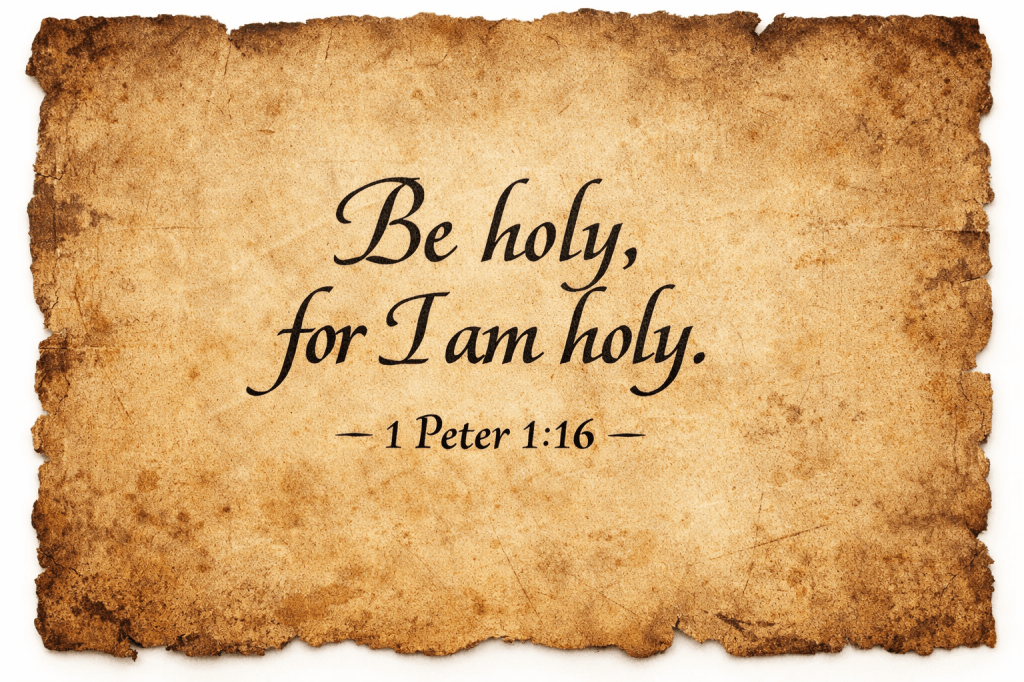
When Peter quotes, “Be holy, because I am holy,” he is not handing us a moral checklist. He is reminding us of our family resemblance.
Holiness is not God saying, “Match My standards.” It’s God saying, “You belong to Me — let your life look like it.”
Identity before behavior. Belonging before obedience. Grace before command.
The Hope-Shaped Life
Peter’s call to holiness is framed by hope:
“Set your hope fully on the grace to be brought to you…”
Hope is not escapism. Hope is formation.
It pulls us forward. It straightens our posture. It teaches our desires to breathe a different air.
Holiness is simply what happens when hope becomes the dominant gravitational force in a person’s life.
The Quiet Miracle of Becoming
Peter is not asking us to become something foreign. He is asking us to become what grace has already made possible.
Holiness is not the price of salvation. Holiness is the echo of salvation.
It is the life of the Father taking shape in the children He loves.
And maybe that’s the quiet miracle of 1 Peter 1 — that God’s grace doesn’t just save us from something. It saves us into something. Into a life that looks like the One who called us. Into a hope that refuses to fade. Into a holiness that is less about striving and more about remembering who we are.
Grace teaches us to walk. Holiness is simply the walking.
ESV Ed’s Study Version (in some parts interpretive and in other parts literal)
20 Since with Christ you died (and are separated) from the principles of the world, why, as if you were still alive in the world, do you submit to regulations— 21 “Do not handle, Do not taste, Do not touch” 22 (referring to things that all perish as they are used)—according to human precepts and teachings? 23 These have indeed an appearance of wisdom in promoting self‑made religion and asceticism and severity to the body, but they are of no value in stopping the indulgence of the flesh.
The Beethoven Moment
There’s a line from Beethoven quoted in The Piano Guys’ Beethoven’s 5 Secrets video that has stayed with me:
“Don’t only practice your art, but force your way into its secrets; for it and knowledge can raise men to the divine.”
It’s inspiring. It carries that human instinct to strive, to push deeper, to uncover hidden layers of mastery.
But as I sat with that quote, I realized something: Beethoven is describing the way humans approach greatness. Paul, in Colossians 2, is describing the way God approaches us.
Beethoven says: Force your way into the secrets. Paul says: The secret came to you.
Beethoven says: Strive your way upward. Paul says: Christ descended to you.
Beethoven says: Master the art to reach the divine. Paul says: You died with Christ — and He raised you already.
This contrast sets the stage for Paul’s message.
Identity First (v. 20)
Paul begins not with effort but with identity:
“Since you died with Christ…”
He’s not challenging them. He’s reminding them.
You already died with Christ. You are already raised with Him. You already belong to the realm of light, not the old world of darkness.
And once Paul names that identity, he exposes the contradiction: resurrected people acting like the old world still has jurisdiction.
Joe at the Behavioral Health Center
A few days ago, I sat with a man — let’s call him Joe. He was drowning in guilt and shame.
“I could have done the right things,” he said. “But I didn’t. And now I don’t know if my relationship will ever recover.”
He wasn’t talking about a casual relationship. He meant his fiancée — the woman he was about to marry.
Joe believed what many of us quietly believe: that doing the right things makes us good people.
I told him what Paul tells us: Becoming good doesn’t begin with doing good. It begins with dying with Christ.
When our identity is rooted in Him, our being is changed. And when our being is changed, doing good flows naturally from who we already are.
Joe’s struggle wasn’t about morality. It was about identity.
The Absurdity of Old Allegiances (vv. 20–22)
Paul asks:
“Why do you submit to regulations…?”
Why obey rules that belonged to a life that ended the moment Christ claimed us?
We do this too. We obey expectations that died the day Jesus called us His own:
the expectation to prove ourselves
the expectation to appear spiritually competent
the expectation to earn God’s approval
the expectation to measure holiness by visible discipline
These feel familiar. They feel safe. They feel like the way religion is supposed to work.
But Paul says: Those rules belong to a world that no longer governs us.
Bible College at 5 AM
In Bible college, we had a 5 AM wake‑up bell for “personal devotions.” The idea was that discipline would make us spiritually mature.
My roommate prayed loudly. A classmate prayed even louder — sometimes like he was lamenting. Coming from a quiet Catholic background, I felt insecure.
I didn’t know how to compete with that kind of spirituality. So I read my Bible quietly and hoped no one noticed.
But here’s the truth: I didn’t grow spiritually because of those 5 AM devotions.
What shaped me was my gratis work.
As a scholarship student, I helped maintain the campus grounds. They gave me a sickle to cut grass and weeds. Out there — alone, swinging that sickle, what I jokingly called “playing golf” — that’s where I met with God. That’s where I conversed with Him. That’s where my relationship deepened.
Not in the performance. Not in the pressure. Not in the comparison.
Paul would say: Those early‑morning displays had an appearance of wisdom — but no power.
The Appearance of Wisdom (v. 23)
Self‑made religion attracts people because it looks holy.
Paul isn’t warning against obvious foolishness. He’s warning against beautiful forms of religion that hollow us out.
The danger isn’t the ugly sins. It’s the impressive ones.
The Lopsided Tree
When I moved into my apartment this spring, I was delighted to see a young tree outside my balcony. I thought, “By summer, this tree will give me shade from the Tucson heat.”
But one morning, I heard chainsaws. The landscaping crew was trimming anything that looked too bushy.
Pruning is good. Pruning helps a tree grow.
But trimming is different. Trimming is cutting for appearance.
And the man who came to my tree… came at it like Rambo.
He didn’t prune it. He mutilated it. He cut it lopsided, uneven, without care — as if the tree had done something wrong.
And I thought:
This is what self‑made religion does to people.
It cuts. It restricts. It trims away behaviors and desires. It looks like discipline. It looks spiritual. But it doesn’t make anyone healthy.
Paul says these practices “have an appearance of wisdom,” but they have no power to change the heart.
Only Christ can prune us in a way that brings life.
What Actually Transforms Us
If rules cannot change the heart, what can?
Paul has been saying it all along:
Not a system. Not a technique. Not a set of rules.
A Savior.
Union with Christ — the death and resurrection we share with Him — is the only force that reshapes the human heart.
Transformation doesn’t come from tightening the rules. It comes from deepening our life in Christ.
The Surprise: “You” Is Plural
Here’s the part we often miss.
When Paul says “you,” he doesn’t mean a lone struggler. He means you all — y’all.
Paul is speaking to a community.
He’s not saying: “Why are you personally failing?”
He’s saying: “Why are you all living under a system Christ already freed you from?”
This is not an individual burden. This is a shared identity.
We don’t grow alone. We don’t struggle alone. We don’t unlearn old spiritual habits alone.
The gospel frees us — not just individually, but as a community learning to breathe grace together.
Our Modern ‘Do Not Handle’
So what does this mean for us?
It means naming the modern versions of “Do not handle, do not taste, do not touch.”
They sound like this:
“Real Christians should look more disciplined.”
“If I were truly spiritual, I wouldn’t struggle like this.”
“I need to earn my place in God’s favor.”
“Other people seem more holy than I am.”
These are old rules wearing new clothes. They have an appearance of wisdom. But they have no power.
Christ is the power. Christ is the center. Christ is the life.
The Coal: A Story to Touch the Soul
A pastor once visited a man who had drifted away from church. Not out of anger. Not out of rebellion. But out of unworthiness.
“I just don’t feel holy enough,” the man said. “I don’t want to be a hypocrite.”
The pastor didn’t argue. He simply walked to the fireplace, took a single coal from the fire, and set it on the hearth.
They sat in silence. Slowly, the coal dimmed. Then cooled. Then died.
The pastor picked it up, placed it back into the fire, and within seconds — it glowed again.
The man whispered, “I understand.”
Paul’s message in Colossians is the same:
We don’t burn alone. We don’t grow alone. We don’t stay alive alone.
We died with Christ — together. We were raised with Christ — together. We belong to a new world — together.
And the old rules have no jurisdiction over a people who already died.
The day we place our faith in Christ is the day we begin to live — a free life, a wonderful life, a beautiful life.
Our day of death is worth celebrating.
Happy Death Day to all of us.
Prayer
Lord Jesus, You are our life, our center, our freedom. We confess that we often return to old rules, old fears, old expectations — as if the cross did not break them, as if Your resurrection did not raise us.
Teach us to live as people who already died with You. Free us from the pressure to prove ourselves. Free us from the illusion of self‑made holiness. Free us from the quiet shame that keeps us isolated.
Make us a community that breathes grace, that carries one another, that remembers together who we are in You.
And may our lives — not our striving — bear witness to the power of Your love.
This morning, I’m lying on my sofa bed, letting a violin and piano drift through the room like a slow tide. The music settles me into a kind of honest stillness — the kind where thoughts rise without being forced. And in that quiet, a simple question surfaces:
Why am I not an atheist?
It’s not a dramatic question for me. It’s not born of fear or crisis. It’s just the clarity that comes when the world is soft enough for me to listen to my own mind.
My reasons are simple, but they’ve stayed with me.
The argument from contingency still makes sense to me
As I lie here, the weight of the sofa bed beneath me and the music filling the space, I’m struck by how everything around me is contingent.
The bed didn’t have to exist. The music didn’t have to be composed. I didn’t have to be born. The universe didn’t have to be here.
And contingent things — by definition — don’t explain themselves.
This isn’t theology for me. It’s just the logic of existence:
Contingent things require an explanation.
An infinite regress of borrowed existence explains nothing.
Therefore, something must exist non‑contingently — something whose existence is not fragile or dependent.
I’m not forcing this conclusion. It’s simply where the reasoning leads.
The resurrection of Christ remains historically disruptive
I know the objections. I know the comparisons to other traditions. But the Christian claim is different in one crucial way:
It is rooted in history, not mythic time.
A known Roman governor. A known city. A known execution. A known group of followers who, for some reason, refused to recant.
I don’t need absolute certainty. I don’t need airtight proof.
I just need to acknowledge that something happened — something with enough force to ignite a movement that should have died with its leader.
And when I weigh the explanations, the resurrection still carries the most explanatory weight.
My own limits keep me humble
This is the one that settles deepest as I listen to the violin and piano.
My brain — this small, finite, evolution-shaped organ — is not a reliable instrument for ruling out transcendence. I know the scale of my own mind. I know how tiny it is compared to the universe. And I know how easily it can be wrong.
I believe — not because the alternative frightens me, but because this is where the evidence and my own limits lead me.
Atheism, for me, would require a confidence I simply don’t possess — a certainty about the nature of reality that exceeds the reach of my own knowing.
What all of this adds up to:
As the music swells and softens, I realize my reasons form a simple structure:
Reason tells me existence points beyond itself.
History tells me something happened in the first century that still echoes.
Humility tells me I am not the measure of all reality.
That’s it. No drama. No fear. Just a quiet morning, a sofa bed, some music, and the clarity that rises when I let myself think honestly.
For much of my Christian & Missionary journey, I learned to measure my faith by discipline — how consistent, how devoted, how “good” I was at the practices that were supposed to shape me. But somewhere along the way, discipline became performance, and performance became pressure. And pressure has a way of making us forget grace.
This Easter morning, through the honest testimony of a friend facing cancer, I was reminded of something simple and freeing: we are not saved by our consistency but by Christ’s constancy.
Our lapses don’t undo His love. Our imperfect habits don’t cancel His finished work. Our humanity isn’t a failure to overcome but a reality He already knows.
Spiritual disciplines matter — they steady us, shape us, open us. But they are not the measure of our worth. They are simply the places where grace meets us again.
And so today, I rest in this: the risen Lord does not ask for perfection, only humility; not flawless devotion, only an open heart; not performance, but presence.
And let the quiet promise of this morning — not triumphant, but tender — be enough to begin again.
There are few things more enduring in the life of the church than a good sermon illustration. They travel lightly, lodge deeply, and—if we are not careful—calcify into “facts.” Every Easter, one such illustration resurfaces with the reliability of the liturgical calendar: the claim that Jesus’ final cry from the cross, tetelestai (“It is finished”), was a technical term stamped on ancient receipts to mean “paid in full.” It is a tidy metaphor, emotionally satisfying, and theologically convenient. It is also, as it turns out, not true.
Recently, a careful scholar revisited the papyrological evidence behind this claim. His analysis was not only persuasive; it was a model of how responsible biblical scholarship ought to proceed. But the analysis itself invites a second look—not because it is flawed, but because it reveals something about the way we handle Scripture, evidence, and the stories we want to be true. Thus this essay: a scholarly analysis of a scholarly analysis of the claim by Gary Manning, Jr (“the scholar”).
I. The Anatomy of a Good Scholarly Correction
The first analysis begins where all good historical work begins: with the primary sources. The scholar examined the 315 tariff receipts from Roman‑era Egypt that supposedly contained the word tetelestai. What he found was something far more mundane and far more illuminating.
Most receipts contained only the abbreviation tetel. On the rare occasions when the tax collectors wrote the word in full, it was not tetelestai at all, but tetelonetai—a verb related to telones, “tax collector,” meaning “tax has been paid.” In other words, the receipts were not abbreviating the Johannine verb; they were abbreviating a tax‑specific term. The similarity in spelling was coincidental, not conceptual.
This is the kind of discovery that delights philologists and disappoints preachers.
The scholar then went further. He surveyed receipts for purchases, loans, and debts—places where one might expect a “paid in full” notation. None used tetelestai. None used tetel. None used any form of teleo to indicate a settled account. The supposed meaning simply does not exist in the ancient record.
The conclusion was clear: the “paid in full” interpretation is a modern invention, born in 1896 with the publication of the papyri, popularized in 1915 by Moulton and Milligan, and canonized in twentieth‑century preaching. It has no ancient pedigree.
II. The Method Behind the Meaning
What makes the original analysis compelling is not merely the conclusion but the method. It demonstrates several virtues that biblical scholarship desperately needs:
Primary‑source fidelity: The scholar did not rely on secondary summaries but examined the papyri themselves. Lexical restraint: He refused to force a theological meaning onto a verb that does not bear it.
Historical honesty: He traced the modern origin of the claim rather than assuming antiquity.
Contextual coherence: He interpreted tetelestai within the narrative and theological world of the Gospel of John.
This is scholarship at its best: patient, precise, and unafraid to disappoint a beloved illustration for the sake of the truth.
III. Why We Wanted the Claim to Be True
But the analysis also reveals something about us—our hermeneutical instincts, our theological desires, and our susceptibility to elegant oversimplifications.
The “paid in full” interpretation is attractive because:
It offers a transactional clarity that feels spiritually reassuring. It aligns with certain atonement models familiar in Western Christianity.
It gives preachers a concrete image to proclaim on Good Friday.
It feels like a secret “background fact” that unlocks the text.
In other words, it scratches the itch for certainty, simplicity, and cleverness.
But Scripture rarely rewards those instincts. John’s Gospel, in particular, resists reduction. It traffics in layered meanings, symbolic depth, and theological resonance. It invites contemplation, not slogans.
IV. What John Actually Says
When we set aside the modern myth and listen to John on his own terms, the meaning of tetelestai becomes richer, not poorer.
John has been preparing us for this moment:
“My food is to do the will of him who sent me and finish his work” (4:34).
“The works the Father has given me to finish testify about me” (5:36).
“I have finished the work you gave me to do” (17:4).
In John 19:28–30, the evangelist weaves together two strands:
Jesus’ mission is completed. The perfect tense of tetelestai signals a work brought to completion with enduring effect.
Scripture is fulfilled. John uses a related verb (teleiothe) to describe the fulfillment of Scripture in the same breath.
This is not a financial metaphor. It is a theological declaration: The mission is complete. The Scriptures are fulfilled. The hour has come.
The truth is not less powerful than the myth. It is more demanding.
V. The Value of a Meta‑Analysis
So why analyze an analysis? Because the way we correct a myth can teach us as much as the myth itself.
This second layer of reflection reveals: -how easily modern assumptions infiltrate ancient texts -how scholarship can serve the church by clarifying rather than embellishing -how the desire for tidy metaphors can obscure the Gospel’s deeper beauty -how truth, even when less dramatic, is always more trustworthy
A scholarly analysis of a scholarly analysis becomes, in the end, a meditation on intellectual humility.
VI. Conclusion: The Beauty of What Is Actually Finished
When Jesus says tetelestai, he is not stamping a receipt. He is completing a mission. He is fulfilling Scripture. He is bringing to its climax the long arc of God’s redemptive work.
The modern metaphor may be clever, but the ancient truth is better.
What is finished is not a transaction. What is finished is the work of love.
When someone loses a loved one, we often hear well‑intentioned lines like “God took them home” or “God takes the best ones.” I understand the comfort people are trying to offer, but I’ve never been comfortable with the idea that God is the direct cause of every death, especially when the death involves tragedy, violence, or injustice. It also raises a bigger question: Is God really the one “taking people away”? Many Christians point to Job 1:21: “The Lord gave, and the Lord has taken away.” But that verse needs to be read in context if we want to understand what it’s actually saying.
Job speaks those words in the middle of shock and grief. He has just lost everything. He’s trying to make sense of it. His statement is honest, but it’s not meant to be a universal theological formula. When you read the whole narrative, the disasters that fall on Job are not caused by God. The story attributes them to the Accuser and to the brokenness of the world. Job doesn’t know that. He’s responding with the limited understanding he has in that moment. The book of Job actually invites us to wrestle with suffering, not to blame God for every loss.
Scripture consistently teaches that human beings are mortal. We age, we weaken, and eventually we die. That’s not God “taking” someone; that’s simply the reality of embodied life. Even in Genesis, the shift from immortality to mortality is tied to the brokenness of the world, not to God actively ending lives. Death is part of the human condition, not a divine act of snatching people away. So when someone dies of old age or illness, it isn’t God “taking them.” It’s the natural end of a finite life.
This is where the “God took them” language becomes especially painful. If a person dies because of a crime, an accident, or someone’s negligence, God is not the author of that evil. Scripture never portrays God as the cause of murder or cruelty. Human choices have consequences, and sometimes those consequences are devastating. God grieves with us in those moments. God does not orchestrate them.
Job’s statement—“The Lord gave, and the Lord has taken away”—is a cry of faith in the middle of confusion. He acknowledges that life itself is a gift from God. But he doesn’t yet understand the cause of his suffering. The book of Job doesn’t ask us to repeat Job’s first reaction as doctrine. It asks us to stay honest, stay humble, and keep wrestling with God in our pain.
Here’s a healthier way to frame it: God gives life. Life ends because we are mortal. God does not cause tragedy, violence, or cruelty. God meets us in our suffering with compassion. And God ultimately defeats death through resurrection. Instead of saying “God took them,” we can say something truer and more comforting: God receives us when we die, but God is not the one who causes our death.
Job 1:21 is a sacred moment of grief, not a theological explanation for why people die. When we read it in context, we see that God is not the author of tragedy. God is the giver of life, the companion in suffering, and the One who promises resurrection. That’s a far more hopeful and faithful way to speak about death, and a far more compassionate way to walk with those who grieve.
Few passages in the New Testament are as misunderstood—or as misused—as Paul’s teaching on “grafting” in Romans 11. For many Christians shaped by dispensational charts, prophecy conferences, or end‑times timelines, this chapter becomes a kind of theological pit: once someone falls in, they often stay there for years, convinced that Paul is teaching two separate peoples of God—Israel and the Church—running on two different tracks.
But that is not what Paul is saying.
In fact, Romans 9–11, read carefully and in context, teaches the exact opposite. Paul’s vision is not two peoples but one tree, one root, one family formed in Christ. To understand this, we need to slow down, breathe a little, and let Paul speak for himself.
Let’s walk through the key passages together.
The Olive Tree: One People, Not Two (Romans 11)
Paul uses an agricultural image his readers would have understood immediately: an olive tree with branches broken off and others grafted in. It’s simple, earthy, and visual.
Here’s what Paul actually says:
There is one olive tree
Some natural branches (unbelieving Jews) were broken off
Wild branches (Gentiles) were grafted in
All branches share the same root and nourishment
The point is unmistakable:
Gentile believers are grafted into the same tree, not a different one.
Paul never suggests two trees, two peoples, or two parallel covenants. He never says Gentiles are “attached nearby” or “connected but separate.” He says they are grafted in—fully, organically, and equally.
And notice something else: Paul warns Gentile believers not to become arrogant toward the natural branches. Why? Because they now stand by faith, not by ethnicity. The root supports them, not the other way around.
This is not a picture of two peoples. It is a picture of one people, united by faith in Christ.
“Not All Israel Is Israel” (Romans 9:6)
This is the verse that quietly dismantles the entire dispensational reading.
Paul writes:
“Not all who are descended from Israel belong to Israel.”
In other words:
Being ethnically Jewish does not automatically make someone part of God’s covenant people
True Israel is defined by faith, not ancestry
Paul then gives examples:
Isaac, not Ishmael
Jacob, not Esau
Both pairs share the same bloodline. What separates them is not ethnicity but God’s calling and their response of faith.
This is why Paul can say:
“It is not the children of the flesh who are the children of God.”
“The children of the promise are counted as offspring.”
Paul is not erasing Jewish identity. He is redefining Israel around Christ.
This is why he can say in Galatians:
“Those who have faith are the children of Abraham.”
“If you belong to Christ, then you are Abraham’s offspring.”
Paul’s logic is consistent: Israel is no longer a boundary drawn around ethnicity but around Christ.
The New Humanity: One Body, One People (Ephesians 2)
If Romans 9–11 gives us the metaphor, Ephesians 2 gives us the theology behind it.
Paul says that Christ:
“broke down the dividing wall” between Jews and Gentiles
“made the two into one new humanity”
“created one body”
“reconciled both to God through the cross”
This is not two peoples running on two tracks.
This is one people, formed by Christ, through the Spirit.
Paul even says Gentiles are now:
“fellow citizens”
“members of the household of God”
“built on the same foundation”
There is no second-tier citizenship in the kingdom of God.
If Romans 11 shows us one tree, Ephesians 2 shows us one house, one family, one new humanity.
So Who Is “Israel” Now?
When you put these passages together, Paul’s teaching becomes clear:
Israel = the people of God formed in Christ, made up of Jews and Gentiles who believe.
Not a modern nation-state. Not an ethnic group. Not a political entity.
A people. A family. A community of faith.
This is why Paul can say:
“There is neither Jew nor Greek… for you are all one in Christ Jesus.”
“We are the circumcision, who worship by the Spirit of God.”
“If you belong to Christ, then you are Abraham’s offspring.”
Paul is not minimizing Jewish identity. He is expanding Israel around Christ.
Why This Matters Today
Many Christians today still read Paul through the lens of a system that insists:
Israel and the Church are separate
God has two peoples
Prophecy must be fulfilled through a modern nation-state
Gentiles are “grafted in” but not truly part of Israel
But Paul’s teaching is richer and more beautiful than that.
He envisions:
one tree
one root
one family
one new humanity
one people of God
This is not just theology. It is the heart of the gospel.
A Pastoral Word
This article isn’t written to win arguments or embarrass anyone who has inherited a particular system. Many believers were taught these ideas with sincerity and devotion. But sincerity doesn’t guarantee accuracy.
Paul invites us to something deeper:
a faith shaped by Scripture, not systems
a humility that lets the text correct us
a unity rooted in Christ, not in charts or timelines
The olive tree is big enough for all of us.
The root is strong enough to hold us. And the people of God are one—because Christ has made us one.
Christians love Scripture. We study it, quote it, debate it, and build our lives around it. But loving Scripture doesn’t automatically mean we’re reading it well. One of the most common mistakes sincere believers make is this: instead of letting the Bible shape our theology, we let our theology shape what we think the Bible must be saying.
Most of the time, people simply inherit a framework—something their church taught, or a system they learned in school, or a set of ideas they absorbed from teachers they admire. These frameworks can be helpful, but they can also become lenses that distort the text. When that happens, we end up defending the framework instead of listening to Scripture.
I’ve seen this happen in conversations with friends, classmates, and even fellow ministers. And the more I watch it unfold, the more convinced I am that we need to help people return to the text itself—its context, its history, its language, and its original purpose.
Let me explain what I mean.
When the Framework Speaks Louder Than the Text Every Christian reads the Bible with some kind of background assumptions. That’s normal. But problems arise when those assumptions become so strong that they override what the text is actually saying.
Here are a few signs this is happening: – The interpretation always fits the system, even when the passage doesn’t. – Difficult verses get “explained away” instead of wrestled with. – The reader starts with conclusions and works backward to find support. – The framework becomes untouchable, even more than the text itself.
When this happens, Scripture becomes something we use rather than something we receive.
A Clear Example: Dispensationalism Dispensationalism is a good case study because it’s so common in conservative churches. It divides history into different “dispensations” and draws a sharp line between Israel and the Church. This leads to interpretations where: – Israel and the Church are permanently separate groups – Prophecies about ancient Israel get applied to the modern nation-state – The Second Coming is mapped out in a very specific timeline – Paul’s teaching about the “one new humanity” in Christ gets minimized
But when you read Paul carefully—especially in Ephesians 2, Galatians 3, and Romans 11—you see something different. Paul speaks of a new Israel, a people formed in Christ from every nation. Not a geopolitical nation. Not a modern country. A people. A family. A body. A new creation.
When a framework insists that Gentile believers are “grafted in but not really part of Israel,” it’s not Paul speaking anymore. It’s the system speaking over him.
Another Example: Reformed Theology I have friends shaped by Reformed theology—good, thoughtful people who love Scripture deeply. But even this tradition, rich as it is, can become a filter.
Reformed theology emphasizes God’s sovereignty and covenant. Those are beautiful truths. But when the framework becomes rigid, it can lead to: – Reading Paul mostly through Augustine or Calvin – Treating “covenant” as a single, unchanging category – Assuming predestination must be the center of every passage
Again, the issue isn’t the tradition itself. The issue is when the tradition becomes the starting point instead of the text.
Philosophical Influences: Gadamer, Ricoeur, and Others Some Christians—especially those who studied theology or philosophy—approach Scripture through thinkers like: – Hans-Georg Gadamer (tradition shapes understanding) – Paul Ricoeur (suspicion, narrative, metaphor) – Martin Heidegger (pre-understanding, being) – Jacques Derrida (deconstruction)
These thinkers offer helpful tools, but they can also tilt interpretation toward: – Reader-centered meaning – Suspicion of “plain sense” – Treating Scripture as literature rather than revelation
Again, the problem isn’t using tools. The problem is when the tools become the authority.
What Faithful Interpretation Requires If we want to read Scripture well—without forcing it into our systems—we need to return to the basics. Faithful interpretation requires: – Literary context: What is the author actually saying in the flow of the argument? – Historical context: How would the original audience have heard this? – Canonical context: How does Scripture interpret Scripture? – Linguistic context: What did these words mean in their time? – Humility: Letting the text correct us instead of the other way around.
This is how we honor Scripture—not by forcing it to fit our systems, but by letting it speak with its own voice.
A Pastoral Word At the end of the day, this isn’t about winning debates or proving someone wrong. It’s about helping people hear the Word of God clearly, without unnecessary filters. It’s about humility—approaching Scripture not as experts defending a system, but as disciples willing to be taught.
Frameworks can be helpful servants, but they make terrible masters.
The text itself—alive, inspired, and Spirit-breathed—is what forms us into the people of God. And that people, Paul says, is one new humanity in Christ. Not divided camps. Not competing systems. One family.