Luke 3:1-6
New International Version (NIV)
John the Baptist Prepares the Way
3 In the fifteenth year of the reign of Tiberius Caesar—when Pontius Pilate was governor of Judea, Herod tetrarch of Galilee, his brother Philip tetrarch of Iturea and Traconitis, and Lysanias tetrarch of Abilene— 2 during the high-priesthood of Annas and Caiaphas, the word of God came to John son of Zechariah in the wilderness. 3 He went into all the country around the Jordan, preaching a baptism of repentance for the forgiveness of sins. 4 As it is written in the book of the words of Isaiah the prophet:
“A voice of one calling in the wilderness,
‘Prepare the way for the Lord,
make straight paths for him.
5 Every valley shall be filled in,
every mountain and hill made low.
The crooked roads shall become straight,
the rough ways smooth.
6 And all people will see God’s salvation.’”[a]
Footnotes:
- Luke 3:6 Isaiah 40:3-5
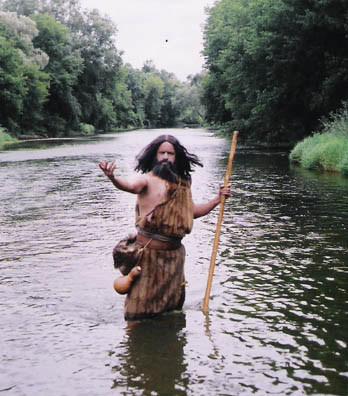
When we listen to this Scripture text today we may imagine a prophet whose thunderous voice captures the attention of all: the poor, the priests, the Pharisees, the politicians and the powerful.
We picture it that way perhaps because that’s how it’s been depicted in so-called Christian movies. Or, that’s how preachers may have been heard whenever they read the narrative.
Some preachers start reading by simply cruising through the first part of the passage. Sometimes in a monotone that can elicit yawns.
But then, suddenly and dramatically, they raise their voice when they get to the second part, they thunder:
“A voice of one calling in the wilderness,
‘Prepare the way for the Lord,
make straight paths for him.
But remember that the “voice” is just a voice. Besides, the voice was only heard within earshot by those who were there. Where? In the wilderness, where people expect to hear not a human voice but those of wild animals.
And let’s not forget that the voice was set in the midst of very powerful voices of men, of which the most powerful was the emperor’s: Tiberius Caesar.
To be sure, none of us is John the Baptist. And none–then and now–can replace his unique role as Christ’s forerunner.
But like John we are to proclaim a message to a world that appears to be controlled by powerful people and whose voices seem to dominate and drown out other voices.
The question is, Will your voice and mine be heard?
The world may scoff at us for our wishful thinking, but this Gospel narrative should give us a great reason to be optimistic. John’s voice may be as insignificant as a fox’s howl in the wilderness, but whose voice is it that the world has been hearing again and again?
Annas’? No! Caiaphas’? No! Herod’s? No! Pontius Pilate’s? No! Tiberius’? No!
If fact, none of these very powerful people’s voices have been heard again. But John’s voice have been heard over and over again. And it is his voice–not the voice of the powerful people–that has really changed the world!
Why? Because John’s voice was not just a voice from the wilderness but a voice from God!
You and I are definitely not John. But like John, you and I are also messengers of God. The message we bring is not just a message of a man or woman but the message of God. Therefore, when we speak forth the message of God, people should hear not just a mere human voice but the voice of God as well!
So knowing that, should we allow the voice of the powerful and influential who do not represent God drown out our voice?
To borrow from a Jennifer Hudson song, “No, no, no, no way!”* And if we truly voice the message of God, no one can drown out that voice!
Why? Because no one can drown out the voice of God!
So let’s see to it that the message we voice is the message from God. And what is God’s message to us today?
As the people in John’s day needed to repent and be baptized so they could see and experience God’s salvation, so must the people in our day!
John was not talking about a repentance that some consider a requirement for salvation, or a baptism that the Apostle Paul is talking about in Romans 6. John was talking about God’s people’s need to repent–and show such repentance through baptism–so that they may be ready for the Lord, the Messiah, who was about to be revealed.
In doing so they would be ready to welcome the Messiah. And in doing so they could gratefully and gladly–not ashamedly–appropriate the grace of God that comes through Christ Jesus.
To repent meant turning away from self and sin and turning to the Lord and trusting him to save them from anything that they needed saving from!
Our message is the same today! But before we can preach to the world, we ought to preach John’s message to ourselves and to our fellow believers first.
Why? Because as in John’s day, the people of God have been listening to the voices of the powerful rather than the voice of the All Powerful!
The last elections have shown some of us our real selves and who we really trust. Perhaps our words and actions have revealed that we trust our political parties and politicians more than God to solve our problems.
God’s Word may have decorated our words but it may be that the real intention was not to reveal the will of God but to demonize others whose politics differ from our own. Or, perhaps we just use God’s words to lend authority to our fallible human words.
If we have done so, then we need to repent so we can once again bask in the warmth of the love and grace of God, guiltlessly.
It is only after we have preached to ourselves and each other and repented of our sins that we can preach to the world with a powerful voice.
Why? Because it is only after we have repented of our sins and experienced the grace of God in our own lives that we can truly know what we’re talking about!
After we have done so, our voice is going to be a very powerful voice. Our voice will be heard and, echoed by others, it will be heard again and again and will reverberate to the ends of the earth!
And that, my sisters and brothers, might just change our world as it did John’s.
__
*”And I Am Telling You”, written by Krieger, Henry D. / Eyen, Tom
Note: Updated 12/04/2016; Aside from few edits, the article has remained basically the same, which is amazing considering the timeliness of the message. The 2012 and 2016 Presidential elections make the connection.
 PENnED
Leave a comment