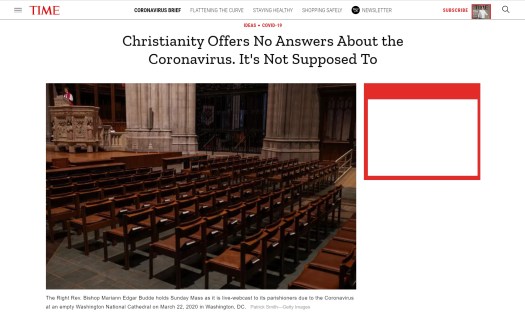
Since I have the luxury of time (thanks but no thanks to the new coronavirus) let me talk about N.T. Wright’s article published in Time magazine titled “Christianity Offers No Answers About the Coronavirus. It’s Not Supposed To.”
First, I am glad (and amused at how he puts it) that Wright is well aware of the presumptuous assumptions about any human crisis, which I think Evangelicals are often guilty of: “No doubt the usual silly suspects will tell us why God is doing this to us. A punishment? A warning? A sign?”
I have actually written against such explanations, particularly that COVID-19 was sent by God to punish sin.
Second, I am also glad about Wright’s emphasis on lament, even though we’ve probably already lamented way before Wright wrote the article. We lament at the suffering and death that perhaps should have been minimized if people in authority did a better job. We lament the bad politics that care more about agendas than the health of the people. We lament the falsehoods, like fake cures, peddled even by those who profess to be speaking on behalf of God.
However, lament and seeking for answers are not mutually exclusive. And to ask questions and try to find answers is not at all not part of our vocation. We are not going to find answers all the time, but finding answers and explaining them should be part of our vocation. I do that almost every Sunday when I preach a sermon!
Offering explanations about Scripture passages especially as they relate to our situation (like the coronavirus crisis) is the very core of the pastor’s vocation as well as those of us who, like Wright, has been called to teach the Bible. Ironically, however, while Wright tells us to not explain, he explains why we ought not to explain.
To say that might imply that after Wright has done his own research, he does not find any explanation worth sharing. If that is the case, we might ask the question, ‘What does he really know?’ or ‘Does he know anything?’ Or, even if he finds adequate answers, he’s not obligated to share them—it’s not part of his vocation!
Even if our main task is not to explain what’s going on in the world, yet for us to be effective in communicating the Word, we have to somehow understand the world, or else we’ll just be talking to the wall.
Finally, I’m glad that despite Wright’s warning to not give hope when there might be none, he concludes his article with a message of hope anyway: “As the Spirit laments within us, so we become, even in our self-isolation, small shrines where the presence and healing love of God can dwell. And out of that there can emerge new possibilities, new acts of kindness, new scientific understanding, new hope.”
And I’m also glad that despite Wright’s thesis–we are not called to offer explanations–he concludes that “even in our self-isolation…there can emerge new possibilities…new scientific understanding.” We may not be scientists, but I assume most of us can understand scientific explanations and there is no rule against sharing such knowledge.
 PENnED
Leave a comment