
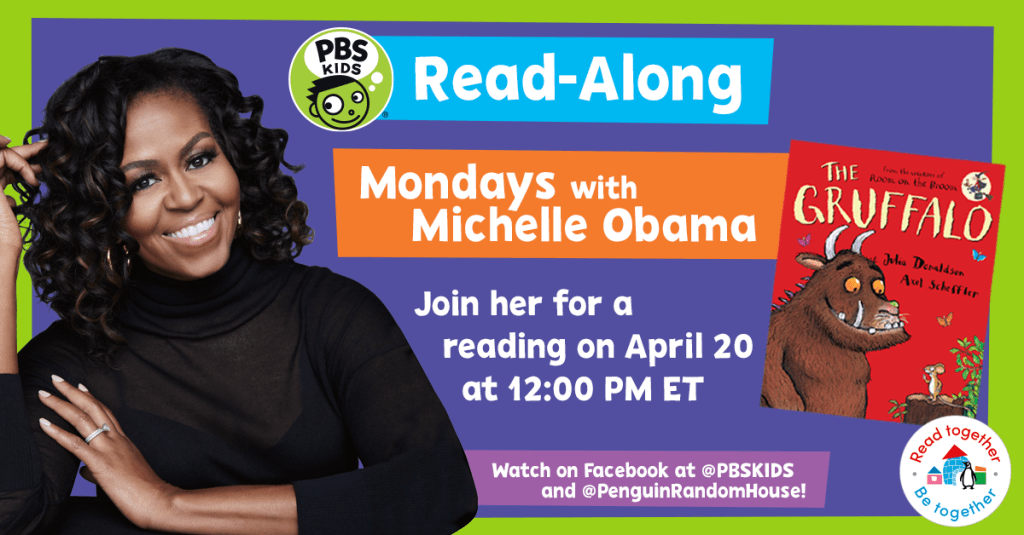
“Mondays with Michelle Obama,” a four-week series of videos that will feature the former First Lady reading aloud from favorite children’s books, begins today with the reading of The Gruffalo, written by Julia Donaldson and illustrated by Axel Scheffler.
The Gruffalo is a story about a mouse that takes “a stroll through the deep dark wood.” There he encounters a fox, an owl, and a snake, respectively. Each of these predators is too eager to have the mouse for lunch. But the mouse who smartly (so it seems) compensates what he lacks in brawn with wit, cleverly fends off each one of them by inventing a monster.
That’s just the kind of story children, like little Donald, want to hear. Let’s continue.
In their attempt to trap the mouse, each predator asks him where he is going. The mouse tells each of them that he is meeting a scary monster who “has terrible tusks, and terrible claws,” and “terrible teeth in his terrible jaws.”
The mouse also tells each of them the monster’s favorite dish, each of which is obviously cooked up to match the one he is conversing with and apparently expected to have an unnerving effect on them: the fox, “roasted fox”; the owl, “owl ice cream”; the snake, “scrambled snake.”
“This smart mouse—he’s just like me!” Little Donald cannot contain himself. Then he adds, “I could be the ‘Mice President’ when I grow up!”
Michelle looks at Donald and puts a finger on her tightly closed lips. “Shush.” Michelle continues reading.
As the mouse points the spot where he and the Gruffalo are going to meet—which is of course where they are—each one scampers away into hiding. The mouse sneers at the predators’ gullibility because “There’s no such thing as a gruffal…?”…OH!”
The smirk on the mouse’s tiny face is quickly erased and the look of shock replaces it when a monster, scarier than a gruffalo he imagined and has just told other animals, suddenly appears:
But who is this creature with terrible claws
And terrible teeth in his terrible jaws?
He has knobbly knees, and turned-out toes,
And a poisonous wart at the end of his nose.
His eyes are orange, his tongue is black,
He has purple prickles all over his back.
The mouse screams with fear when he realizes that the Gruffalo is real:
Oh help! Oh no!
It’s a gruffalo!
I wonder how scared little Donald is when the Gruffalo sees the mouse and says, “My favourite food! You’ll taste good on a slice of bread!”
Surprise! Surprise! The mouse regains his composure. Confidence in his ability to fool other animals has grown. He believes that as he was able to fool the other predators, he can also fool the scariest of them all, the Gruffalo.
Little Donald’s face lights up. He’s happy. He sees himself in this smart little mouse.
But will it work? Well, as far as the story goes, it does!
But how about in real life? Will it always work? As the saying goes, “You can fool all the people some of the time, and some of the people all the time, but you cannot fool all the people all the time.”
If I were the author of the book, I would have ended the story differently—with the mouse on a slice of bread being eaten by the Gruffalo. Why? To teach the danger of unrealistic confidence, especially when ability is in fact lacking. But it’s not my story.
The story goes on and, because of that, it is, in my estimation, one of the finest illustrations for the saying, “Fake it till you make it.”
The mouse successfully shows the Gruffalo how scared are the fox, the owl, and the snake of him (when, in truth, they are scared not of him but the Gruffalo):
“Well, Gruffalo,” said the mouse. “You see?
Everyone is afraid of me!
But now my tummy’s beginning to rumble.
My favourite food is – gruffalo crumble!”
In the end, the scary monster, the Gruffalo, gets scared:
“Gruffalo crumble!” the Gruffalo said,
And quick as the wind he turned and fled.
“Yay!” Little Donald yells as if the mouse’s victory is also his.
No doubt, the story has captivated the imagination of young listeners and, based on the rave reviews, adult readers as well!
But is the story teaching children, like little Donald, the right thing?
Faking it till you make it may not be bad if it is used as a tool to develop character. For instance, a person who has a problem telling the truth might “fake it” by saying to himself I am an honest person (despite the fact that he just told a lie) to help him stop saying dishonest things.
Anything that can help transform us, is worth trying, especially if it doesn’t cause harm. But to fake an ability that one does not have, or might never have, is a dangerous thing—your story might end this way:
All was quiet in the deep dark wood,
Except for the Gruffalo crunching a mouse for food.
Finally, is it OK to read the story, as is, to children? I think so, provided adults point out to them the wrong ideas they should not pick up.
 PENnED
Leave a comment