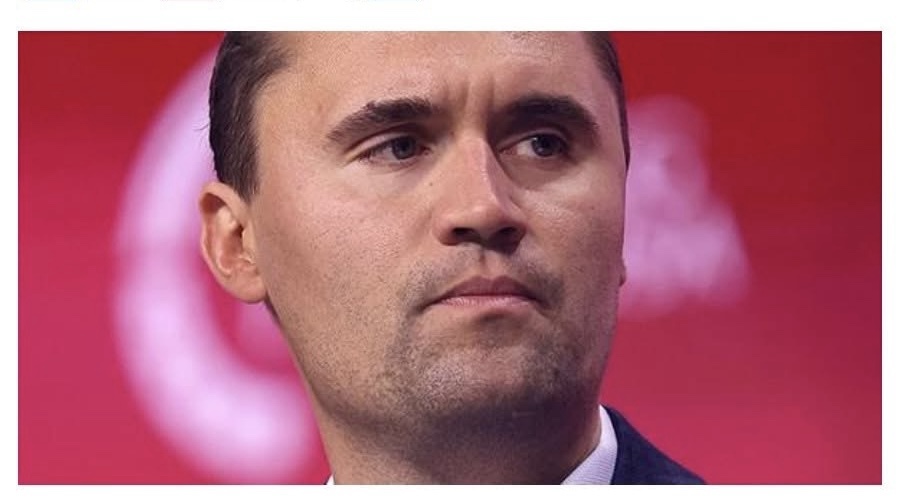
In the wake of Charlie Kirk’s tragic death, many in the evangelical world have rushed to memorialize him as a bold truth-teller and defender of Christian values. But for Black communities and their allies, this moment demands more than mourning—it demands honesty.
Kirk’s legacy, like that of 19th-century theologian Robert L. Dabney, is a study in contradiction. Both men were articulate defenders of Christian orthodoxy. Both were also unapologetic opponents of Black dignity and testimony. Dabney, revered in Reformed circles, wrote extensively in defense of slavery and white supremacy. Kirk, in more modern terms, used his platform to undermine Black narratives, often cloaking his rhetoric in appeals to free speech and patriotism.
Theological brilliance cannot excuse moral blindness. As Black theologians like James Cone and Willie Jennings have long argued, any theology that ignores the suffering of the oppressed is not merely incomplete—it is complicit. Cone’s Black Liberation Theology reframed the gospel as a message of emancipation, not empire. Jennings exposed how Western theology has historically been entangled with racial hierarchies and colonial power.
Today, communities are reckoning with these legacies. Churches are revisiting the heroes they once celebrated. Seminaries are re-evaluating the texts they teach. And Black scholars are offering counter-narratives that center truth, justice, and memory.
This is not about erasing history. It’s about telling the whole story. Mourning Kirk’s death should not mean silencing the voices he spent his life opposing. Sympathy and accountability are not mutually exclusive. If we are to move forward, we must confront the theological traditions that have too often sanctified exclusion—and listen to the communities that have borne the cost.
Some stories in Scripture don’t just teach—they wake us up. The Parable of the Talents is one of those stories. It’s not just about money or productivity. It’s about readiness. It’s about trust. It’s about knowing the Master—and being known by him.
Jesus tells this parable to help us understand what it means to live faithfully while we wait for his return. And he doesn’t give us a checklist. He gives us a story. A story about a master, three servants, and the difference between trust and fear.
The Master Goes Away
Jesus begins:
“For it is as if a man, going on a journey, summoned his slaves and entrusted his property to them…” (Matthew 25:14)
The man in the story is clearly a stand-in for Jesus himself. He’s going away—but not forever. His departure points to his death, resurrection, and ascension. And his return? That’s the hope we live by.
This is the truth we proclaim every time we gather at the Lord’s Table:
“Christ has died. Christ is risen. Christ will come again.”
That’s the arc of our faith—the sweep of salvation history. And we live in the “in-between”—between resurrection and return. In that space, we’re not called to wait passively. We’re entrusted with something. Something valuable. Something that belongs to the Master.
Serving the Master Is Not Optional
The servants in the parable aren’t given suggestions. They’re given responsibility. And not just any responsibility—they’re entrusted with the Master’s own property.
The Greek word used here for “slave” is δοῦλος1 (doulos)—a bond-slave. Someone who willingly and wholeheartedly offers themselves to serve a chosen master. Strong’s Greek word studies says this term is used with the highest dignity in the New Testament—referring to believers who live under Christ’s authority as devoted followers.
That’s us. Jesus is our Master. We are his doulos. And serving him? Not optional. He owns everything. We own nothing. Everything we have—our time, our gifts, our breath—is his.
What Are We Entrusted With?
In the parable, the master entrusts his servants with talents.2 These aren’t skills or abilities—though the word has come to mean that in English. In Jesus’ time, a talent was a weight of precious metal—gold, silver, or bronze—used as currency. So we’re talking serious value.
What matters most is what the servants *do* with those talents. That’s what reveals their trustworthiness.
“The one who had received the five talents went off and traded with them and made five more talents. In the same way, the one who had the two talents made two more talents.” (Matthew 25:16–17)
They doubled what they were given. That’s a 100% return. Pretty impressive, especially compared to today’s investment benchmarks.
But the point isn’t the percentage. It’s the faithfulness. The Master is pleased with both servants and says:
“Well done, good and trustworthy slave… enter into the joy of your master.” (Matthew 25:21)
They didn’t just manage money. They honored the Master. They lived awake.
The Servant Who Buried His Talent
Now let’s talk about the third servant—the one who buried his talent like it was radioactive.
Why did he hide it?
“Master, I knew that you were a harsh man… so I was afraid, and I went and hid your talent in the ground.” (Matthew 25:24–25)
He didn’t know his Master. He misjudged him. And he tried to *judge* him. But that’s not the role of a servant. The Master is the judge.
Even if the Master reaps where he didn’t sow, he doesn’t keep the harvest for himself—he gives it back to the faithful. The buried talent is taken and given to the servant with ten:
“Take the talent from him and give it to the one with ten talents.” (Matthew 25:28)
The Master doesn’t condemn him for failing to double the investment. He condemns him for doing *nothing*. He could’ve put it in a savings account with 4% interest. But instead, he buried it.
And so the Master says:
“You wicked and lazy slave!” (Matthew 25:26)
Lazy and wicked. And it all stems from not knowing the Master—not trusting his character, not believing in his generosity.
Judgment and Joy
“Throw him into the outer darkness, where there will be weeping and gnashing of teeth.” (Matthew 25:30)
While the good and trustworthy servants are welcomed into the joy of their Master, this one is cast out—into sorrow and regret.
So we ask:
Does the Lord know me? Do I know the Lord?
This isn’t about working for salvation. It’s about relationship. Jesus says in Matthew 7:
“Not everyone who says to me, ‘Lord, Lord,’ will enter the kingdom of heaven… I never knew you.” (Matthew 7:21–23)
Being “known” by Jesus is the foundation. Work without relationship is just noise. But faith—faith that flows from knowing the Master—produces fruit.
The Joy of the Master
The fullness of the Kingdom—the joy, the celebration, the life made perfect—is found in his presence. And serving him isn’t just for his glory. It’s for our good.
He doesn’t need anything from us—but he delights in giving everything to us.
So let’s live awake. Let’s live ready. Let’s live faithful.
Maranatha! O Lord, come!
__________
Footnotes:
1. Strong’s Greek: 1401. δοῦλος (*doulos*) — a slave ([bibleapps.com](https://bibleapps.com))
2. The Four Coins Jesus Knew – CoinsWeekly; see also v. 27, “money” is used for talents
In memory of Lola Margarita, whose hands brewed love into every cup.
I grew up with coffee not just as a beverage, but as a ritual—an inheritance steeped in memory. My grandmother, Lola Margarita, cultivated her own beans in South Cotabato, on the island of Mindanao. She roasted them over fire, ground them by hand, and brewed them with reverence. Her coffee was bold, aromatic, and deeply comforting. It was the taste of morning prayer, of quiet strength, of home.
Earlier this year, I returned to the Philippines carrying a two-pound bag of Starbucks’ Caffè Verona, hoping to share something familiar with my family. I expected to find better coffee there—something closer to Lola’s—but I was surprised, even disappointed, by what I tasted. The local brews lacked the depth and aroma I remembered. A family member gave me barako from Batangas, but it felt flat and one-dimensional. Another gifted me Robusta from Sultan Kudarat, which was bold but bitter in a way that didn’t resonate.
It made me wonder: what happened to the coffee I knew?
Lola’s beans were likely Arabica, grown in the highlands near Mt. Matutum, where indigenous communities like the B’laan and T’boli still cultivate heirloom varieties. Today, that region produces some of the Philippines’ finest Arabica, but much of it doesn’t reach local markets. Instead, instant coffee dominates, and traditional roasting methods have faded.
A drone shot of Mt. Matutum on the island of Mindanao, Philippines
Back home in Nevada, I grind and brew my own coffee—$14 a pound, plus tax. It’s not cheap, especially with prices rising and tariffs looming. But it’s worth it. Each cup is a quiet act of remembrance. The hum of the grinder, the bloom of the pour, the steam rising like incense—it all brings me back to Lola’s kitchen, to the warmth of her hands and the dignity of her craft.
Coffee, for me, is more than flavor. It’s legacy. It’s presence. It’s the bittersweet taste of change—and the enduring aroma of love.
Lakepointe Church senior pastor Josh Howerton delivered a sermon titled, “How to Vote Like Jesus.” In it, Howerton “repeated GOP rhetoric in a veiled attempt to convince his Dallas-Fort Worth congregation how to cast their votes in November’s election.”
Howerton recommended that Christians “should rid themselves of the idea that presidential candidates, including former President Donald Trump and Vice President Kamala Harris, must be perfect. Instead, he suggested people vote for the politician they believe best upholds their religious values.”
So, if you’re a Christian, how do you vote like Jesus”? Howerton’s implied answer to that is of course, “Vote for Donald Trump.” But does Trump uphold Christian values?
I’ve seen lists of “Christian values” that obviously try to tailor-fit Donald Trump’s conservative political stance, or at least what he says he believes in, presumably to please his evangelical supporters. But I won’t fall into the same temptation by hand-picking Christian values that may favor Kamala Harris, or by going the opposite direction and coming up with a list that traps and judges Donald Trump. So I asked the question, What might be a source for a list of Christian values that would be seen as politically neutral?
What can be more apolitical than than the values Christian parents teach their children? To find a list, preferably a short one (as I don’t have the time for a very long one), I searched online for books that might help parents teach their children Christian values.
I found one: 10 Christian Values Every Kid Should Know. By the way, we shouldn’t think there’s one set of values for kids and another for adults. And the book does not imply that at all.
We’re not going to use 1,000 strategies for teaching voting adults Christian values, but we’re going to use the same values that Habernicht has on the list.
RESPECT Even if you’re the most loyal of all Donald Trump’s MAGA fans, you would not consider Trump a respectful man. And Jesus would certainly agree with you! Trump is known for the opposite. He disrespects anyone who opposes him. His disrespectful name-calling are too embarrassing to mention in detail here. So I won’t. But let me make an exception: Trump called Kamala Harris “dumb as a rock” and a “low-IQ individual.” By the way, that’s a very interesting insult from a very disrespectful presidential candidate who didn’t want to debate with his opponent again after she defeated him in the only one they had.
SELF-CONTROL What is self-control? Meriam-Webster defines it as follows: “restraint exercised over one’s own impulses, emotions, or desires.” I think that anyone of us can sometimes lose self-control, but there’s one among us who always loses his cool. The most recent one, if you missed it, is a display of utter lack of self-control. His behavior and actions were, to say it mildly, not appropriate for general audience and definitely not befitting a person running for the most dignified office in the world: President of the United States. In a recent political rally in Milwaukee, Donald Trump lost his cool over the microphone that didn’t serve him well: “I get so angry. I’m up here seething. I’m seething, I’m working my ass off with this stupid mic. I’m blowing out my left arm, now I’m going to blow out my right arm and I’m blowing out my damn throat too because of these stupid people….” From a display of anger, he transitioned to an act of lewdness as he depicted a sexual act using the mic stand.
PERSEVERANCE Perhaps this is a trait that Donald Trump possesses. He lost the last election, denies he lost, and is now running again as candidate for president. He perseveres! But why? It seems obvious to me that he’s running again not really because he cares about people and the country. He cares about himself, how he can use his power to avoid punishment for the crimes he has been convicted of, and he wants to wield enormous power against his enemies. Unfortunately, that’s not the kind of thing good leaders patiently suffer through to achieve their dreams that are often not just for themselves but also for the country and the world. If Trump is known for anything, it is for short cuts. What can be a faster way of making more money than giving tax cuts to billionaires like himself (if he is still considering his debts).
LOYALTY Loyalty happens to be a big word to Donald Trump. But loyalty is always towards him. Anyone who is not loyal to him was and will be fired! The list of the people he fired is long and you can google that yourself. Trump is not known for loyalty. He is not loyal to his own country—he degenerates the United and criticizes how it is governed by leaders a lot smarter and better than himself, and praises despots like Vladimir Putin, Xi Jinping, and Kim Jong Un. His only loyalty is to himself.
FAITH IN GOD Donald Trump talks about his faith. Yes. Rarely, but he does, especially when he is speaking to his evangelical base. He praises people like Franklin Graham who, in times of natural disasters, go out there and help people (see for example). Caring and helping others can be a sign of faith. James 2:14-17 (English Standard Version) reads,
What good is it, my brothers, if someone says he has faith but does not have works? Can that faith save him? If a brother or sister is poorly clothed and lacking in daily food, and one of you says to them, “Go in peace, be warmed and filled,” without giving them the things needed for the body, what good is that? So also faith by itself, if it does not have works, is dead.
But is Trump really interested in helping people because his faith makes him such a caring person? Those who know Trump know him very well:
Donald Trump deliberately withheld disaster aid to states he deemed politically hostile to him as US president and will do so again unimpeded if he returns to the White House, several former Trump administration officials have warned.
As Hurricane Helene and then Hurricane Milton have ravaged much of the south-eastern US in the past two weeks, Trump has sought to pin blame upon Joe Biden’s administration for a ponderous response to the disasters, even suggesting that this was deliberate due to the number of Republican voters affected by the storms. Harris accuses Trump of ‘playing politics’ with hurricane disaster relief.
So back to the question: “How to vote like Jesus?”
Yes, a presidential candidate does not have to perfect. And I agree with Pastor Howerton that we “should rid ourselves of the idea that presidential candidates, including former President Donald Trump and Vice President Kamala Harris, must be perfect. “Instead…people (should) vote for the politician they believe best upholds their religious values.”
So if we are to teach people the Christian values listed above and choose one of the candidates who better embodies and upholds those values, though imperfectly, who might that be?
You know who my choice is. And I think Jesus would approve of my choice. Who is yours?
I have a daily routine. Part of it is taking my blood pressure before making coffee.
After I pushed the blood pressure monitor’s start button in the morning of the 20th of March 2024, Ruth caught me leaning towards my left side with my tongue sticking out on one side of my mouth.
“What’s happening to you?”
“I’m sleepy.”
I passed out.
When I snapped out of it, I was being carried in a stretcher by paramedics.
One of them instructed me to raise a particular limb after another. I did for each one.
In the ambulance, I was conscious all the way to the hospital. I even recognized the road we were on as I’d driven there countless times on the way to and back from Costco Businesses Center.
When we were entering the hospital’s Emergency Room, I asked, “Are we at UMC?”
“Yes,” the paramedic replied.
I felt good about myself.
Ruth, however, had not been feeling good about what was happening to me. She believed I had a stroke. She observed that I had all the symptoms of a stroke. And that’s why she instructed our youngest son to call 911.
What could have triggered this health crisis? I try to eat a healthy balanced diet and exercise regularly. In fact, just a couple of days before, I went hiking near Red Rock Canyon!
Hiking First Creek Trail near Red Rock Canyon
My sister-in-law who came with her whole family from the Philippines for a surprise visit jokingly said it was caused by my shock for unexpectedly seeing them after so many years.
We all had a good laugh. But the question remains.
After a barrage of tests, the young ER doctor (probably in his mid 30s) said, “The good news is we don’t find anything wrong with you. The bad news, you have COVID.” Then he went on to explain that he believed the virus infection triggered my blood pressure* levels to go up (163/81) and that’s why I got dizzy and passed out.
I visit hospice patients and am too familiar with death and dying. Some of the patients I’ve seen were younger than me. One was almost two decades younger. Yet despite the fact that I’m now in my late 60s I still feel young and healthy. I never really felt threatened by death until now. Neither was my family worried about my health until now.
Death is a fact of life. We have to deal with it sooner—indeed now—than later.
Recently, Ruth and I talked about certain things that we have to set up before it’s too late (like a trust) to get ourselves and our family ready.
For now, despite being aware that death can come anytime, I have to make a commitment to continue to take care of myself. I want to be there for my loved ones, friends, and the rest of the people who need my support and care for as long as possible.
In the quiet chapel, where stained glass whispered stories of saints and sinners, I find solace. My footsteps echo, a rhythmic cadence that matches the beat of my heart. Each pew holds secrets—some whispered, others shouted in prayer or lament. But today, I carry a unique burden, one that weighs upon my soul.
The man in Room 157, his pain etched into the grooves of his hands, recounts a symphony of suffering. Neuropathy, like discordant notes, reverberates through his bones. The veins spared, but the leg’s grand artery—the highway of life—removed. A relic of 2000, yet it still throbs, a silent hymn.
And then, the hip—broken twice, a testament to resilience. Laughter spills from his lips, a bittersweet melody. “A big challenge,” he says, and I nod in agreement.
He traces his spiritual journey—a Baptist once, now a seeker. In 2002, California’s prison walls held him. There, he met a Muslim—a fellow traveler on this winding road. Conversations flowed like hymns, prayers interwoven with shared doubts.
“I accept the Muslim,” he tells me. “Sometimes my prayers stumble, seeking better footing. The mosque beckons, a challenge to return.”
His eyes, galaxies of faith, hold both love and struggle. “Physical love,” he says, “makes worship harder. But God—whether Allah or Jesus—knows no boundaries. In 2003, a stroke blurred my vision, yet I seek clarity.
In the California choir, I strummed my guitar, harmonizing with souls. The Bible, once my compass, now shares space with the Quran. Walls crumble; God remains.
And prayer—the universal tongue. It heals not only the spirit but also the body. Worries find solace in whispered conversations with the Divine. “Anytime,” I assure him, “God listens. All the time.”
As I leave Room 157, the man’s voice lingers—a psalm of endurance. The chapel absorbs his melody, and I hum along, knowing that faith transcends labels.
In the quiet corridors, I carry his song—a harmonious blend of brokenness and healing. And somewhere, in the vastness of the universe, angels lean closer to listen.
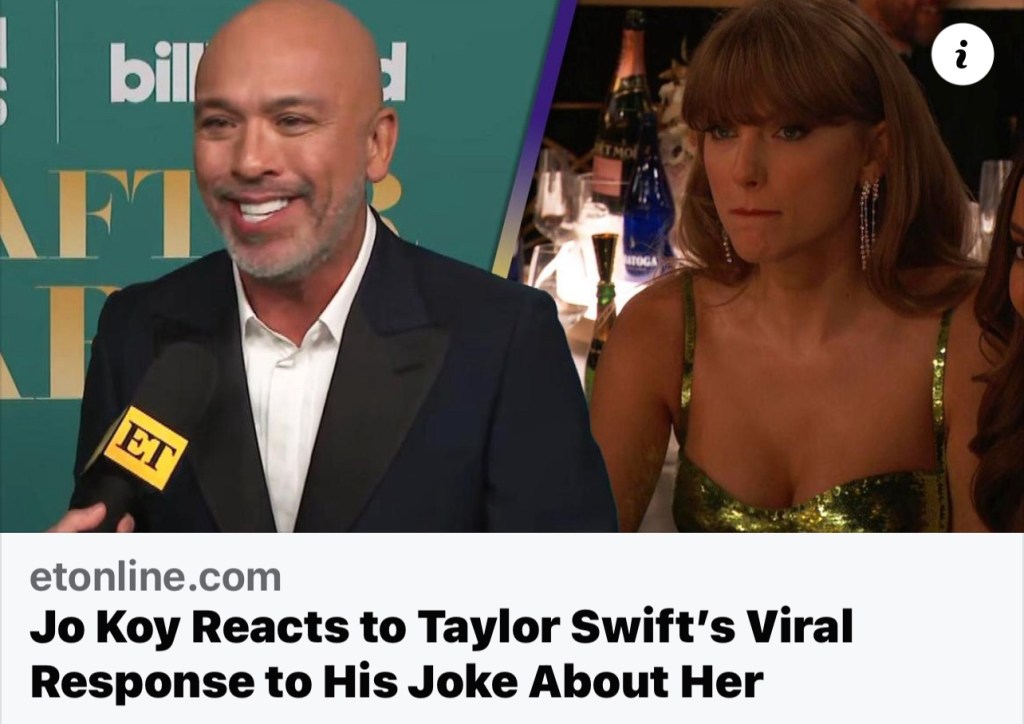
What’s wrong with that? Really, nothing! Besides, it’s matter-of-factly true! And if you’re not an onion-skinned Taylor Swift fan, that’s actually funny! Especially if you’ve seen the who-knows-how-many camera shots of Swift at the NFL.
So why is the media so hard on Filipino American comedian, Jo Koy? My guess is that the star-struck media and Swift fans just went with the flow and follow her lead: Swift’s tight-lip reaction to the joke.
They’ve made Jo Koy look even worse by saying his jokes weren’t funny. C’mon! Watch the clips and see how people were laughing. Some even found the Swift/NFL joke funny, excluding Swift, of course!
But what if Swift was sport enough to just ride on Jo Koy’s joke, like Robert De Niro and Meryl Streep did? I bet things would have been different.
I don’t find all of Jo Koy’s jokes that funny, but it’s not fair to judge his performance based on Swift’s facial response to his joke. Yes, even if she is Time Magazine’s Person of the Year.
Oh one! Oh one! Whose birth falls on January one! At this age what have you already done? Perhaps that’s the wrong question to ask an old man A better question to ask such a man is ‘Are you a grown man?’
Old Man
But what do we mean when we ask an old man if he’s a grown man? Physical stature is measurable and is a lot easier to define But when it comes to growth, build and looks aren’t what he wants you to find His inner being is more important than anything else that you can find
Conscious of my consciousness, I am aware that I am But I am conscious that I am not alone in such consciousness So I don’t give in to the idea that I am “The Great I Am” Indeed the opposite is happening within: the more I see the vast universe, the smaller I see myself
When one passes life beyond halfway through In his late 60’s he becomes more aware that life can be almost through Especially so when he feels so fragile and unwell And thoughts of his own brothers, who passed away when about his age, on his mind sadly dwell
Sometimes I think that I’m being crazy— Thinking ‘God willing, I’m going to do this and that one of these days’ But perhaps that’s why I’m still here today ‘God’s not done with me yet,’ as I heard some folks would like to say
So I do my part, to keep myself up to whatever task has been entrusted to me I daily walk and listen to teachers to keep both my body and mind healthy I share thoughts to anyone who is willing to listen Hoping that light would help dispel some darkness within
I don’t know when this sad feeling began gnawing deep within my old yet still conscientious soul. I just know that it was long after I made that stroll in a new-found little forest of tall trees that wasn’t there before. In the farm that then already brought joy to a child’s heart of mine, I was now pleasantly surprised that after more than a decade a green paradise had sprung up and given a reason for my twenty-something heart to smile a grand.
It was in the late 80s when I last went back to our family farm and walked into a glade in the middle of giant trees for the first and, sadly, last time. The little forest that apparently thrived on the upper level of our land, just above where the edge of the unruly Allah River used to flow—before it left a huge swamp between our land and the river when it left to follow its new path—drew me, like magnet, to go under its shady canopy on that unforgettable hot summer day.
As I entered the coolness beneath the towering trees in what I first thought was just a plant kingdom, I looked up as I heard a cacophony of bird sounds. Behold, a big family of beautiful parrots dressed in bright red and green! My eyes feasted on that beautiful sight until my neck was too stiff to continue looking up and watching and enjoying the free show of the winged actors on the stage of branches and twigs against a backdrop of verdant leaves and a cloud-dotted blue sky high above.
I don’t remember telling anyone about it—not even my brother and his family who lived there, and definitely not his son who, like any child in rural Sultan Kudarat, knew how to skillfully use a good homemade slingshot. Perhaps that’s because my heart told me it was just our little secret. And perhaps because I knew that for some hungry Filipinos a beautiful parrot, even if it can talk like you do, can be turned into a special Adobo!
Many years have passed and now I live far away across the Pacific Ocean where one can just forget everything he’s left behind. But how can I? How can I forget a place that brings very happy memories of my childhood? Dipping my overheating energetic small and hairless body beside our big farm carabao’s hairy and bulky one in the cool and limpid pool surrounded by tall reeds where I imagined schools of tiny Haluans swam away from us and hid with their dads and moms, for instance, was a paradisiacal experience for myself as a child. There were many other wonderful memories. But a memory that brings both joy and sadness to my heart is about that little forest and the parrots that sheltered and lived in it. Devoid of sorrow, they sang and played like there was no tomorrow!
Indeed, there was no tomorrow for them there in our farm. Their fate was sealed by an arbitrary human decision that favored humans. Or did it? The lady whose family bought a portion of our land told me the little green forest was now gone! The tall trees were cut down and the timbers were carried away somewhere across the river to build the home of some guy’s family and then some.
It’s quite sad the little green forest is now gone. And it’s even more sad that the family of beautiful parrots or their descendants are also gone. Their home, the little green forest, was destroyed. Poor little parrots! Where are they now? Have they survived?
Why can’t we, humans, just build homes but not at the expense of the little parrots?
Are you apprehensive about what others might say because you are already happy with what you believe to be true, and don’t want to change?
Such uncomfortable feeling is usually felt when you see others as having more knowledge in certain areas, and you feel that you can’t effectively defend your position.
For example, we don’t want to talk to an insurance or car agent on our own because we believe they have more information than we do; and we lack the information to “defend” ourselves. That’s why we bring along a friend or a family member who we believe know more about insurance policies or cars than we do to help us out.
We may know quite a few about certain personal truths that we hold dear, but we also know that we don’t have the knowledge that the experts we admire and have relied on and who “speak for us” might have.
My hunch is that we may have depended too much on experts, especially when making decisions. And we shouldn’t! We should learn things for ourselves.
Our doctors, for example, may be experts in medicine, but it helps us a lot if we learn more about, say, certain diseases. Armed with sufficient knowledge, we can help ourselves make the right decisions, which may be related to matters of life and death. And if the information we find from more reliable sources are better than what our doctor recommends, then it may be time to consult with another.
Thank God that these days information is just a Bing or Google away! We can even get the help of an AI to find information that would definitely take a lot more of our time if we’re doing research on our own and in a physical library.
When after learning more about a certain topic and we find that a certain “personal truth“ overlaps “objective truth” (anything that anyone anywhere finds to be true as a result of, say, scientific research or it is accepted by experts in the field) then that’s great! You don’t have to change your personal truth to the objective one because they’re about the same, except perhaps to make little amendments here and there to make the former more like, if not the same, as the latter.
But what if your personal truth is contradicted by objective truth? Would you abandon it and embrace objective truth?
What you do about objective truths would depend on what you are. If you are a “personal truth defender” then you would defend your personal truths or might just avoid conversations related to them. But if you are an “objective truth seeker” your’e not afraid to know the truth. And, as they say, you “follow the truth no matter where it leads.” And that is quite liberating!
As Jesus said, in John 8:31-32, “If you hold to my teaching, you are really my disciples. 32 Then you will know the truth, and the truth will set you free.”
Last Sunday we talked about The Parable of the Ten Virgins. Some of you may have already forgotten about that. Today I’m reminding you about that parable because it is closely related to The Parable of the Talents, which is the basis of the sermon today.
Sometimes we come across passages in the Bible that are closely connected to each other. Such is the case of the apocalyptic passages we find in chapters 24 and 25 of the Gospel of Matthew. The editors of the New Revised Standard Version or NRSVUE have divided them into 10 passages each with each own heading.
Now that is like a 10-course meal in a Chinese restaurant. The only thing is that it doesn’t end with the usual fortune cookie. The last passage, which will be our text next week, is not all sweet, but like the fortune cookie, it tells us what our fortunes will be. It is about judgment which can be sweet or sad. But I promise, I’ll do my best to help all of us escape judgment or damnation.
So how are The Parable of the Virgins and The Parable of the Talents connected? Let me point out what I think is the connection between the two: The Parable of the Talents picks up the question that the conclusion and application of The Parable of the Ten Virgins raises:
13 Keep awake therefore, for you know neither the day nor the hour.
The Parable of the Virgins, which reminds us to be always aware that the Lord is coming again, also reminds us that his coming has been delayed and that we don’t know the day or hour of his arrival. Therefore, as the parable teaches us, like the wise virgins, we are to be always prepared and ready for his arrival. What the parable, however, has not really answered for us is, ‘What must we do to get ourselves prepared and ready,’ or ‘What does it mean to keep awake and be ready for the Lord’s arrival? The Parable of the Talents answers that.
What does it mean to keep awake?
To keep awake does not mean to never sleep. If you remember, the wise virgins also slept just as the foolish ones did.
5 As the bridegroom was delayed, all of them became drowsy and slept. 6 But at midnight there was a shout, ‘Look! Here is the bridegroom! Come out to meet him.’
What does it mean then to “keep awake” while we’re waiting for the Lord’s coming? The Parable of the Talents answers that question in a more comprehensive way.
The thing however is, the question raised in the previous parable is answered by Jesus telling another parable! And like any parable, we are faced with the same challenge: interpreting a parable. And that’s not easy, especially because we have a tendency to say things it does not really say.
Having said that, we must try our best because it is extremely important that we interpret this parable correctly and apply it appropriately. The reason is because it is very important that we understand why “The Grand Wedding Party” at the coming of Jesus, the bridegroom, will be open to some but closed to others. Yes, we now know that we are to “keep awake” to be ready enter the coming Kingdom of heaven, but what does it really mean? ‘What does it mean to “keep awake”?’
To answer that question, Jesus begins by saying,
14 “For it is as if a man, going on a journey, summoned his slaves and entrusted his property to them…”
Keeping awake has to do with what we must do for our Master who has gone away. The man, the master, is going on a journey. Now if that gives us the idea that Jesus has in mind his own going away, we are correct. The fact Jesus that keeps talking about his coming in chapters 24 and 25 obviously implies that he is going away first before his coming again can happen. And indeed, at the very beginning of the next chapter, 26, he predicts his death:
1 When Jesus had finished saying all these things, he said to his disciples, 2 “You know that after two days the Passover is coming, and the Son of Man will be handed over to be crucified.”
Jesus died, but that’s not the final stage of his going away. When he rose from the dead, in John 20, he said to Mary,
17 … “Do not hold on to me, because I have not yet ascended to the Father. But go to my brothers and say to them, ‘I am ascending to my Father and your Father, to my God and your God.’”
This is the same truth that we proclaim when, at the Lord’s Supper, we recite the Memorial Acclamation: “Christ has died, Christ is risen, Christ will come again.”
So, while the Master is gone, the slaves are to get busy doing his will. Indeed, they must do his will. It is not an option for a slave who has no ownership rights of her own, even for a bond-slave (which is probably what is meant by the Greek word, δοῦλος, here) who willingly and voluntarily offered herself to be a slave for her chosen master.
Strong’s Greek word studies tells us that “doúlos (‘bond-slave’) is used with the highest dignity in the NT – namely, of believers who willingly live under Christ’s authority as His devoted followers.” 1 And that, my friends, is a good reminder of our own master-slave relationship: Jesus our Lord is our Master; we are his slaves; and serving him is not an option! He owns everything; we do not own anything. Everything belongs to him, and so we owe everything to him, including our lives, and without him we are nothing! Serving Jesus, our Master is not an option; it is a must!
Keeping awake has to do with being trustworthy with what the Master has entrusted to us.
In this parable, the master entrusted his property to his slaves. We can better understand that if we know exactly what that means. And to know what that means we want to know what is included in the “property” that Master has entrusted to us.
The parable does not tell us in detail what that property is. But we know that whatever is given to the slave, who has no right of her own, belongs to the master. Therefore, anything the slave has is her master’s!
But in this parable, the slaves are given something specific: talents. And what they do with the talents will prove their trustworthiness or lack of it. It will also serve as our guide as we get busy doing things with whatever our Lord and Master has entrusted to us.
I’m sure you have already heard this before: talents in this parable are not special aptitudes or abilities or skill, although I think it can be applied broadly as to include them. Talents refer the weight of gold or silver or bronze that were used as currency or medium of exchange in Jesus’ time.2
So, what did the servants do with their talents so that they were declared by their master trustworthy?
The “good and trustworthy” slaves doubled their talents
At once 16 the one who had received the five talents went off and traded with them and made five more talents. 17 In the same way, the one who had the two talents made two more talents.
Again, we’re not given the details of what or how they did it but the two slaves who were given 5 and 2 talents, respectively, doubled the weight of the money! Now that’s a pretty good investment compared to last year’s S&P 500 Annual Return, which was only 26.89, or the last 10 years’ return at 138.8%. So today, we may consider this the two guys’ investment strategy as moderate—not conservative nor aggressive. They may not have the same amount or weight of money, but both have the same exact rate of return: 100%!
I don’t think we should insist that we all have the same “rate of return” for whatever it is that our Master has entrusted to us. I think the principle here is that we are to use whatever our Master has given us in a way that would please him.
The master is pleased with the two slaves so that at his return he commends them with the same commendations, entrusts them with more, and both are given what I believe to be the ultimate joy that a slave can experience:
‘Well done, good and trustworthy slave; you have been trustworthy in a few things; I will put you in charge of many things; enter into the joy of your master.’
On the other hand, what the slave who was given one talent and what he does with it tells us what not to do with our own, whatever that “talent” might be.
The wicked and lazy servant hid his one talent
Why does the servant who is given one talent hide it?
First, he does not really know his master that well. His own words betray his wrong view of his master. When the master returns and the day of reckoning has come, he said to him,
“Master, I knew that you were a harsh man, reaping where you did not sow and gathering where you did not scatter, 25 so I was afraid, and I went and hid your talent in the ground. Here you have what is yours.’
Calling his master “a harsh man” is an unfair judgment, especially because a bond-slave is one who willingly gives herself to a master. Why would a person do that? There must be great reasons why people would give themselves as slaves to a master. When you’re poor and starving, would you rather die, or give yourself as a servant to a master who is known for goodness, kindness, and generosity?
The wicked and lazy servant, on the day of reckoning, tries to judge his master. And his judgment lacks understanding for even if the master reaps where he did not sow or gathers where he did not scatter, he does not reap and gather for himself. In fact, he does not get his talents back; instead, he gives them back to his slaves who are good and trustworthy and productive! Indeed, the one talent that was given to him is taken away from him and given to the one who has the most talents:
28 So take the talent from him, and give it to the one with the ten talents. 29 For to all those who have, more will be given, and they will have an abundance, but from those who have nothing, even what they have will be taken away.
But although a bondslave is regarded to have the highest dignity among slaves, it is not his place to judge his master. He doesn’t get to do that. That’s not the role of a slave. It is the master who is the judge.
And thus, the master condemns the wicked and lazy slave:
26 But his master replied, ‘You wicked and lazy slave! You knew, did you, that I reap where I did not sow and gather where I did not scatter? 27 Then you ought to have invested my money with the bankers, and on my return I would have received what was my own with interest.
Second, the master judges him not because his talent did not yield 100% like the investment of the two other slaves’ but because he is not wise enough to do something about it so that it grows even just a bit, like when it is invested with a banker.
The language of the master seems to say something like what might happen today if you invest your money in a bank: they offer the lowest return of investment. Nevertheless, if you don’t know how to invest, say in stocks, perhaps the safest and surest way to grow your money is to put in a savings account that yields about 4% annually. But 4% is better than 0%!
Going back to the wicked and lazy slave, it looks like the master would have given him the same commendation as the good and trustworthy slaves who doubled their money, if he invested his money in a no-sweat “investment for dummies”: with a banker. But he did not. Why? He does not really know his master and what he can do for him, and because he is a lazy servant. And the way he judges his good, kind, and generous master, makes him wicked!
And so, the master condemns him:
30 As for this worthless slave, throw him into the outer darkness, where there will be weeping and gnashing of teeth.
While “the good and trustworthy” slaves are welcomed to the “joy of (their) master, “the wicked and lazy” and “worthless slave” is banished from the presence and joy of his master and to a place of utter darkness and painful sadness and terrible regret.
Does the Lord know you? Do you know the Lord? But doesn’t that look like we are to work for our salvation so that unlike the wicked and lazy and worthless servant we will not be condemned and thrown into the dreadful outer darkness?
No! Although we may be tempted to get some help by interpreting this parable with the help of other with Scripture texts that, like Ephesians 2:8-10, that might be considered clearer or straightforward on the role of faith and work in our salvation, we do not have to do that. We have enough in this parable and the previous one to make sense of the basis for reward and judgment which seems to have to do with work trustworthiness, laziness, and wickedness, respectively.
In other words, the parable seems to say that those who are good and work hard will be rewarded with eternal joy in the presence of God; on the other hand, those who are lazy and wicked will be condemned and thrown into hell. But we have to understand that this parable of the talents is closely connected the previous parable of the virgins. There, in the Parable of the Ten Bridesmaid, the young women who had no oil for their lamps and were unprepared for surprise coming of the bridegroom, were pleading for the bridegroom to open the door that was shut: ‘Lord, lord, open to us’ (v. 11), But the Lord replied,
“Truly I tell you, I do not know you’” (v. 12)
That statement reminds us of what Jesus said in Matthew 7. After warning his disciples of “false prophets, who come to you in sheep’s clothing but inwardly are ravenous wolves” and who they will know by their fruits or lack thereof (vv. 15-20) he said,
21 “Not everyone who says to me, ‘Lord, Lord,’ will enter the kingdom of heaven, but only the one who does the will of my Father in heaven. 22 On that day many will say to me, ‘Lord, Lord, did we not prophesy in your name, and cast out demons in your name, and do many mighty works in your name?’ 23 Then I will declare to them, ‘I never knew you; go away from me, you who behave lawlessly.’
In other words, to be “known” by Jesus is the root and foundation on which anyone who calls Jesus “Lord, Lord” grow from, and like a tree, they will grow and bear good fruits. Doing the will of the Father in heaven is something that only the true children of God can do! Work alone without such relationship with God would not do. Salvation or entering the kingdom of heaven is not based on works, it is based on faith and our relationship with God who gave us his Son so that through faith in him we may be saved from sin and eternal damnation.
Such faith grows out of our knowledge of God who has revealed himself through his son, our Lord Jesus, who is represented by the in the Parable of the Talent. And that’s why we should not be surprised that the lazy and wicked slave does not really know his master. He judged him as a harsh man and one who exploits his slaves. The truth, however, is that he is a good and generous master who does not get his talents back but instead gives them away to those who are good and trustworthy and whose faith in their master is shown through their faithfulness to him!
So, the questions we may ask ourselves are these: Does the Lord know me? Do I know the Lord?
The fullness of the kingdom of God that our Lord will inaugurate when he returns is a place of indescribable joy. To be in the kingdom of heaven and be in the presence of our good, kind, and generous Master and King will be fullness of life made perfect. Our Lord and Master has given himself to us—he lived and died for us–and he provides everything we need to serve and please him. And serving him is not just for his glory and honor but also for our own benefit because he, as Master, owns everything and does not need anything. And that is why he gives it all back to us and shares his joy with us now and more so when he comes again!
Maranatha! O Lord, come!
——
1 String’s Greek: 1401. δοῦλος (doulos) — a slave (bibleapps.com) 2 The Four Coins Jesus Knew – CoinsWeekly; see also v. 27, “money” is used for talents
If a narissist parent can put his family, including his children, at risk, as a country’s leader, he can also put the whole nation, including his fanatic followers, at risk. Thus, it is unwise to choose a narcissist to lead a powerful country and the world.
It is quite disturbing that a new poll finds a great number of people prefer a narcissist, who also appears to be an aspiring fascist and who is now facing charges for conspiracy to defraud his own country, for a leader to one that has in reality helped his country and the world to make some progress despite the seemingly insurmountable challenges.
We can live with an old “sleepy” person (not a lot older really but looks healthier than the nacissist fellow) who has allowed us time to take a break and enjoy what this country has to offer and be refreshed, but we cannot and should not tolerate a crazy and egotistic person who barks like a dog at anyone and for any reason to rule us. So, before that even happens, nip it in the bud and give us a break!
Small trees are growing
Forest fires are raging
Women are giving birth
Men at war are killing
Some visionaries are helping save the planet and humanity from ruin
Some missionaries just don’t care—
saving souls for heaven is their calling

These realities can easily make us mourn our death in advance
Just as hell’s orchestra is just as ready to play an eerie requiem
Until we begin to believe we can all be united together for the good of all
We’re just like the Guyana folks who drank the Kool Aid and lied down to die
In this universe we must choose to survive and thrive
Or humanity will be forever forgotten











 PENnED