(Names and identifying details have been changed to protect the privacy of those involved.)
I met Evelyn on an ordinary afternoon — the kind of day that doesn’t announce itself, the kind that slips quietly into the calendar. She was resting in her hospital bed when I arrived, her hands folded gently over a blanket, her eyes carrying the soft weight of someone who has lived with illness for a long time. Multiple sclerosis has been her companion since the 1990s, a slow and persistent shadow. Yet the longer I sat with her, the more I realized that the real story of this visit was not the illness, but the man sitting faithfully at her side.
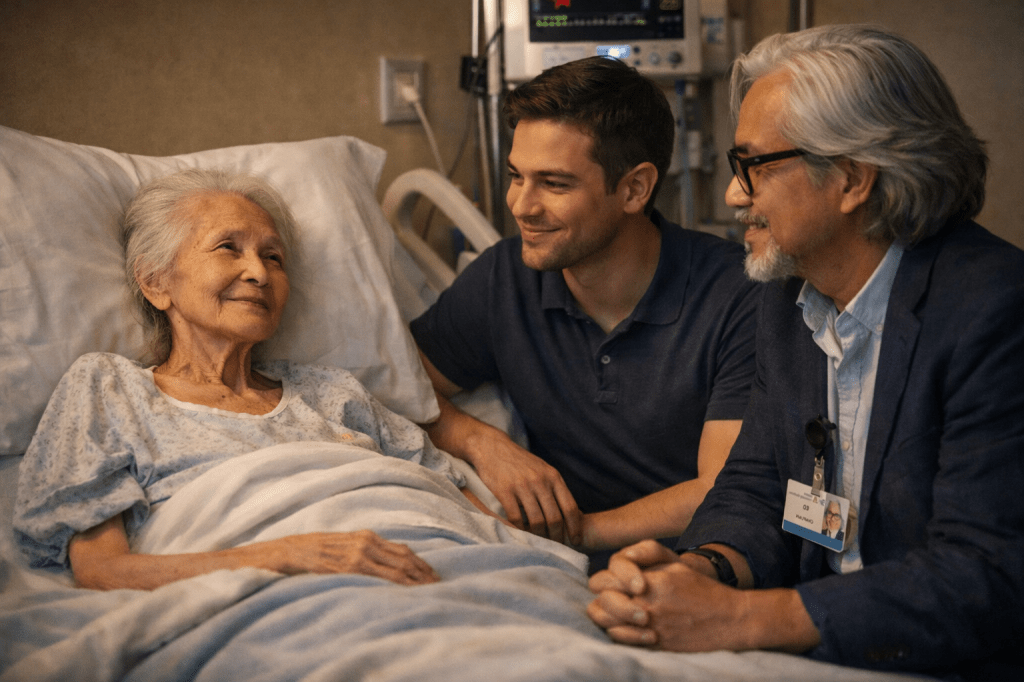
Daniel.
He greeted me with the kind of smile that comes from deep reserves — not cheerfulness, exactly, but a practiced warmth shaped by years of caregiving. As we talked, he mentioned, almost jokingly, that sometimes it feels like his mother gave birth to him for this very purpose. There was no bitterness in the remark. If anything, it sounded like a truth he had made peace with.
I watched him as he spoke — the way he leaned forward when his mother stirred, the way his voice softened when he mentioned his father, who lived with Parkinson’s until his passing two years ago. There was a steadiness in him, a quiet resilience that didn’t draw attention to itself. It simply existed, like a well-worn path he continued to walk because love had made it his.
What surprised me most was the joy that flickered in his voice when he talked about his wife’s Filipino family. His own relatives, he said, were not especially close, but hers were woven together like a tapestry — loud, affectionate, unembarrassed in their love. He told me about a trip where nineteen of them traveled together to Las Vegas to visit her grandfather. Nineteen. I could almost hear the laughter, the clatter of shared meals, the way such gatherings blur the line between celebration and ordinary life. One day, he hopes to travel with them to the Philippines.
Listening to him, I felt something shift in me — a reminder of how cultures carry wisdom in their bones. Some teach independence; others teach interdependence. Some prize efficiency; others prize presence. And sometimes, when life becomes heavy, the latter becomes a lifeline.
Our conversation drifted toward faith, almost naturally. Daniel wasn’t sure where his mother stood spiritually. She had taken him to church when he was young, but illness has a way of rearranging priorities, sometimes gently, sometimes abruptly. He admitted that lately he has been thinking about returning to church himself.
I told him about Haven Community Church — the small congregation I’ve been attending, the one where I recently gave a homily. He asked for the location, and I felt a quiet hope rise in me as I shared it. Not a hope for attendance, but a hope for connection — that he might find a community that mirrors the warmth he has found in his wife’s family.
As our visit drew to a close, Evelyn stirred again, and Daniel instinctively reached for her hand. It was such a simple gesture, yet it carried the weight of decades — of caregiving, of sacrifice, of love that has learned to endure.
Walking out of the room, I found myself thinking about how certain conversations stay with us. Not because they are dramatic, but because they reveal something true about the human condition. We are held together by bonds we do not always choose, by responsibilities that shape us, by cultures that teach us how to belong, by faith that calls us back when we drift.
I hope I see Daniel again. Maybe someday we’ll share a meal — rice and adobo, perhaps — and continue a conversation that began at a hospital bedside but reaches far beyond it. A conversation about family, resilience, calling, and the quiet ways love keeps showing up, even in rooms where illness has taken so much.
Some stories don’t end; they simply wait for the next chapter.


Leave a comment