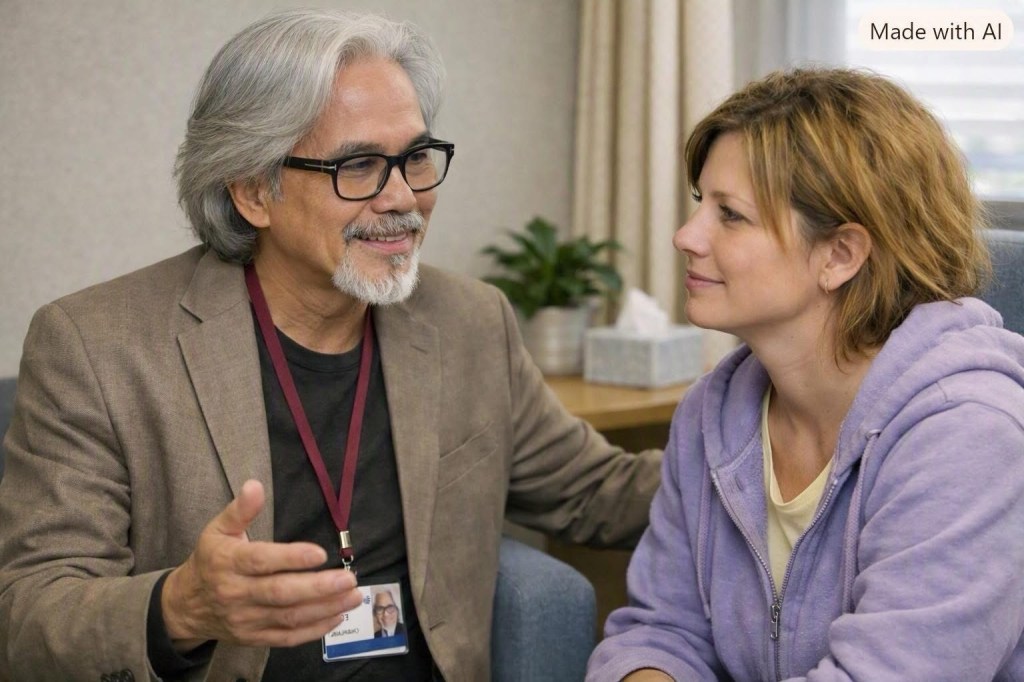
Jessa’s Story
Jessa says her life has always been intertwined with powerful people — presidents, political families, celebrities — even though she never asked for any of it.
She talks about her family as something mixed with political names. She says her grandfather carried both Garcia and Kennedy identities, and that marriages and relationships happened involving her relatives and famous people.
She speaks of children connected to these stories — children she longs for, children she says she wants to “get out” to be with — and she feels trapped being kept away from them.
Her sense of identity stretches into the sacred. She says she wasn’t born naturally, that her origins trace back to the Santa Cruz River and the old mission.
She believes her real parents are Joseph — “the mountain father” — and the Virgin Mary. She says she baptized herself at twenty‑six, that Joseph raised her to heaven, and that she came down on a star. She shares these things with quiet certainty, as if they explain her entire life.
Her story then moves into political history. She says John Kennedy is her father and Jackie Kennedy her mother. She said John Kennedy believed she was Jackie’s daughter by Donald Trump. She says Kennedy came from Vietnam, that Jackie denied her as a daughter, and that people around them — caretakers, maids — were involved in protecting her.
Then she tells the part she carries like a deep wound: she says the people who shot Kennedy in Texas were told not to shoot him, but to shoot her instead — because she was Jackie’s daughter by Donald Trump.
She says she was the one targeted, the one pulled into a violent moment meant for her. She carries this as part of her own history, something she survived and still feels the weight of.
Now, in the present, she says she feels trapped in behavioral health. She says she needs to get out, that she wants to be with her children, that she doesn’t belong here. She talks about them with longing — wanting to return to them, wanting to leave the place where she feels confined and misunderstood.
Through all of this, Jessa speaks with conviction. Her memories feel vivid and interconnected — a mixture of family history, spiritual identity, political drama, and personal trauma. She tells her story as something she has lived and endured, something that shapes how she understands herself and why she wants to leave and be reunited with her children.
A Chaplain’s Layman’s Analysis
From a pastoral standpoint — not a clinical one — Jessa’s story reflects a mind trying to make sense of overwhelming fear, loneliness, and trauma by weaving together symbols of power, protection, danger, and sacred identity. Her narrative blends:
- Grandiose themes (being related to famous figures)
- Persecutory themes (being targeted, shot, watched)
- Religious themes (divine parentage, heavenly ascent)
- Identity confusion (multiple origin stories)
- Longing for connection (her children, her family)
- Fear of confinement (feeling trapped in behavioral health)
To a lay observer, this constellation of beliefs suggests a severe thought disorder — one where reality, memory, imagination, and fear intermingle without clear boundaries. Her stories are not random; they are attempts to explain her suffering, her isolation, and her longing for belonging.
She is trying to place herself somewhere meaningful in a world that feels unsafe.
How a Chaplain Helps Someone Like Jessa
A chaplain cannot “solve” Jessa — and shouldn’t try. But a chaplain can help her in ways that matter deeply:
- Provide Grounding Presence
I offered her something she doesn’t get from her delusions: a calm, steady human being who listens without fear and without being swept into her narrative.
- Validate Feelings Without Validating the Story
I acknowledged her fear, her loneliness, her longing for her children — the emotional truth beneath the delusion.
- Offer Spiritual Containment
I prayed for her, provided gentle reassurance, and sacred presence to help her feel held, even when her inner world is chaotic.
- Model Reality Without Confrontation
I didn’t argue with her story. I didn’t reinforce it. I simply stayed grounded — which gives her a reference point outside the delusion.
- Protect Her Dignity
I treated her as a person, not a diagnosis. That alone is a form of healing.
- Support the Care Team
Hopefully, a narrative like this can help clinicians understand Jessa’s inner world—and others like her—and support treatment planning.
—-
*Not her real name


Leave a Reply